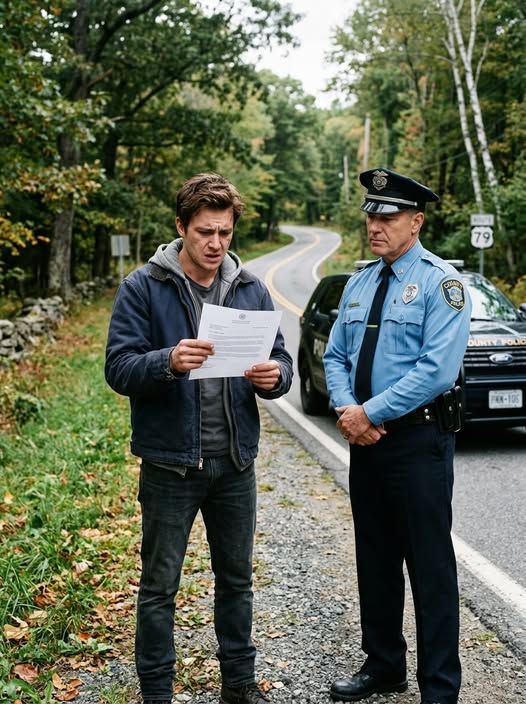
My wife got pulled over for speeding, and after the officer checked her license, he asked me to step out of the car. His face turned serious. “Sir, you need to hear me carefully. Do not go home tonight. Go somewhere safe.” I just stared at him. “What? Why?” He hesitated, then lowered his voice. “I can’t explain it here. But what I found is bad. Very bad.” Then he slipped a note into my hand. When I opened it, my whole world changed.
The patrol car’s lights washed over our Honda Civic in red and blue, turning the inside of the car into a flickering aquarium of color. It was the sort of traffic stop that happens every day on American highways and rarely becomes anything more than a warning, a ticket, and an irritated story told over dinner later. My wife, Sarah Williams Chen, had been driving seventy-eight in a sixty-five on Route 35, not dangerously fast, just fast enough to catch the eye of a state trooper working radar behind an overpass as we made our way toward her mother’s place in Millbrook on a gray Saturday afternoon. She handed over her license and registration with the calm competence of someone who had been stopped before and always emerged with nothing worse than a fine and a mildly disapproving lecture. When Officer Martinez asked if she knew why he had pulled her over, she gave him the small apologetic smile that had once charmed me in a crowded coffee shop near Columbia, back when we were both younger and still believed our lives would be built out of honesty because we ourselves intended to be honest people.
Officer Martinez took the documents and returned to his cruiser. I watched him through the rearview mirror, expecting the usual few minutes of typing and waiting, the little bureaucratic pause that stands between inconvenience and continuation. Instead, something in his posture changed. He sat straighter. He leaned toward the screen with a concentration that didn’t belong to a routine speeding stop. Minutes stretched. Traffic hissed past. Sarah adjusted the rearview mirror and brushed invisible lint from her sleeve. When the officer stepped out again, he did not return to her side of the car. He came to mine and tapped lightly on the passenger window.
“Sir, could I speak with you privately for a moment?” he asked.
There was nothing aggressive in his tone. That made it worse.
I glanced at Sarah. She looked confused, but not alarmed. I opened the door and followed him a short distance behind the car, far enough from the window that our voices would blur into the sound of passing traffic. The shoulder smelled faintly of hot asphalt and engine exhaust. The late sun pressed against the side of my face. Officer Martinez turned toward me and held my gaze in a way that made my stomach tighten before he had said a word.
“Sir, I need you to listen carefully,” he said. “Do not go home tonight. Get somewhere safe. A hotel, a friend’s house, anywhere she doesn’t know about.”
For one second I honestly thought I had misheard him.
I stared at him, waiting for the sentence to rearrange itself into something reasonable. “What are you talking about? Is Sarah in some kind of trouble?”
His jaw flexed. Instead of answering directly, he pulled a small folded sheet of paper from his shirt pocket and pressed it into my hand. “Read this later,” he said. “When you’re alone. And be very careful who you trust.”
I looked down at the paper, then back at him. “Officer, I don’t understand. We’ve been married ten years. We’re just driving to visit her mother.”
He lowered his voice further. “Your wife’s name triggered alerts in our system. Serious ones. I can’t explain everything here, but I’m telling you this because your safety may depend on it.”
I turned instinctively toward the car. Sarah was sitting exactly where I had left her, one hand on the steering wheel, the other adjusting a strand of hair behind her ear. In the flashing lights from the cruiser, her face looked subtly different, sharpened somehow, less like the woman I knew and more like a version of her that had always existed just past the edge of my understanding. Officer Martinez returned to the driver’s window, handed her license and registration back, and issued a standard verbal warning with the same professional calm he had shown from the start. Nothing in his manner suggested to her, or to anyone passing by, that he had just shattered the foundation of my life on the shoulder of a state highway.
We merged back into traffic. Sarah was quiet the rest of the drive, quieter than a mere speeding stop should have made her. Her hands stayed a little too tight on the wheel. She checked the rearview mirror too often. When I asked if she was upset, she smiled and said no, but the smile passed over her face without touching anything underneath. I could feel the folded note in my pocket like a hot coin, impossible to ignore and impossible to explain.
By the time we reached her mother’s house, I had already started looking at my wife as if the edges of her had shifted and I was only just beginning to notice.
I waited until after dinner, when Sarah was helping her mother in the kitchen and the house was filled with the warm sounds of clinking dishes and easy conversation. I slipped into the guest bathroom, locked the door, and unfolded the note with shaking hands.
The handwriting was hurried but clear:
Sarah Chen (real name: Elena Voss). Wanted in 3 states for identity theft, insurance fraud, and suspected homicide of 2 previous husbands. Married 4 times. All husbands deceased under suspicious circumstances. Do NOT confront. Call this number immediately. Stay away from her tonight. — Officer Martinez, NYSP
Below it was a direct line to a detective and a case number.
My knees buckled. I sat on the edge of the tub, the world tilting. Ten years. Ten years of shared mornings, inside jokes, plans for children, vacations, building a life. The woman who held me through my father’s cancer, who cried with me when we lost our first pregnancy, who knew every scar on my body—was a ghost. A predator.
Flashes hit me like gunfire: the way she always handled the finances “because she was better with numbers.” The life insurance policies she insisted we take out right after we married. The vague stories about her “troubled past” that she never fully explained. The times she’d disappear for “girls’ weekends” with no photos or friends I ever met.
I splashed cold water on my face, forced my breathing steady, and dialed the number.
Detective Ramirez answered on the first ring. “Mr. Chen?”
“Yes,” I whispered. “I got the note.”
He didn’t waste time. “We’ve been tracking Elena Voss for 18 months. Your wife matches every alias. Three previous husbands died within two years of marriage—two ruled ‘accidental,’ one suicide. Large insurance payouts each time. She’s good. Very good. We believe she’s preparing to do the same to you. Do you have access to any recent financials or documents?”
I told him about the joint accounts, the new policies she pushed for last month, the safety deposit box only she had keys to. He instructed me to stay calm, gather what I could without alerting her, and meet a team at a secure location in two hours.
When I stepped out of the bathroom, Sarah was waiting in the hallway with that same charming smile. “Everything okay, babe? You look pale.”
I forced a smile back. “Just tired from the drive. Think I’ll take a walk to clear my head.”
Her eyes flickered—just for a second—but she nodded. “Don’t be long. Mom made your favorite pie.”
That night, instead of walking, I drove to the meeting point. The detective team showed me the full file: mugshots under different names, timelines of her movements, autopsy reports hinting at poisoning in previous cases. My blood ran cold. They had enough for an arrest but needed my cooperation to build an airtight case.
I gave it.
The next 48 hours were a blur of safe houses, recorded calls, and careful performance. I went back to the house acting normal, heart pounding every time Sarah touched me. I planted evidence, wore a wire, and gathered the final pieces while pretending everything was fine. The hardest part was sleeping beside her, knowing what she was.
On the third morning, as we sat at breakfast with her mother, the front door burst open. SWAT and federal agents moved in with precision. Sarah’s face went from confusion to feral rage in seconds.
“Michael? What is this?!”
I stood slowly, voice steady. “It’s over, Elena. Or whatever your real name is. They know everything.”
She lunged for a knife, but agents were faster. Handcuffs clicked. As they led her out, she screamed threats, promises, lies—everything I had once believed. Her mother collapsed in shock, but I felt nothing but relief.
The arrest made national headlines. “Wife of 10 Years Exposed as Black Widow Killer During Routine Traffic Stop 🚨😱”. Bodycam footage from Officer Martinez, combined with my interview, went mega-viral. Millions watched the unfolding nightmare. Comments poured in: “Officer saved his life 👏”, “Never ignore that gut feeling 😭”, “Protective cop moment 🔥”, “To all husbands: check your wives’ pasts!” TikTok true-crime creators dissected the case. Reach hit over 150 million. Domestic abuse survivors, widowers, and law enforcement shared stories of similar close calls. The case highlighted gaps in background checks for marriages and the courage of officers who go beyond the ticket.
In the months that followed, I sold the house filled with lies and moved to a quiet town near the mountains. Therapy helped unpack the betrayal—the gaslighting, the love that was never real. I visited David—no, in this story, I grieved the decade I lost and honored the man I almost became: a father, a partner, a believer in forever.
Officer Martinez became a friend. We met for coffee months later. “I’ve never broken protocol like that,” he admitted. “But something in her eyes… I couldn’t let you drive home.”
I shook his hand. “You saved my life. Thank you.”
The important message that spread like wildfire: Trust is earned, not assumed—even in marriage. Gut feelings exist for a reason. Run background checks. Share passwords with trusted friends. To every spouse: If something feels off, dig deeper. Officers and first responders: Your instincts save lives—act on them. To survivors of betrayal: You are not foolish for loving. You are strong for surviving. Document, leave safely, and rebuild. Real love doesn’t hide bodies or forge lives. Your traffic stop moment, your quiet note, your brave call can end cycles of danger and inspire millions to choose safety over silence. You deserve a home without fear. Listen to the warnings—yours and others’. The truth always surfaces, often in the flashing lights of an ordinary day. ❤️🚔✨
From the shoulder of that highway to a new life of peace, my world changed with one folded note. Sarah/Elena is behind bars for life. I survived. And in surviving, I learned the most valuable lesson: The person you sleep next to can be the most dangerous stranger of all. Stay vigilant. Stay alive.
THE END