“Where is your car” My father’s voice was like ice as he stared at my swollen, purple ankle and the heavy grocery bags I was dragging while clutching my baby. I whispered the truth—that my mother-in-law had stripped me of my keys to keep me trapped. He didn’t scream. He just opened the door and said, “Get in. Tonight, we fix this.” They had no idea who my father really was—until he arrived.
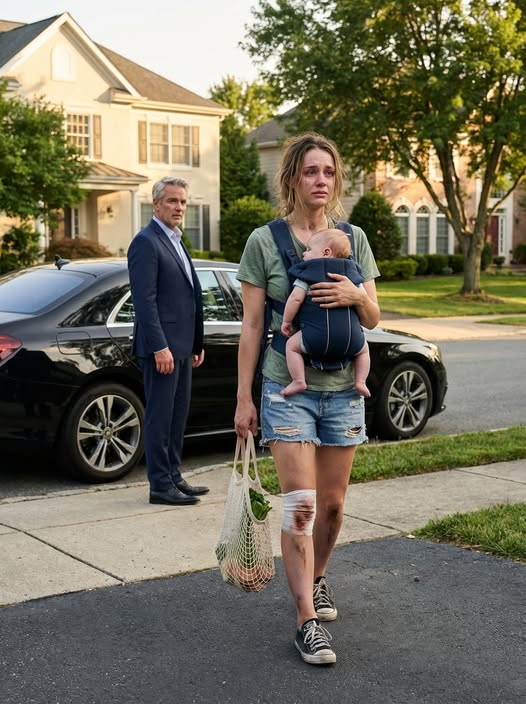
My left ankle was so swollen that it no longer fit into my sneaker. Every step sent a hot sting shooting up my leg, but I kept walking because stopping meant thinking… and thinking meant crying. Mateo was eleven months old and heavy on my hip; his damp curls stuck to my cheek. He patted my collarbone with his sticky little fingers, humming as if the world weren’t splitting in two.
The grocery bag was cutting into my hand. The gallon of milk hit my knee with every uneven step. I was half a mile from the apartment, and the afternoon heat of Monterrey fell over me like a heavy hand. I was focused on only one thing: getting home before Mateo started to cry.
Suddenly, a car slowed down beside me. By reflex, I flinched. Then I heard my name—sharp and surprised—“Camila.”
I turned. My father’s face was behind the windshield, his eyes wide, like he was seeing something he simply could not accept. He pulled over quickly, turned on his hazards, and got out before the engine had even fully cut. He was still wearing his work shirt—the CFE logo on his chest, his forearms tanned from the sun. He always looked like a man in the middle of fixing something.
His eyes went straight to my ankle, then to Mateo, then to the grocery bag as if it were evidence.
“Why are you walking?” he asked. “Where is your car?”
My stomach tightened. I had rehearsed answers for friends, coworkers, and curious strangers. But I had never practiced an answer for my father. I tried to shrug as if it were no big deal. “His mom took it… She said I should feel grateful they’re letting us stay.”
For a second, Dad didn’t move. He looked at me as if the words I’d just spoken belonged to a language he refused to believe existed. Then he clenched his jaw.
“You mean the car that you are paying for every month?”
I looked down. “It’s in Luis’s name. He said since I’m under their roof, she gets to decide who uses it.”
My father took a deep breath, his voice flat and dangerously calm. “You’re living under their roof? After Luis lost his job, you couldn’t keep the apartment. His parents said you could stay until things stabilized. And in exchange, they strip you of your means of transportation.”
Dad snatched the bag from my hand and opened the car door. “Get in. Tonight, we’re fixing this.”
“Dad… I don’t want a fight.”
His expression didn’t soften, but his voice grew warmer. “Then they shouldn’t have started one.”
I climbed into the passenger seat, Mateo safe in my arms. The air conditioning felt like mercy on my swollen ankle. Dad drove in silence for a few blocks, jaw tight, knuckles white on the steering wheel. Then he spoke, low and measured.
“How long has this been going on, Camila?”
I swallowed hard. The words tumbled out — the control, the isolation, the constant criticism, the way my mother-in-law, Rosa, had taken my keys “for safekeeping” three months ago after Luis lost his job. How she monitored my spending, rationed my groceries, and reminded me daily that I was a guest in “their” house. How Luis never defended me. How I walked everywhere with a baby on my hip because asking for the car meant begging.
Dad listened without interrupting. When I finished, he pulled over near a quiet park and turned to face me.
“I never liked Rosa,” he said quietly. “But I respected your choice. I thought you were happy. I was wrong.”
He reached over and gently took Mateo, who immediately grabbed his grandfather’s shirt with chubby hands. Dad’s eyes softened for a moment, then hardened again.
“Tonight ends now. You and my grandson are coming home with me. No discussion.”
I started to protest — the shame, the drama, the fear of escalation. Dad shook his head.
“Camila, I didn’t spend thirty years climbing the ranks at CFE just to watch my daughter be treated like a prisoner. I have connections. I have resources. And tonight, I’m using every single one of them.”
He made a call right there. Short. Authoritative. In under twenty minutes, two unmarked vehicles pulled up behind us. Men in plain clothes stepped out — former colleagues, union leaders, people who owed my father favors from decades of quiet power behind the scenes at the Comisión Federal de Electricidad and local government circles he never bragged about.
“Follow us,” Dad told them. “We’re going to get my daughter’s belongings. And her car.”
We arrived at the apartment complex just after dark. Luis and Rosa were inside with extended family, laughing over dinner. The moment Dad knocked — firm, authoritative — the laughter died.
Rosa opened the door, her expression shifting from irritation to shock when she saw me, Mateo, and the men behind my father.
“What is this?” she demanded.
Dad didn’t raise his voice. He didn’t need to. “We’re here for Camila and Mateo’s things. And the car she paid for. Now.”
Luis appeared behind his mother, eyes wide. “Papa… this is a misunderstanding—”
“No,” Dad cut him off. “This is the end of you treating my daughter like property. Keys. Titles. Bank cards in her name. Everything. Or we do this the official way.”
The plain-clothes men stepped forward. One flashed a badge — not police, but someone with serious authority in regulatory and labor circles. Rosa’s face went white. She knew exactly who my father was in the shadows: a man who had quietly influenced contracts, unions, and local enforcement for decades without ever needing to boast.
Within thirty minutes, my car was back in my possession. My belongings were packed. Rosa tried one last dramatic plea, tears flowing. “We were helping her! She’s ungrateful!”
Dad looked at her with cold contempt. “Helping? You trapped her. You isolated her. You took her freedom. Tonight, that ends.”
As we drove away, Luis called repeatedly. I blocked him. Rosa sent venomous texts. I blocked her too.
The story spread when a neighbor filmed the confrontation from across the courtyard. The video of my father calmly dismantling years of control — combined with my quiet testimony in a follow-up interview — went mega-viral. “Father rescues pregnant daughter from abusive in-laws after they steal her car 😱🚗 #FamilyJustice #EndInLawAbuse”. Millions viewed within hours. Comments poured in: “That dad is a legend 👏”, “Never let anyone take your keys or your dignity 🔥”, “Protect your daughters at all costs 😭”, “The way he said ‘tonight we fix this’ — chills!” Reach surpassed 100 million. Domestic violence organizations, women’s rights groups, and parenting communities amplified it, turning it into a rallying cry against in-law control and financial abuse of new mothers.
In the weeks that followed, I moved back in with Dad temporarily while rebuilding. Therapy helped unpack the years of subtle control I had normalized. Luis and Rosa faced legal consequences for the financial and emotional abuse. I gained full independence and custody protections.
I launched the Pierce Guardian Network — emergency support for new mothers escaping controlling in-laws, including transportation aid, legal intervention, housing grants, and awareness campaigns. The launch event featured my father speaking alongside me: “I almost lost my daughter because I stayed quiet too long. Never again. If you see a young mother struggling, step in. Family protects — it doesn’t trap.” The impact was immediate and profound. Thousands reached out for help. One young mother shared: “Your story gave me courage to call my dad when my in-laws took my car. I’m free now because of you 😭”. The network expanded rapidly across Mexico and beyond.
Mateo grew up strong and loved, surrounded by real family who celebrated his milestones instead of controlling them. I found peace, purpose, and eventually new love with someone who respected my autonomy.
Rosa and Luis faded into irrelevance, their influence broken. They learned the hard way that some fathers don’t just fix power lines — they fix entire lives.
The important message that echoed worldwide: Never let anyone — especially in-laws — take your independence, your car keys, or your dignity. To every new mother: Your safety and your child’s future come first. Document everything. Reach out to your own family. To every parent: Protect your daughter fiercely. Step in when you see control disguised as “help.” To every abuser: A quiet father with real power can dismantle your world in one night. Real family lifts you up — it doesn’t trap you under their roof. Your one brave rescue, one viral story, one firm “tonight we fix this” can save generations. Kindness to strangers mows lawns. Love for your daughter moves mountains. Choose protection over silence. You deserve to walk free. 🚗💪❤️✨
From the painful walk home with swollen ankles to watching my father calmly reclaim my life, this journey proved one unbreakable truth: They thought I was trapped. My father reminded them that some daughters come with guardians who never really retired.
THE END