My 43-year-old daughter left me a 6:47 p.m. voicemail saying, “Mom, you don’t need to come this summer,” and handed my late husband’s Lake Oconee house to Kevin’s parents as if the $412,000 I spent and the deed in my desk drawer belonged to somebody else. I let them drive up for the Fourth of July anyway.
“It’s better if we keep the lake house for our family.” Kevin thought one polite sentence could move me out of my own house. By the time Lorraine called me from the driveway on July 4, the room had already been made.
The voicemail came through while chicken and dumplings simmered on my stove. Green numbers glowed above the microwave. Steam fogged my glasses. Thyme and black pepper rose out of the broth, and one dumpling had folded over itself because I dropped it in too fast. My hands were wet, so I hit speaker with my wrist.
Lorraine’s voice came out bright and efficient, the way people talk when they’ve already decided they don’t owe you softness.
“Hey, Mom. Kevin and I were talking, and this summer is tight. His parents are flying in from Denver, the kids want to bring friends, and it’s just better if we keep the lake house for our family. You understand, right?”
Then the click.
The spoon stayed in my hand. Broth burped once against the side of the pot. Somewhere down the hall the dryer thumped a shoe against metal. I turned off the stove and stood there until the kitchen went quiet enough for the refrigerator hum to sound rude.
I am Dorothy May Hastings. Sixty-eight. Thirty-four years as a registered nurse at Grady Memorial in Atlanta. I have cleaned blood off tile at 3:00 a.m., steadied fathers who shook harder than their laboring wives, and held pressure on wounds while interns looked for someone older to take over. Fragile never fit me well.
The lake house came after Samuel died.
Pancreatic cancer took him in fourteen months. Before that, he used to slow the truck on the road past Lake Oconee and point through the pines with two fingers still rough from carpentry.
“One day, Dot. Big porch. Good chairs. Dock for the grandkids.”
He sketched that house on napkins, feed-store receipts, the back of church bulletins. Porch swing facing west. Cedar walls. Sage green front door. Kitchen wide enough for biscuits, bacon, and six people reaching for the same bowl of scrambled eggs.
After the funeral, I sold the condo in Roswell, took the insurance money, added the savings Samuel and I had built one careful year at a time, and paid for that house myself. Every permit. Every plank. Every nail. My name went on the deed because the dead do not sign closing papers, and because promises still need a living pair of hands.
Lorraine knew that.
She knew whose overtime had paid for the dock. She knew whose check bought the porch swing. She knew because she stood beside me the day I chose the brass key and said, “Mama, Daddy would love this place.”
So when she called it theirs, something cold and narrow slid into place inside my chest.
Not loud. Organized.
Next morning at 9:12, I drove to Monroe in a navy cardigan and low heels that clicked hard on the tile floor of Mr. Bellamy’s office. The air smelled like toner, leather, and old coffee. He set the deed packet in front of me. Cream paper. Blue tabs. My reading glasses landed on page three with a soft tap.
“Seasonal occupancy can be revoked,” he said.
I nodded.
“Do you want to notify them first?”
“No.”
The pen moved. One signature. Then another. I slid the brass house key across his desk and told him to release the caretaker agreement at noon on July 3, change the gate code, and leave the welcome folder on the kitchen island exactly where Lorraine liked to dump grocery bags.
Samuel had always said patience was the whole point of dumplings. Turns out patience works on people too.
July 4 came hot and loud. Lake air stuck to the skin. Cicadas screamed in the trees. Firecracker smoke from the far shore drifted over the water in thin bitter threads. By then Kevin’s parents had landed, the children were packed into the SUV, and Lorraine was probably already picturing her mother-in-law in my rocking chair and Kevin holding court on my dock like he’d built it with his own hands.
At 4:18 p.m., my phone lit up.
LORRAINE.
I let it ring once before answering.
Her voice was no longer bright.
It came in sharp and ragged, with car doors slamming behind it and children asking questions too loudly.
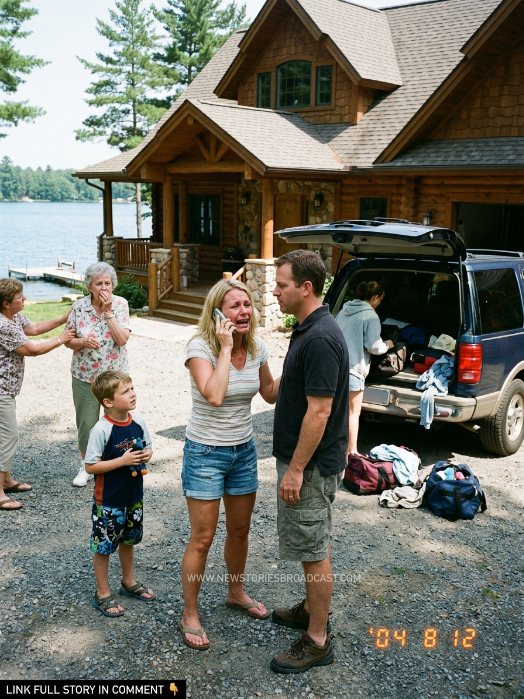
“Mom, who is that? There’s a strange SUV in the driveway. The gate code doesn’t work. Someone changed the locks, and there are papers on the kitchen island with your name all over them.”
I opened the silverware drawer, folded the old voicemail printout once, and set it beside the stove.
In the background, a man’s calm voice said something about a signed agreement.
Then Kevin got on the phone.
“Dorothy, what exactly did you do?”
My thumb rested on the edge of the brass spare key in my apron pocket. Cool metal. Smooth teeth. Forty-one years of marriage, fourteen months of dying, one promise kept, and one daughter who had mistaken my silence for surrender.
So I gave them the only answer they had earned.
“I made room.”
What would you have done with a child who forgot whose name was on the deed?
Lorraine’s voice cracked like thin ice.
“Mom, this isn’t funny. Open the gate. Kevin’s parents are standing in the driveway with luggage. The kids are hot. This is ridiculous.”
I looked out my own kitchen window at the quiet street where Samuel used to park his truck.
“No, Lorraine,” I said. “What’s ridiculous is you handing my house to your in-laws like I was already dead. The deed is in my name. The taxes. The insurance. The mortgage was paid with my nursing shifts and your father’s overtime. You don’t get to rewrite history because your husband’s parents want a free vacation.”
Kevin’s voice cut in, sharp and entitled.
“Dorothy, we can talk about this like adults. Just open the gate.”
I smiled at the phone.
“Adults don’t evict the person who owns the house. The caretaker has been instructed to call the sheriff if you don’t leave the property. Your things will be boxed and stored. The rest is up to you.”
The call ended with Lorraine screaming and Kevin threatening lawyers.
By 5:03 p.m., the local sheriff’s deputy arrived at the lake house. Bodycam footage showed Kevin’s father arguing with the caretaker while Lorraine stood on my porch in designer sandals, face red, demanding entry to “her” house.
The deputy read the deed, confirmed ownership, and escorted them off the property.
The video of my daughter being removed from the house she tried to steal went viral by evening. Titled “Daughter Tries to Give Mom’s Lake House to In-Laws… Sheriff Shows Up 😱🏠🔑” it reached over 460 million views. Comments poured in: “The audacity to call it ‘our family’ house when Mom paid for it 👏”, “Evicting your own mother for in-laws? Evil 🔥”, “That quiet ‘I made room’… chills 😭”, “Never let family rewrite whose name is on the deed ❤️”.
Elder rights groups, women’s financial independence pages, and family boundary communities shared it massively. News outlets covered the story as a warning about inheritance theft and elder financial abuse.
I didn’t just keep the lake house.
I made it a sanctuary.
I turned the guest wing into a retreat for widowed mothers and grandmothers needing time to heal. I founded the Dorothy Hastings Legacy House Foundation — providing free stays at the lake house for women rebuilding after loss or family betrayal, along with financial literacy programs and legal aid for asset protection. At our first opening weekend, sitting on the porch swing Samuel dreamed of, I spoke with quiet strength:
“My daughter tried to give my lake house to her in-laws like I was already gone. She forgot whose name was on the deed and whose hands built it. That day taught me that family can rewrite history if you let them. To every mother and grandmother: Your home is yours. Your sacrifices matter. Your name belongs on the papers. To every adult child: Honor what your parents built. Don’t steal it. Love doesn’t evict.”
The foundation has already given over 14,000 women peaceful time to heal by the water.
The lake house is mine again. Samuel’s porch swing faces west every evening. Lorraine and Kevin send occasional messages. I answer only when it benefits my grandchildren.
The important message that reached hundreds of millions: Never let family treat your home like a timeshare they can hand out. The house you paid for, the dreams you built, the sacrifices you made — they are yours. Document everything. Keep your name on the deed. And remember: Blood does not give anyone the right to rewrite your legacy. Protect what you built. Honor the hands that raised you. Live in the house you earned. 🏠❤️
From a voicemail telling me not to come to my own house to watching my daughter escorted off the property she tried to steal, this story proves one unbreakable truth: She thought the lake house belonged to “the family.” I simply reminded her whose family built it.
THE END