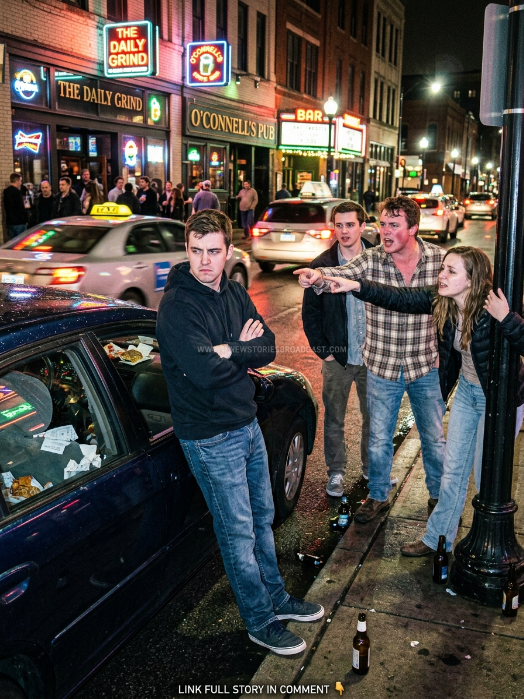
I never thought setting one simple boundary would make me the most hated person in a friend group I’d belonged to for fourteen years. But after being the permanent designated driver for over a decade — always sober, always reliable, always picking up the pieces — I finally said “No more.” Now I’m the selfish, boring, “no-fun” friend who “abandoned the group,” and the fallout has been brutal.
My name is Cameron Ellis. I’m 34 years old, a middle school math teacher and baseball coach in Raleigh, North Carolina. I’ve always been the responsible one — the planner, the organizer, the guy who shows up early and leaves last. For most of my adult life, I was proud of that role. Until it started costing me my peace, my safety, and my dignity.
Our friend group — “The Saturday Crew” — started in college in 2011. There were nine of us originally. We bonded over cheap beer, late-night study sessions, and weekend parties. As we graduated and entered the real world, the tradition continued: every Saturday night, someone hosted or we went to a bar, and someone had to be the designated driver.
That someone was almost always me.
It started innocently. In our early twenties, I didn’t drink much anyway. I had a reliable SUV with good gas mileage. I liked making sure everyone got home safe. The group would thank me, buy me food the next day, and call me a hero. It felt good.
But as the years passed, the dynamic became permanent.
By age 28, I was the only one with a consistent, well-paying job that didn’t involve heavy drinking culture. Most of the others worked in sales, marketing, or creative fields where happy hours and client dinners were the norm. They drank heavily every weekend. I stayed sober so they could let loose.
It wasn’t just once in a while. It was every single time.
If we went to a bar, I drove.
If someone hosted a house party, I drove.
If we did bachelor parties, beach trips, concerts, or cabin weekends, I was behind the wheel.
They stopped even asking. It was simply assumed: “Cam’s driving, so let’s get fucked up.”
I tried dropping hints for years.
“Hey guys, maybe we can rotate the DD role? I’d like to have a beer sometimes too.”
They would laugh it off. “Come on, Cam. You’re so good at it. We trust you. Plus, you don’t even like drinking that much anyway.”
Or the classic guilt trip: “If you don’t drive, who will? You want someone to get a DUI? You want us to die in a crash?”
So I kept doing it. Because I loved them. Because I didn’t want anyone to get hurt. Because I was terrified of being labeled “the difficult one.”
The breaking point came on a humid Saturday night in August last year.
We were at a big rooftop bar downtown celebrating our friend Derek’s promotion. Eight of us. Everyone except me was drinking heavily. By 1:30 AM, three people were throwing up in the bathroom, two were barely conscious, and the rest were sloppy and loud. I had been nursing water for six hours, exhausted from a full week of teaching and coaching.
As we stumbled toward the parking garage, my friend Marcus — who had been particularly rowdy — slapped me on the back.
“Alright, Cam the Man! Time to chauffeur us home. Let’s go!”
Something inside me finally snapped.
I stopped walking. “No. Not tonight. Someone else can drive or we can get Ubers. I’m done.”
The group stared at me like I had grown horns.
Marcus laughed. “Bro, stop joking. Keys, please.”
“I’m not joking,” I said, voice shaking with years of pent-up anger. “I’ve been the DD for fourteen years. Every single time. I’m exhausted. I want to have a drink. I want to relax. I’m not driving tonight.”
The reaction was immediate and vicious.
Brooke, one of the girls in the group, rolled her eyes. “Oh my God, Cameron. It’s one night. Don’t be dramatic.”
Derek, whose promotion we were celebrating, looked genuinely confused. “Dude, this is what you do. This is your role. Why are you making this weird?”
My best friend since freshman year, Tyler, pulled me aside. “Cam, come on. Don’t ruin the night. We’ve all been drinking. You’re the only sober one. Just do it like always.”
I stood my ground.
“I’m calling Ubers for everyone. I’m going home alone. I’m done being the group’s free taxi service.”
I ordered three Ubers, paid for them myself, and walked to my car alone while they yelled after me — calling me selfish, unreliable, a buzzkill, and a bad friend.
That night was the beginning of the end.
The group chat exploded the next morning.
Tyler: “What the hell was that last night, Cam? You embarrassed all of us.”
Brooke: “Some people change when they think they’re too good for the group.”
Marcus: “If you’re not willing to help out anymore, maybe you shouldn’t come to things.”
Even some of the girls who rarely drank defended the tradition: “You’ve always been the responsible one. Why ruin it now?”
I tried explaining in a long message:
“I’ve been the DD for 14 years. I’ve missed out on so many nights of just relaxing and having fun. I’ve driven drunk people home at 3 AM more times than I can count. I’ve cleaned vomit from my car multiple times. I’ve risked my license and my life countless times. I’m tired. I need boundaries. We’re adults. We can rotate or use ride-share apps.”
The response was brutal.
They accused me of being selfish, of abandoning the group when they needed me most, of “changing” and becoming “stuck up” now that I had a stable career. One of them even brought up my divorce three years ago, saying “We were there for you when you were falling apart, and this is how you repay us?”
The guilt was crushing. For days I replayed every memory — the nights they had comforted me after my wife left, the hospital visits when my dad had a heart attack, the countless times we had each other’s backs.
But then I remembered the other side.
I remembered driving with a migraine. Driving after working 12-hour days during report card season. Driving while they sang loudly and spilled drinks in my car. Driving when I was grieving. Driving when I just wanted to be home with my dog and a book. Driving while they mocked me for “never loosening up.”
I realized I had been enabling their irresponsibility for years while sacrificing my own comfort and safety.
I stayed away from the group for three weeks.
During that time, two people got DUIs — one of them Marcus. Another person got into a minor accident after a night out. The group chat was full of complaints about expensive Ubers and “no one wanting to drive.”
Slowly, a few of them started reaching out privately.
Tyler admitted, “You were right. We took advantage of you. I’m sorry.”
Brooke sent a long voice note crying about how the group dynamic felt different without me.
But the majority doubled down. They created a new group chat without me and continued the tradition with rotating DDs — but they made sure to post stories about how “some people think they’re too important to help their friends.”
The most painful moment came at our friend Jenna’s wedding two months later.
I was still invited, but the seating chart had me at a table with distant acquaintances. During the reception, Marcus gave a toast that included a not-so-subtle jab: “To the friends who actually show up and help when it matters.”
Several people looked at me.
I left early.
Eight months have passed since that rooftop night.
The friend group still exists, but it’s fractured. Some still invite me to smaller things. Others have fully cut me off. I’ve made new friends through my coaching job and hobby groups — people who respect boundaries and don’t treat me like a servant.
I still feel the grief of losing the “Saturday Crew” I once loved so much. Those friendships shaped my twenties. We grew up together. But I’ve also gained something I didn’t know I needed: self-respect.
The most important message I want every person reading this to hear is this:
Being the reliable one doesn’t mean you have to be everyone’s doormat.
It’s okay to set boundaries, even with people you love. Sacrificing your comfort, safety, and peace repeatedly is not friendship — it’s exploitation. Real friends will understand when you say “no.” The ones who punish you for it were never true friends to begin with.
You are allowed to stop pouring from an empty cup. You are allowed to choose yourself. You are allowed to walk away from traditions that no longer serve you.
I refused to be the designated driver every single time.
It cost me friendships I thought would last a lifetime. It made me the villain in many people’s stories. But it also gave me back my weekends, my peace of mind, my dignity, and the freedom to finally enjoy my own life.
And I’ve never regretted it.
Am I the asshole for refusing to be the designated driver every single time after years of doing it without complaint? Or was it reasonable for the group to expect me to continue in that role?
I’m reading every comment. Because even though I stand by my decision, some nights I still miss the old version of my friends… and I wonder if speaking up was worth losing them.
THE END