PART 3 — FULL STORY / COMPLETE ENDING
FULL STORY — PAGE 1
Lily Did Exactly What She Had Been Taught
Before Lily ever hit the classroom floor, she had done exactly what adults had taught her to do:
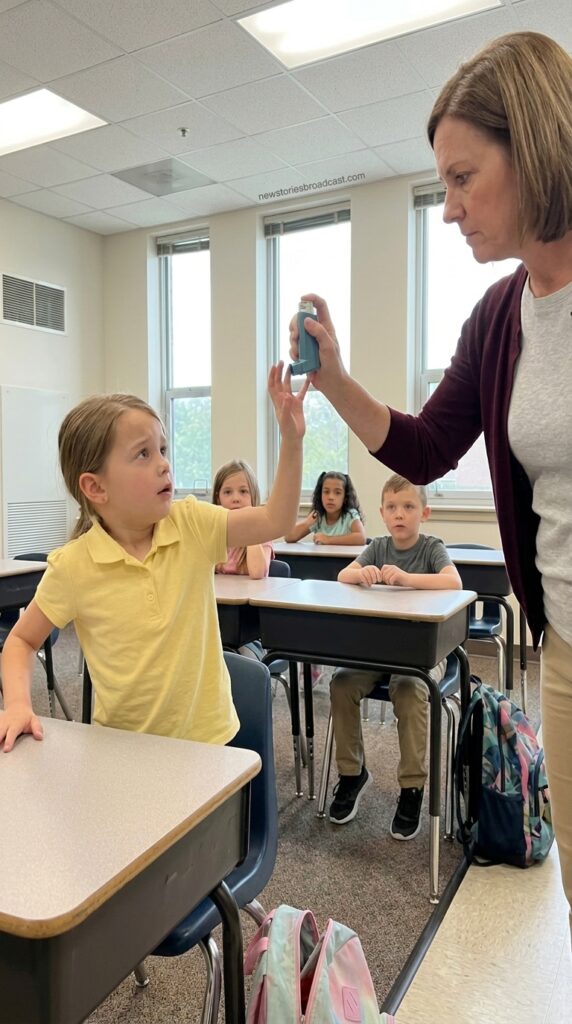
Recognize the warning signs.
Reach for her rescue medication.
Ask for help.
The problem was that the adult in charge had stopped her.
That was the fact I refused to let disappear beneath everything that happened afterward.
The nurse had responded.
The paramedics had arrived.
Lily had received her inhaler with a spacer.
Those things mattered, and I was grateful for every person who helped once the emergency was recognized.
But none of them changed what happened at 10:17 that Tuesday morning.
Lily had spoken up.
She had named the problem.
She had reached for the medication she was supposed to carry.
Then Mrs. Grayson had taken it from her hand.
On the other end of the phone, Principal Mark Holloway didn’t immediately answer my question.
He could hear hospital noise behind my voice, along with the clipped rhythm of someone trying very hard not to let fear turn into shouting.
I repeated myself.
“Why did one of your teachers take away my daughter’s rescue inhaler?”
“Mrs. Carter,” he said carefully, “I am finding out exactly what happened.”
“Then start with the inhaler.”
Not the ambulance.
Not the hallway.
Not the fact that the nurse responded once Ethan found her.
The inhaler.
Mark understood the distinction.
He ended the call only after promising me the school would preserve the timeline of the morning and review the emergency information already on file for Lily.
Then he walked out of his office.
Rebecca Owens was in the nurse’s room putting supplies back into her emergency bag.
Her hands were steady now.
Her face wasn’t.
“Rebecca,” Mark said, “I need Lily Carter’s health file.”
She stopped.
“Her asthma plan?”
“Everything we have.”
She pulled up the information the school had received from me and Lily’s doctor.
There it was.
The emergency action plan wasn’t something I had mentioned casually at pickup months earlier.
It was part of Lily’s school health information.
It identified her asthma, addressed the rescue inhaler, and stated that Lily was permitted to carry and use it when symptoms appeared.
Mark read the relevant section twice.
Then he asked Rebecca one question.
“When you reached the classroom, what did you see?”
Rebecca didn’t dramatize it.
She didn’t need to.
Lily was on the floor.
Her breathing was severely compromised.
Her classmates were frightened.
Ethan had arrived at the nurse’s office saying Lily couldn’t breathe.
Rebecca had entered, assessed Lily, called 911, located the rescue inhaler, used it with a spacer, and stayed with her until paramedics took over.
“Was there any doubt she needed help?” Mark asked.
“Not when I saw her.”
Mark nodded.
That answer explained only the final minutes.
It didn’t explain the first ones.
FULL STORY — PAGE 2
The Teacher’s Explanation
Mrs. Grayson was waiting in an empty conference room near the office.
She had stopped teaching after the ambulance left, and another staff member was covering the class.
When Mark entered, she started talking before he sat down.
“I didn’t know it was going to become that serious.”
Mark placed Lily’s emergency plan on the table between them.
“Tell me what happened from the moment Lily first spoke to you.”
Mrs. Grayson folded her arms.
At first, her version sounded almost reasonable if someone ignored the ending.
Lily had been talking normally earlier.
She had seemed upset during class before.
Mrs. Grayson believed she was becoming anxious and thought slowing her breathing would help.
Then Mark asked the question I had forced him to ask.
“Did Lily take an inhaler out of her backpack?”
Mrs. Grayson hesitated.
“Yes.”
“Did you take it from her?”
Another pause.
“Yes, but I was trying to calm her down first.”
There it was.
Not a misunderstanding about whether the inhaler existed.
Not confusion about where it was stored.
Not an emergency that developed before anyone knew what Lily needed.
The teacher had seen the medication in Lily’s hand and removed it.
Mark kept his voice level.
“What did Lily say when you took it?”
Mrs. Grayson looked toward the tabletop.
“She said her chest hurt.”
“Anything else?”
“She said she needed it.”
Mark let that answer sit where it belonged.
Mrs. Grayson began explaining again.
She said children sometimes panicked.
She said Lily had complained during recess the previous week.
She said she believed she was preventing Lily from relying on medication when she might simply need to settle herself.
But every explanation ran into the same problem.
Lily’s medical plan existed precisely so a seven-year-old child wouldn’t have to win an argument about whether her breathing felt dangerous enough.
Mark didn’t accuse Mrs. Grayson of intending to hurt Lily.
Intent wasn’t the first question anymore.
Action was.
“Where was the inhaler when Rebecca entered the room?” he asked.
Mrs. Grayson told him.
Mark wrote it down.
Then he asked about Ethan.
Mrs. Grayson stiffened.
“He ran out after I told him to sit down.”
“Why did he run out?”
“To get the nurse.”
“And did the nurse need to be called?”
Mrs. Grayson didn’t answer.
She didn’t have to.
Across town, I sat beside Lily’s hospital bed with her yellow school shirt folded inside a plastic belongings bag near the chair.
Lily was exhausted.
The frightening tightness had eased after treatment, but every few minutes I caught myself watching her chest rise just to confirm that it still did so easily.
I had spent years teaching Lily one simple rule about asthma:
If your breathing starts changing, tell an adult and use the rescue medicine the way you’ve been instructed.
Lily had followed that rule.
That was what I couldn’t get past.
“Mom?”
I looked up.
“I’m here.”
Lily’s voice was small.
“Am I in trouble?”
My stomach tightened.
“For what?”
“For taking my inhaler out in class.”
I stared at her.
“No. Absolutely not.”
Lily looked unconvinced.
“Mrs. Grayson said I didn’t need it.”
I moved my chair closer.
“You knew your breathing felt wrong. You told her. You reached for the medicine we talked about. You did what you were supposed to do.”
Lily blinked hard.
“I tried.”
Two words.
I would remember them longer than anything the principal said that day.
I tried.
A child had recognized danger in her own body and had still come away wondering whether asking for help was something she should feel guilty about.
That changed my goal.
I didn’t just want an explanation for the morning.
I wanted Lily to leave the experience trusting herself again.
FULL STORY — PAGE 3
The Timeline Told the Story
When Mark called back, I didn’t demand dramatic punishment over the phone.
I asked for facts.
He told me the school had confirmed that Lily’s emergency plan was on file.
He told me Mrs. Grayson acknowledged taking the inhaler from Lily after Lily removed it from her backpack.
He told me the school was reviewing the incident and that Mrs. Grayson wouldn’t return to Lily’s classroom while that review was underway.
I closed my eyes for a moment.
That mattered.
But I wasn’t finished.
“What about Ethan?”
Mark sounded surprised.
“Ethan?”
“The boy who went for the nurse.”
Mark had already spoken with him.
Ethan’s account was painfully straightforward.
He had heard Lily say she couldn’t breathe properly.
He had watched her take out the blue inhaler.
He had seen Mrs. Grayson take it.
He had warned that Lily looked sick.
He had been ordered to sit down.
Then Lily collapsed.
He ran.
He ran because Lily wasn’t talking anymore.
He ran because the adult in charge wasn’t leaving the room.
He ran because, at seven years old, he understood that the situation had crossed a line.
Mark told me Ethan wasn’t being disciplined for leaving the classroom.
“Good,” I said quietly. “Because he may be the reason the nurse got there when she did.”
That evening, Mark reconstructed the morning minute by minute using the accounts already available to the school.
At 10:17, Lily raised her hand and said she couldn’t breathe right.
She reached for the rescue inhaler in her backpack.
Mrs. Grayson removed it from her hand.
Lily’s breathing worsened.
Ethan spoke up.
He was told to sit.
Lily collapsed.
Ethan ran for Rebecca.
Emergency help was called.
Paramedics arrived five minutes later.
At 10:29, my call reached the principal’s office.
Written in sequence, the story lost every soft edge.
There was no room to hide the key choice inside phrases like “a difficult situation” or “a rapidly developing medical event.”
The medical event had developed while Lily was asking for access to the very object meant to help her during it.
The next morning, I spoke with Mark again.
This time, I had a short list.
I wanted confirmation that Lily would be able to keep her rescue inhaler accessible.
I wanted the adults responsible for her during the school day to know what the emergency plan required.
I wanted the school to address what happened without making Lily retell the collapse to every adult who became curious.
And I wanted Ethan’s decision to get help treated as what it was:
A response to an emergency, not classroom defiance.
Mark agreed to each point the school could put into practice immediately and told me the review of Mrs. Grayson’s conduct would continue separately.
I appreciated that separation.
Lily’s safety couldn’t wait for an argument over consequences.
First came access.
First came care.
First came making sure a frightened child never again had to persuade an adult that she was allowed to follow her own emergency plan.
The consequences could follow the facts.
Mrs. Grayson, meanwhile, was given another opportunity to explain her decision.
This time, she no longer disputed taking the inhaler.
Instead, she focused on why she believed she had done it.
She said she thought Lily was escalating her own fear.
She said she expected to return the inhaler after Lily settled down.
She said she hadn’t understood how quickly the situation would become dangerous.
The explanation did something she probably didn’t intend.
It confirmed the central issue instead of weakening it.
She had substituted her judgment about Lily’s emotions for the emergency instructions governing Lily’s asthma.
She had seen the medication.
She had heard the request.
She had made a choice.
And Lily had paid for the delay.
FULL STORY — PAGE 4
Lily Went Back to School
The review didn’t need a villain speech.
It needed the timeline.
Rebecca’s account supplied the medical response she observed.
Ethan’s account established what happened before the nurse entered.
Lily’s own words established that she recognized the symptoms and asked for the inhaler.
Mrs. Grayson’s explanation established that taking it was deliberate, even if she claimed her intention was to calm Lily rather than deny necessary care.
My submitted plan established that Lily’s asthma was already known to the school.
One fact supported the next.
That was enough.
Three school days after the collapse, Lily was ready to return.
I drove her that morning with the blue inhaler secured in the same backpack she had carried on Tuesday.
Before we got out of the car, Lily touched the zipper of the pocket where it sat.
“I can use it if I need it?”
I turned toward her.
“Yes.”
“Even in class?”
“Yes.”
Lily nodded.
But her hand stayed on the zipper.
I understood why.
Rules printed on paper felt different after an adult had looked at the medicine in your hand and told you the rule didn’t count.
Inside the school, Mark met us near the office rather than turning Lily’s return into a public event.
Rebecca came out of the nurse’s room and crouched slightly so she could speak to Lily without towering over her.
She didn’t ask Lily to recount what happened.
She simply confirmed where the inhaler was and told Lily she could come to the nurse whenever she needed help.
Then Ethan appeared at the far end of the hallway with his class.
He spotted Lily.
He slowed down.
For the first time since Tuesday, Lily smiled without someone asking whether she felt okay.
Ethan gave her an awkward little wave.
She waved back.
I wanted to hug him.
Instead, I waited until he was close enough and said:
“Thank you for getting help.”
Ethan shrugged in the uncomfortable way children do when adults make something important sound important.
“She couldn’t breathe,” he said.
That was all.
No hero speech.
No performance.
Just the same clear observation he had made in the classroom when another adult told him to sit down.
Lily returned to a classroom being covered by another teacher while the school continued reviewing what happened with Mrs. Grayson.
Her classmates watched her enter, then quickly pretended not to.
That was probably the kindest thing they could have done.
Lily placed her backpack beside her desk.
For a moment, her fingers rested on the pocket holding the inhaler.
Then she opened her reading book.
The room settled into the ordinary sounds of paper, chairs, pencils, and children whispering before class began.
I watched from the doorway only long enough to see Lily turn to the correct page.
I didn’t need a ceremony.
I needed this.
An ordinary morning.
An accessible inhaler.
Adults who understood that a medical plan wasn’t a suggestion to be debated after symptoms appeared.
And a seven-year-old who could raise her hand again without wondering whether telling the truth about her own body would get her in trouble.
Before I left, Lily glanced back toward her backpack one more time.
The blue inhaler was still inside the front pocket, exactly where she could reach it.
This time, no one moved it away from her.