My name is Diego. I’m 21 years old, a third-year college student in Guadalajara, and like a lot of broke students trying to survive, I took whatever part-time jobs I could find.
Preview
Tutoring. Coffee shop shifts. Carrying boxes. Running errands. Anything that helped me stay in school and keep food on the table.
Then one day, while scrolling through a Facebook job group, I saw a post looking for someone to clean the home of an elderly woman who lived alone in a narrow little alley near downtown.
The pay wasn’t amazing, but for me, it mattered.
Her name was Carmen.
The first time I knocked on her door, I wasn’t prepared for what I would see.
She looked painfully fragile. Tiny frame. Snow-white hair. Shaking hands gripping a cane like it was the only thing holding her upright. Her house was small, dim, and worn down by time. Inside, everything felt frozen in another era. A broken radio sat on a shelf. Faded family photographs hung crooked on the walls. An old wooden bed creaked with every movement.
She told me she had severe arthritis and high blood pressure. Walking even a few steps was difficult, which was why she needed someone to come once a week to help clean.
The job sounded simple enough. Sweep the floor. Dust the furniture. Wash a few dishes.
She promised to pay me 200 pesos every visit.
For a college student like me, that wasn’t pocket change. That was bus fare, meals, maybe enough to breathe for a few more days.
So I said yes.
But after a few visits, I started noticing things I couldn’t ignore.
Her refrigerator was almost always empty. A couple of eggs. Wilted vegetables. Sometimes just rice and a little sauce. That was it.
I asked her once why she lived like that.
She just smiled weakly and said her children lived far away and she didn’t want to bother them.
That answer stayed with me.
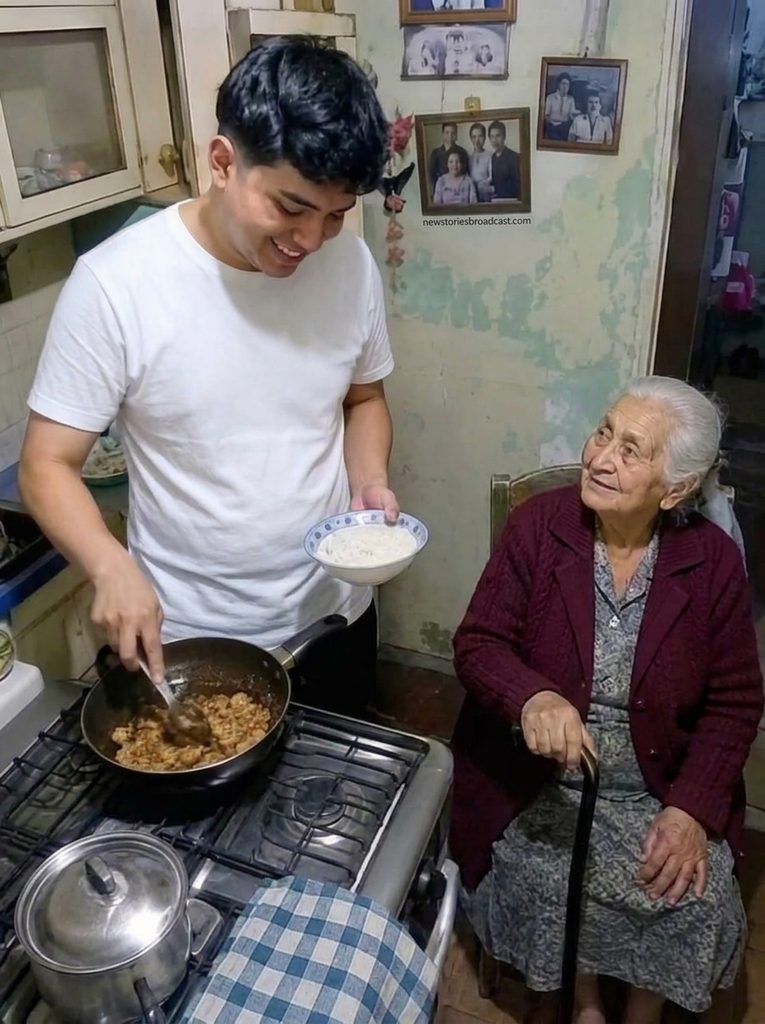
So after I finished cleaning, I started staying a little longer. I would walk to the market, buy meat or fish when I could afford it, and cook her something warm and real.
Preview
She loved that.
Every time I placed a bowl of hot soup or stew in front of her, her eyes lit up in a way that made the whole tired house feel less lonely.
Sometimes her joint pain got so bad she could barely stand. On those days, I took her to the public hospital myself and sat there waiting with her for hours until she got her medicine.
One afternoon, as we were leaving the hospital, she reached for my hand and held it gently.
Then she said in a quiet voice, “You remind me so much of my youngest son. He was a good boy too.”
I didn’t know what to say after that.
Maybe because I could hear the ache behind her words. Maybe because I knew what loneliness looked like, and hers had been sitting in that house for years.
So I kept helping her.
Week after week.
Month after month.
And the truth is… she never paid me.
Not once.
She always had a reason. Next week. After I fix something. When my money comes. Soon, Diego. I promise.
But somehow, I never walked away.
Maybe I felt sorry for her. Maybe I believed she meant it. Or maybe, deep down, I knew I wasn’t just cleaning her house anymore.
I was keeping her company in the last chapter of her life.
Then one day, she died.
And I thought that was the end of the story.
I thought all the time, effort, and unpaid work would disappear with her.
But after the funeral, someone handed me a single letter she had left behind.
My name was written on the front.
I opened it expecting an apology.
What I found inside left me completely shaken.
Preview
I opened the letter with shaking hands.
The paper was thin, the kind that comes in cheap pads sold at corner stores. Carmen’s handwriting was uneven, the letters trembling the way her hands always had, but every word was clear.
Diego,
If you are reading this, then I am already gone. Do not be sad for too long. I was tired, and the pain had been with me for many years. You made the last part of my life quieter and warmer than it would have been without you.
I never paid you. I know that. Every week I told myself next time, next time, next time. The truth is I had the money. Not a lot, but enough. I kept it because I was afraid. Afraid that if I paid you properly you would stop coming. Afraid that once the work was done you would have no reason to sit with an old woman who talked too much about a past no one else wanted to hear.
I was selfish. I used your kindness. For that I am sorry.
But I also watched you. I saw how you looked in my empty refrigerator and then went to the market without saying anything. I saw how you waited at the hospital even when your own classes were waiting. I saw that you never asked for more than the 200 pesos I kept promising and never giving.
My children have not visited in four years. They send money sometimes. They call on Christmas if they remember. They are not bad people. They are simply busy with their own lives, and I became someone who needed more than they were willing to give. That is the quiet truth of getting old.
You were not busy. Or rather, you were, but you still stayed.
In the small metal box under the bed there is an envelope with cash. It is everything I saved from the little pension and the money my children sent. There is also the deed to this house. It is paid for. It is mine to give. I had a lawyer write the papers months ago. Everything is in your name now.
I do not leave it to you because you cleaned my floors. I leave it to you because when I was lonely you made the loneliness smaller. That is rarer than money.
Live well, Diego. Finish school. Eat properly. And if one day you find an old person whose house is too quiet, stay a little longer than you have to.
Thank you for being kind when you did not have to be.
—Carmen
I sat on the edge of her narrow bed and read the letter three times. The fourth time the words blurred.
The metal box was exactly where she said it would be. Inside was a thick envelope of cash—more money than I had ever held at once—and a folder of legal documents with my full name on every page. The house. The small savings. A short will signed and stamped months earlier.
I went numb the way the title promised.
Not because of the money. Not even because of the house. I went numb because the woman I thought had been too poor to pay me had been quietly choosing me over the children who shared her blood.
The days after the funeral were strange and heavy.
Carmen’s son arrived first, a man in his late forties with a tired face and a phone that never stopped lighting up. Her daughter came the next afternoon, polite, distant, already calculating how long she could stay before her own life pulled her back. They looked at me the way people look at a stranger who has somehow ended up in the middle of family business.
When the lawyer read the will in the small living room, the temperature in the house changed.
“She left the property and remaining funds to Diego Reyes,” the lawyer said in a flat, professional voice. “The documents are in order. She was of sound mind. There are no grounds for contest unless you can prove undue influence.”
Carmen’s son stared at me. “You’re the cleaning boy.”
“I was,” I said.
His sister’s voice was tighter. “She barely knew you.”
I didn’t argue. I simply handed them the letter. They read it in silence. When they finished, neither of them spoke for a long time.
Eventually the son cleared his throat. “We should have come more often.”
It was the closest either of them came to an apology—to her or to me.
They left the same evening. They did not ask for the house. They did not threaten lawyers. They simply packed the few personal items they wanted—photographs, a small jewelry box, the broken radio—and walked out of the narrow alley without looking back.
I stood in the doorway and watched them go. The house felt larger without them in it. It also felt emptier.
I did not move in right away.
For two weeks I kept living in the tiny shared room near campus, going to classes, working the coffee-shop shifts, pretending the letter and the deed did not exist. At night I would lie on my thin mattress and hear Carmen’s voice saying, You remind me so much of my youngest son.
Guilt sat in my chest like a stone. I had cleaned her floors and cooked her meals and held her hand at the hospital, but I had also accepted her excuses week after week. Part of me had known she was lonely. Part of me had stayed because of that loneliness. Another part—smaller, quieter, harder to admit—had stayed because being needed felt better than being invisible.
The money in the envelope was real. The house was real. Both felt too large for the boy who used to count coins for bus fare.
One evening after a late class I walked back to the alley. The key she had given me months earlier still worked. I stepped inside and stood in the middle of the dim living room. Everything was exactly as she had left it: the crooked photographs, the creaking bed, the empty refrigerator I had tried so many times to fill.
I sat on the floor with my back against the wall and cried the way I had not cried since I was a child.
Not for the inheritance.
For the quiet fact that an old woman had spent the last months of her life choosing my company over honesty about money, and that I had let her.
In the end I kept the house.
Not because I wanted a free place to live, but because selling it immediately felt like erasing the only person who had looked at me and seen something worth leaving behind. I cleaned it properly this time—not as a paid job, but as a final act of care. I fixed the broken radio. I straightened the photographs. I filled the refrigerator with real food even though no one was there to eat it.
I used part of the cash to pay the rest of my tuition for the year. The rest I put into a small account I promised myself I would not touch unless I had no other choice. I kept going to classes. I kept the coffee-shop job for a while longer than I needed to, because the habit of working hard was harder to break than the habit of being broke.
Sometimes neighbors would stop me in the alley and say they had seen me coming and going for months, that Carmen used to speak about “the boy who cooks” with something close to pride. Those conversations always left me quiet for hours afterward.
Two years later I graduated.
The ceremony was ordinary. My parents came on the bus from the small town where I grew up. They did not fully understand the story of the house or the letter, but they understood that their son had finished school without drowning in debt, and that was enough for them.
After the ceremony I went back to Carmen’s house—my house now, though I still thought of it as hers—and sat on the front step with the diploma in my lap. The alley looked the same. The light was the same late-afternoon gold that used to fall across her floor when I swept it.
I thought about the first day I knocked on her door, expecting only a simple cleaning job and 200 pesos. I thought about all the weeks I left unpaid. I thought about the letter that turned everything I thought I knew into something heavier and more complicated.
Kindness is not always pure. Sometimes it is mixed with loneliness, with need, with the quiet hope that someone will stay. Carmen had used my willingness to stay. I had used her need for company. And somehow, in the middle of that imperfect exchange, something real had grown.
I still live in the house. I rent the extra room to another student who needs a cheap place near campus. On Sundays I cook more food than I can eat and leave containers with the older neighbors who live alone. I do not tell them why. Most of them do not ask.
Sometimes, when the house is quiet and the radio plays the old songs Carmen used to hum, I open the letter again. The paper is softer now from being folded and unfolded so many times. The words have not changed.
Stay a little longer than you have to.
I try.
Not because I expect another letter or another house or another miracle.
I try because once, when I was twenty-one and tired and barely holding on, an old woman looked at me and decided I was worth the risk of being left alone a little less.
That is the part that still leaves me quiet.
Not the money.
Not the deed.
The fact that someone chose to see me when she did not have to—
and then made sure I would never forget it.