he champagne flutes made a bright, delicate sound in my parents’ kitchen.
Vanilla frosting and perfume hung in the late-afternoon air beneath Madison’s gold birthday banner.
For everyone else, it probably sounded like a celebration.
To me, it sounded like a warning.
My daughter Lily was six years old.
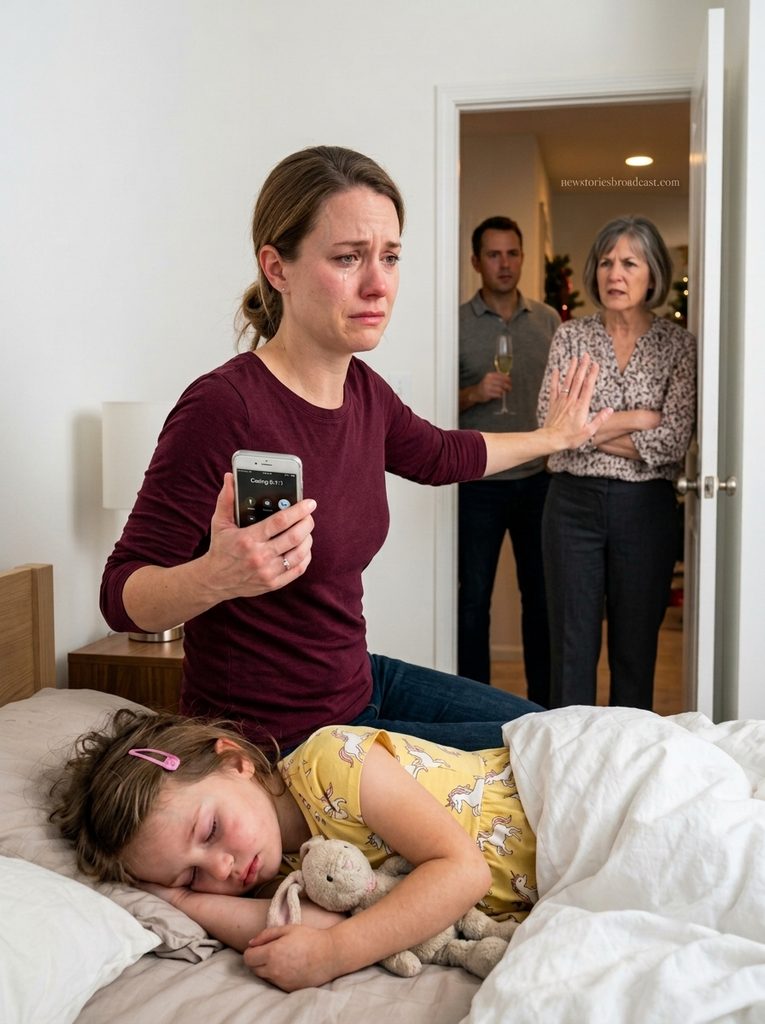
She was upstairs in the guest room wearing her yellow unicorn dress, with a glitter barrette holding back her brown hair and her stuffed rabbit tucked beneath one arm.
She had been tired when we arrived.
I had noticed the way she leaned against me while the adults talked.
Still, she had tried to be cheerful.
That was Lily.
She could sense when adults were unhappy and would somehow find a way to make herself smaller so nobody had to deal with it.
I had checked the guest-room door twice after putting her down.
I left it open.
I remember that detail because it became important later.
My mother, Patricia, had disliked Lily’s dress almost immediately.
“You let her wear that?”
Lily squeezed my hand.
I told myself Patricia was simply being critical.
That was easier than admitting what I was beginning to see.
My father, Robert, looked past us toward my old SUV and asked if it still ran.
He didn’t ask how Lily was doing.
He didn’t compliment her dress.
He didn’t even really look at her.
He looked at the vehicle.
The way he said it made my money problems sound like something dirty I had parked on his perfect driveway.
I swallowed the response that came to mind.
There was no reason to start a fight.
Not that day.
Not at Madison’s birthday.
I told myself we would eat cake, take one family picture, and go home.
That was the plan.
But the entire afternoon seemed designed around making sure Lily understood that she occupied a different place in the family.
Madison had a three-tier cake.
There was a rented balloon arch.
There was a photographer Patricia repeatedly described as “necessary.”
There were carefully arranged decorations and a gold birthday banner.
Lily got a warm juice box and a paper plate.
Her chair was positioned close enough to the wall that she could disappear from the photographs without anyone having to tell her to leave.
Whenever the photographer raised his camera, Patricia pulled Madison closer.
“Just the birthday girl now.”
Then came the second instruction.
“Immediate family for this one.”
I remember looking at Lily.
She didn’t protest.
She simply smoothed the skirt of her unicorn dress.
Then Madison looked at her.
Lily smiled.
That hurt more than if she had cried.
Children notice exclusion even when adults pretend they don’t.
Lily had been around Patricia long enough to know what that tone meant.
I had been around Patricia much longer.
That was why I kept making excuses for her.
I had spent my entire life learning that family arguments could be survived.
A cold remark could be ignored.
An insult could be swallowed.
A bad afternoon could be forgotten.
I thought I knew the limits.
I thought grandparents had a line they would not cross.
I was wrong.
When Lily became sleepy, I carried her upstairs.
The guest room smelled faintly of dust and old perfume.
The blanket felt stiff beneath my fingers.
I tucked it around her and adjusted the stuffed rabbit beneath her arm.
“Don’t let them start without me,” she whispered.
“I won’t.”
I kissed her forehead.
She closed her eyes.
Her breathing settled into the slow rhythm of sleep.
I walked back downstairs.
I thought she was safe.
That sentence is difficult to write now.
I thought she was safe because she was sleeping in a room inside her grandparents’ house.
I thought she was safe because there were adults downstairs.
I thought she was safe because I had never imagined I would need to protect my child from the people who had invited her to a birthday party.
Twenty minutes later, the atmosphere in the kitchen changed.
I noticed it before I understood it.
The photographer lowered his camera.
David stopped cutting cake.
Karen stared at a balloon ribbon without touching it.
The ordinary noises of the party seemed to thin out.
Then Robert’s voice traveled down the hallway.
“Finally she’ll look as worthless as she is.”
The champagne glasses touched.
Patricia laughed.
The sound was almost delicate.
That was what made it worse.
There was no shouting.
No visible anger.
Just a sentence about a child followed by the cheerful clink of glasses.
My hand locked around the kitchen counter.
For one ugly heartbeat, I imagined the glass pitcher beside me in my hand.
I imagined throwing it.
I imagined the entire room finally becoming as ugly as it felt.
Then I left the pitcher where it was.
If I exploded, they could turn the story into something about my behavior.
Lily needed me to make it about what they had done.
I ran upstairs.
One shoe slipped on the polished wood.
My palm burned against the banister.
The guest-room door was closed.
I had left it open.
I knew it.
I had checked it twice.
That was when the fear became something physical.
I pushed the door open.
Lily was lying far too still on the pillow.
Her stuffed rabbit was trapped beneath one limp arm.
The glitter barrette had fallen loose from her hair.
Then I saw her face.
It was swollen.
A dark red stain marked the white pillowcase beneath her cheek.
My stomach dropped.
“Lily.”
I moved toward the bed.
“Baby. Wake up.”
Nothing.
For one horrible second, I thought I had lost her.
Then I saw the faint movement of her breathing.
She was alive.
I reached for my phone.
My hands were shaking so badly that I missed the 9 the first time I tried calling 911.
The operator asked for the address.
I gave it.
She asked Lily’s age.
“Six.”
She asked whether Lily was breathing.
“Yes.”
She asked whether I could see an injury.
I looked at my daughter.
“Yes.”
Then came the question I had been trying not to think about.
Were the people who had hurt her still inside the house?
“Six,” I kept saying.
“She’s six. Please.”
The call timer passed 4:12.
Then I heard shoes outside the room.
Patricia’s shoes.
She wasn’t running.
She walked in looking annoyed.
“What are you doing?”
I moved between her and Lily.
“Do not touch her.”
Patricia barely looked at the bed.
“She must have fallen.”
“While she was asleep?”
“Don’t be dramatic.”
Robert appeared behind her.
He was still holding his champagne flute.
“Put the phone away before you embarrass this family.”
Something inside me became very calm.
There are moments when anger becomes so sharp that it stops feeling like anger.
It becomes focus.
I looked at the live call.
“She is breathing,” I told the operator.
“Both of them are outside the room. They’re telling me to hang up.”
Robert’s expression changed.
I lifted Lily carefully.
I supported her shoulders and knees.
Her stuffed rabbit hung against my wrist by one worn ear.
I carried her downstairs.
The birthday party had stopped being a birthday party.
It had become a room full of witnesses.
David’s fork hovered above his plate.
Karen covered her mouth.
Madison backed against the wall.
The photographer lowered his camera onto the counter.
The candles kept burning.
Nobody blew them out.
“They did this,” I said.
“They hurt her while she was sleeping.”
Robert called it absurd.
Patricia sighed.
She acted as if I were creating an inconvenience.
That reaction may have been the moment I stopped hoping for an explanation.
I had spent years trying to translate Patricia’s cruelty into something more acceptable.
Maybe she was stressed.
Maybe she was jealous.
Maybe she didn’t understand Lily.
Maybe she didn’t realize how much her comments hurt.
But there are moments when excuses become another form of denial.
This was one of them.
“You could have told me not to bring her,” I said.
“She’s a child. I would have kept her home.”
Patricia looked at me.
Then she smiled.
It wasn’t a nervous smile.
It wasn’t an apologetic smile.
It was small and satisfied.
“What fun would that be?”
She paused.
“I wanted the whole family to know only my real grandchild matters.”
Nobody corrected her.
Nobody laughed.
Nobody defended Lily.
The room just froze.
David’s fork remained suspended.
Karen’s hand stayed over her mouth.
Madison stood against the wall.
The photographer stared at the counter.
A balloon ribbon moved slightly in the air.
Wax continued sliding down the birthday candles and into the frosting.
Nobody moved.
I looked at Lily.
Then I looked at the people around that table.
The old family rule had always been to keep the peace.
But peace is not always peace.
Sometimes it is simply silence protecting the person who caused the harm.
I had finally understood that.
Keeping peace can mean protecting the people who broke it.
Protecting a child means refusing to help them hide what they did.
I held Lily tighter.
The stuffed rabbit’s worn ear rested against my wrist.
Her yellow unicorn dress looked painfully bright against the adults’ muted clothes.
Then the sirens reached the driveway.
I heard them before I saw the lights.
Blue-white flashes swept across the kitchen windows.
They passed over the gold birthday banner.
They reflected in the champagne glasses.
Patricia’s smile disappeared.
The first pounding knock hit the front door.
Nobody spoke.
The second knock came harder.
Robert finally looked at Lily.
Then he looked at me.
For the first time, he seemed to understand that this was no longer a family argument he could control.
He wasn’t going to decide what happened next.
The second knock had changed the room.
Patricia looked toward the front door.
Then she looked at Robert.
The confidence that had carried her through the afternoon was gone.
Robert placed his champagne flute on the counter.
It made a tiny sound against the surface.
“Don’t say anything until we know what she told them,” he whispered.
David heard him.
His face changed.
“I heard him say it,” David said.
Robert turned.
David swallowed.
“I heard Robert downstairs.”
Patricia snapped her head toward him.
“David.”
But he didn’t take it back.
The birthday party had become a record of who had spoken, who had laughed, and who had remained silent.
My phone was still connected to 911.
The operator told me to remain where I was and keep Lily away from anyone who might hurt her.
I kept my arms around her.
Then I noticed something on the counter.
It was the printed birthday shot list.
Patricia had prepared it for the photographer.
Madison’s name appeared repeatedly.
Lily’s appeared once.
Beside it, in Patricia’s handwriting, were two words.
“Not necessary.”
I stared at them.
They weren’t proof of what had happened upstairs.
But they were evidence of something else.
Lily’s exclusion had been deliberate.
Patricia had been deciding all afternoon who deserved to be seen.
And now the person she had treated as invisible was the only person everyone in the room could see.
Patricia reached for the paper.
I pulled it away.
“Don’t.”
Her hand stopped.
Karen began crying silently.
Madison stopped looking at the cake.
Robert looked at the phone in my hand.
“Please,” he said.
“We can explain.”
I looked at him.
Then at Patricia.
Then at the cake.
Then at the candles still burning as if the afternoon were ordinary.
Finally, I looked down at Lily.
She was six.
She had gone to sleep expecting a birthday party.
She had trusted the adults downstairs to leave her alone.
I had trusted them too.
That was the part I would remember.
Not only the injury.
Not only the words.
The trust.
Because betrayal hurts differently when it comes from people you once believed were part of your child’s safety net.
The knocking stopped.
A voice came from the other side of the door.
I tightened my arms around Lily.
Robert’s face had gone pale.
Patricia stood perfectly still.
And for the first time that afternoon, nobody in that house was pretending this was a celebration.
The next moment belonged to the people at the door.
And whatever happened after that would begin with one fact nobody could laugh away anymore.
Lily was six.
She was breathing.
And I had called 911.