Step Into the Digital World and Explore the Ideas, Innovations, and Technology Shaping Our Future.
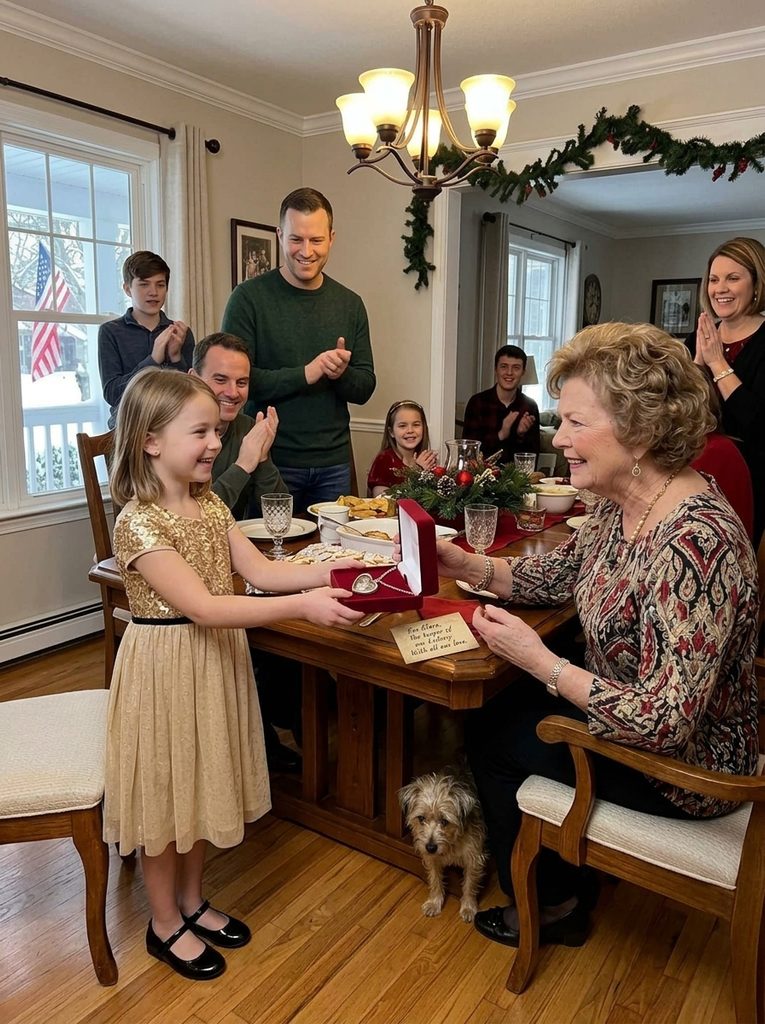
My name is Rachel, and I still remember the exact sound the little brass key made when it touched the bottom of Lorraine’s red velvet box.
It was Christmas morning.
The kind of Christmas morning people put into photographs.
Pine garland hung over the doorway.
Cinnamon rolls cooled beneath foil.
The chandelier reflected against silver napkin rings.
Outside, a small American flag tapped softly against the porch rail in the winter wind.
Everything looked beautiful.
Nobody looking through the windows would have guessed how tense the room actually was.
Everyone knew Lorraine’s rules.
Smile.
Stay polite.
Never challenge her when she decided somebody needed to remember their place.
For years, those rules had worked.
Then Lorraine chose my daughter.
Zia was seven.
She was wearing the gold dress Travis had steamed twice before we left home.
Her black Mary Janes were tucked neatly beneath the chair.
Her hands rested together in her lap.
She was trying very hard to look happy.
Before we entered the house, Travis had noticed a scuff on one of her shoes.
He wiped it away with his thumb.
Then he leaned down and said, “She deserves one holiday where she feels chosen.”
I knew exactly why he said it.
Lorraine had spent three years making sure Zia never felt that way.
Zia was my daughter from my first marriage.
Travis never treated that fact as a qualification.
He didn’t introduce her as his stepdaughter when people weren’t paying attention.
He didn’t treat her differently when his mother was around.
He packed her lunches.
He knew which stuffed rabbit had to face her bedroom door before she could sleep.
He knew which foods she refused to eat.
He knew the difference between her real laugh and the careful laugh she used when she was nervous.
Lorraine knew all of those things.
She simply refused to let them change her opinion.
She called Zia “Travis’s girl.”
Sometimes she said “your child.”
Once, when Zia was standing right beside her, Lorraine called her “that sweet little visitor.”
Always almost family.
Never family.
I used to correct her quietly.
I would say that Zia was her granddaughter.
Lorraine would smile.
Then she would change the subject.
After a while, I stopped correcting her in front of everyone.
I thought I was protecting Zia from embarrassment.
I was wrong.
Children notice the things adults think they have hidden.
Zia noticed.
Travis noticed.
I noticed.
The only person who seemed determined not to notice was Lorraine.
That Christmas, she had arranged presents across the room.
The larger boxes were stacked beneath the tree.
Shiny cards sat beside the place settings.
The older children were already whispering about what they might receive.
At 8:47 a.m., Lorraine began handing out gifts.
She did it like a ceremony.
One cousin opened an iPad.
Another received the same.
The older children pulled thick envelopes of cash from shiny cards.
Everyone smiled.
Everyone thanked Lorraine.
Zia watched.
She didn’t complain.
She didn’t ask what she was getting.
She simply sat beside me.
Then Lorraine looked toward her.
“Oh. Zia.”
The way she said the name made my stomach tighten.
She picked up a thin drugstore gift bag.
There was a crooked bow attached to it.
“This is for you, sweetheart.”
She smiled.
“I didn’t want you to feel totally left out.”
The room went quiet.
Not completely.
The refrigerator still hummed.
Someone shifted a chair.
The little dog beneath the table scratched at the floor.
But the conversation stopped.
Zia accepted the bag with both hands.
“Thank you, Grandma.”
Her voice was polite.
She lifted the tissue paper.
Inside was a cheap vanilla candle.
That wasn’t the worst part.
The worst part was the handwritten tag.
To Travis’s Girl.
I saw it.
Travis saw it.
Zia saw it.
The words seemed to sit there longer than they should have.
A fork stopped halfway to someone’s plate.
One cousin stared at the carpet.
Someone near the window looked suddenly fascinated by the Christmas tree.
Beside me, Travis crushed the side of his paper coffee cup without seeming to notice.
I whispered his name.
He leaned toward me.
“I told her to give Mom the red box if this happened again.”
I turned toward him.
“What red box?”
“The one in her overnight bag.”
“You planned this?”
He shook his head.
“No.”
His voice was quiet.
“I prepared for it.”
There was a difference.
Planning meant expecting a particular event.
Preparing meant accepting that the event might happen and making sure your child wouldn’t face it alone.
Zia placed the candle on the table.
She didn’t cry.
She didn’t argue.
That hurt more than tears.
I wanted to take the tag away from her.
I wanted to tell Lorraine exactly what I thought.
But Travis reached beneath the table and touched Zia’s hand.
She looked at him.
He gave her the smallest nod.
Not permission.
Trust.
The rest of Christmas morning passed awkwardly.
People tried to restart conversations.
Someone asked about the weather.
Someone else offered cinnamon rolls.
The children continued opening presents.
But the room had changed.
The candle sat on the table like an accusation nobody wanted to name.
Later that night, I found Zia sitting on the guest-room bed.
Her gold dress was wrinkled.
One black Mary Jane had been kicked off beside the bed.
The candle rested in her lap.
She was studying the tag.
I sat beside her.
She didn’t look at me.
“Mom?”
“I’m here.”
“Am I only Dad’s girl?”
The question broke something inside me.
I opened my mouth.
Nothing came out.
Then Travis appeared in the doorway.
He crossed the room and knelt in front of her.
“You are my daughter,” he said.
Zia looked at him.
“No matter what anyone writes on a tag.”
Her eyes filled slightly.
Then he reached into her overnight bag.
He pulled out a small red velvet box.
Zia stared at it.
“What is that?”
“You decide.”
He placed it in her hands.
“If Grandma ever makes you feel invisible again, you decide whether she gets this.”
Zia turned the box over.
“Will she be mad?”
“Probably.”
“Will you still be my dad?”
Travis looked wrecked for half a second.
Then his expression softened.
“Always.”
She hugged him.
The next morning, Lorraine hosted brunch.
The dining room had been reset.
White dishes.
Silver napkin rings.
Fresh coffee.
Cinnamon rolls.
Handwritten place cards.
Everyone had a name.
Then Zia saw hers.
Or what Lorraine had written instead.
Guest.
She stared at the card.
I expected her to look at me.
She didn’t.
She didn’t look at Travis either.
She reached into the little purse he had given her.
Her fingers closed around the red velvet box.
Then she stood.
The chair scraped against the floor.
Every conversation stopped.
Zia crossed the room.
She was only seven.
But she walked with the careful dignity of someone who had finally understood that being polite did not require accepting humiliation.
She stopped in front of Lorraine.
“Grandma,” she said, “Dad told me to give this to you if you ever ignored me again.”
Lorraine looked at the box.
Then at Travis.
“Well, isn’t that dramatic.”
Travis stood behind Zia.
“Open it.”
Lorraine’s smile remained in place.
For a moment, she looked almost amused.
She lifted the lid.
Then she saw the key.
Her expression changed.
It was a small brass key.
Nothing dramatic about it.
No diamonds.
No expensive engraving.
Just a key.
Beneath it was a folded white card.
Lorraine picked it up.
Her fingers were suddenly less steady.
She unfolded it.
I watched her eyes move across the page.
First confusion.
Then disbelief.
Then fear.
“What is this?” she asked.
Travis didn’t answer.
“Read it,” he said.
Lorraine looked at him.
“You wrote this?”
“Yes.”
Her lips tightened.
She read again.
The card explained what the key meant.
It was the spare key Lorraine had once been given to our home.
The key she had treated as proof that she could come and go whenever she wanted.
The card stated that it no longer worked as a symbol of access.
The locks would be changed.
The door code would be changed.
And from that day forward, Lorraine would not simply assume access to Zia, Travis, or me.
Visits would happen when we invited her.
Not when she demanded them.
Not when she decided she was entitled to them.
And certainly not when Zia was being made to feel like a guest in her own family.
Lorraine looked up.
“You’re throwing me out?”
Travis shook his head.
“No.”
“You’re cutting me off.”
“No.”
“Then what is this?”
“A boundary.”
The word seemed to make her angrier than anything else.
“A boundary?”
“Yes.”
She looked toward Zia.
“She is a child.”
Travis’s expression hardened.
“Exactly.”
Lorraine’s eyes narrowed.
“You’re letting a seven-year-old decide this?”
Travis didn’t raise his voice.
“I let my seven-year-old daughter decide whether she wants to hand you the box.”
Zia stood silently beside him.
Lorraine looked at her.
“You think this makes you important?”
Zia didn’t answer.
I could see her little fingers tightening around the strap of her purse.
Travis noticed too.
He moved one step closer to her.
That was when I realized what the red box had really been.
It wasn’t revenge.
It wasn’t a trap.
It was a physical reminder that Zia had a choice.
For years, Lorraine had controlled the room by deciding who belonged.
Now someone else had drawn the line.
Lorraine looked at the candle sitting on the counter.
Then she looked at the place card marked Guest.
“You’re destroying Christmas over a candle?”
I finally spoke.
“No.”
She turned toward me.
I pointed at the card.
“It’s not the candle.”
Lorraine said nothing.
I continued.
“It’s what you meant when you gave it to her.”
Her face tightened.
“She was being sensitive.”
“No.”
My voice surprised even me.
“She was being excluded.”
Nobody interrupted.
Not one person.
The room was so quiet that I could hear the coffee maker clicking in the kitchen.
That was the moment the family finally had to sit inside the thing we had all been avoiding.
Not grief.
Not misunderstanding.
Not one bad joke.
A pattern.
Three years of little words.
Little exclusions.
Little reminders that Zia was tolerated rather than loved.
The candle was simply the first time nobody could pretend they hadn’t seen it.
Lorraine turned toward Travis.
“I am your mother.”
He nodded.
“I know.”
“You owe me respect.”
“I respect you.”
She pointed toward Zia.
“This is disrespect.”
Travis looked at our daughter.
Then back at his mother.
“No.”
He paused.
“This is protection.”
Lorraine’s eyes filled.
“You would choose her over me?”
Travis answered immediately.
“I choose my daughter.”
The sentence landed with absolute simplicity.
Zia looked up at him.
Her expression softened.
Lorraine stared at both of them.
For the first time, she seemed to understand that the old rules no longer applied.
She couldn’t shame Travis into silence.
She couldn’t make me smooth over the conflict.
And she couldn’t use family tradition to force Zia back into the role of grateful outsider.
Then Lorraine reached toward Zia.
It was not an aggressive movement.
It looked almost instinctive.
But Zia stepped backward.
One small step.
Then another.
She held the red box against her chest.
Lorraine stopped.
Her hand remained suspended in the air.
The entire family saw it.
Zia wasn’t rejecting her grandmother because she hated her.
She was protecting herself because she had learned that being related to someone didn’t automatically make that person safe.
Lorraine lowered her hand.
Her face crumpled.
“I never meant—”
She stopped.
Nobody knew what came next.
Because the sentence had too many possible endings.
I never meant to hurt her.
I never meant to exclude her.
I never meant for you to notice.
I never meant to lose you.
But intent was no longer enough.
Travis took the brass key from the table.
He placed it beside the candle.
Then he folded the card.
“This isn’t about winning,” he said.
Lorraine looked at him.
“Then what is it about?”
He looked toward Zia.
“Making sure she never has to wonder whether she belongs again.”
That was the first time Lorraine cried.
Not when she realized the key no longer worked.
Not when she understood the locks would be changed.
When she realized that her behavior had created a question in a seven-year-old’s mind that her own son now had to answer.
Am I only Dad’s girl?
Zia had asked it the night before.
Travis had answered.
Always.
That answer was the thing Lorraine could not take away.
The family brunch ended early.
Nobody argued.
Nobody laughed.
Nobody defended the candle.
One by one, people began leaving the table.
Lauren stopped beside me.
She didn’t say much.
“I should have said something yesterday.”
I nodded.
“Yes.”
She looked at Zia.
“I should have.”
Then she walked away.
Derek said nothing.
Eric avoided my eyes.
The cousins were unusually quiet.
Lorraine remained in her chair.
The white place card still sat in front of Zia.
Guest.
I picked it up.
Then I tore it in half.
Not dramatically.
Just once.
I dropped the pieces into the trash.
Zia watched me.
“Does that mean I’m family now?”
I knelt beside her.
“You always were.”
She looked toward Travis.
He nodded.
“Always.”
She smiled.
It wasn’t the careful little smile she used around Lorraine.
It was her real laugh waiting underneath it.
The one Travis knew.
The one I knew.
The one that had been missing from too many family gatherings.
Months later, Lorraine apologized.
Not perfectly.
Not immediately.
But genuinely enough that we could tell she had finally understood the problem wasn’t the candle.
She apologized to Zia first.
That mattered.
She didn’t say, “I’m sorry you felt hurt.”
She said, “I’m sorry I treated you like you didn’t belong.”
Zia listened.
Then she hugged her.
But the boundaries stayed.
The locks were changed.
The access rules changed.
Family visits became invitations instead of assumptions.
And Zia never again received a present labeled “Travis’s Girl.”
Because after that Christmas, nobody in our family needed to explain who she was.
She was Zia.
She was seven.
She was our daughter.
And she belonged.
The red box eventually disappeared into a drawer.
The brass key became useless.
The card faded at the folds.
But I kept all three.
Not because I wanted to remember Lorraine’s humiliation.
I kept them because I wanted to remember the moment my daughter stopped asking whether she belonged and started understanding that belonging was never something another person was entitled to take away.
And every Christmas after that, when Zia wore gold, Travis still checked her shoes before we left the house.
Not because they had to be perfect.
Because that small ritual reminded us of what he had told her before that first painful Christmas morning.
She deserved a holiday where she felt chosen.
After the red box, she finally did.