✨Where Entertainment Comes Alive, Bringing Energy, Fun, and Unforgettable Moments to Every Screen.
Their father used to joke that he wanted a big family.
“A loud house,” he’d say.
“A table that’s never empty.”
For ten years, that was exactly the life we built.
We had six children, and for a long time I thought the noise would last forever.
There was always something happening in our home.
Someone was crying.
Someone was laughing.
Someone was looking for a shoe five minutes before leaving the house.
There were doors that slammed too hard and footsteps that never seemed to stop.
At dinner, elbows bumped.
Glasses tipped.
Children argued over who had gotten more food.
And somehow, no matter how crowded the kitchen felt, I always found room for one more chair.
Their father loved that part of it.
Or at least, I believed he did.
He used to stand in the middle of the kitchen and look around as though the chaos itself proved something about us.
We were a family.
We were loud.
We were busy.
We belonged to one another.
Then one day, he decided the house was too loud.
There had been no warning I understood at the time.
No family meeting.
No gradual conversation about being unhappy.
He met another woman online.
She lived overseas.
Within months, he packed a suitcase and told me he “needed to find himself.”
There are sentences people say when they want to leave that are designed to make abandonment sound like a journey.
“I need to find myself” was one of them.
He found himself somewhere else with her.
I was left behind.
Six children.
A mortgage.
Bills that did not care whether I had slept.
And a future that suddenly looked nothing like the one I had spent ten years building.
At first, I did not know how I would make it work.
Then I stopped asking whether I could.
I simply began doing what had to be done.
In the mornings, I stocked shelves at a grocery store.
I learned the weight of cardboard boxes and the sting of cold air from the stockroom.
I learned how early a morning can begin when you have already been awake half the night worrying about money.
At night, I cleaned offices.
The buildings were quiet by then.
Sometimes I would move from one empty room to another and think about how strange silence could be.
At home, silence had once meant the children were asleep.
At work, it meant everyone else had gone home to someone.
I learned how to fix leaking faucets.
I learned how to make repairs because paying someone else was sometimes impossible.
I learned which problems could wait and which ones would become disasters by morning.
I learned how to stretch one chicken into three dinners.
That was not a metaphor.
It was a skill.
A little meat one night.
A casserole another.
Soup when there was almost nothing left.
There were weeks when I knew exactly how many meals were still possible from what was in the refrigerator.
There were also things I quietly stopped buying for myself.
Appointments could wait.
New clothes could wait.
Rest could wait.
Almost everything I wanted could be postponed because six children had needs that could not.
I missed weddings.
I skipped vacations.
I put off my own appointments so my children could go on school trips.
I made sure they had decent clothes.
I made sure they had new shoes when they needed them.
I did not always manage everything perfectly.
But I kept trying.
That was the part nobody saw from the outside.
Motherhood, at least the kind I knew, was made of small calculations.
Can this bill wait until Friday?
Can I mend this instead of replacing it?
Can I work one more shift?
Can I make them believe everything is all right until it actually is?
Children do not always see the arithmetic happening around them.
They see dinner.
They see clean clothes.
They see someone waiting at home.
That was enough for me.
I wanted them to feel safe.
Birthdays were different.
No matter how tight money was, I baked their cakes myself.
I let them scrape the bowl clean.
There was always flour somewhere it did not belong.
On the counter.
On the floor.
On someone’s face.
I can still remember the arguments over who had gotten the larger spoonful of batter.
Those moments seemed small when they happened.
Years later, they became enormous.
I made sure my children felt loved.
That was the one thing I refused to treat as optional.
I truly believed that one day they would understand what I had given up for them.
Not because I wanted them to spend the rest of their lives thanking me.
Not because I believed children owed their parents repayment.
But because I thought memory mattered.
I thought they would remember who had stayed.
Then they grew up.
And, of course, they were supposed to.
College turned into careers.
Marriages turned into new homes.
Some of those homes were in different states.
Phone calls became shorter.
Visits became promises for “maybe next month.”
At first, I told myself this was normal.
Children grow up.
Families change.
I repeated those sentences whenever disappointment tried to become resentment.
They had jobs.
They had spouses.
They had responsibilities.
I had raised them to build lives of their own.
It would have been unfair to expect them to remain children simply because I missed them.
Still, there is a difference between understanding distance and never feeling it.
I felt it.
Especially on quiet days.
Especially when the house seemed too large.
Especially when I passed a room and remembered who used to sleep there.
For my 60th birthday, I did not ask for much.
I did not want a party.
I did not invite neighbors.
I did not want gifts.
I wanted one thing.
I wanted my six children around the same table again.
That was all.
Seven places.
One for me.
Six for them.
I thought perhaps that was a simple enough request.
So I prepared for it.
I cooked their favorite meals.
I thought about what each of them used to ask for when they were younger.
I remembered who hated certain foods.
I remembered who always wanted seconds.
I remembered who used to eat too quickly and who could make one plate last an hour.
Then I baked Sarah’s apple pie with extra cinnamon.
I had made it that way for years.
Extra cinnamon was not a complicated instruction.
It was simply how Sarah liked it.
That detail mattered to me.
I set the table.
I placed seven settings carefully.
The napkins had been ironed that morning.
It seems almost ridiculous to remember that now.
But I remember.
I remember standing there with an iron in my hand, smoothing fabric because I wanted everything to look right.
I remember checking the table from different angles.
I remember thinking that, for one evening, the house might sound like it used to.
Then I waited.
At first, waiting felt ordinary.
People run late.
Traffic happens.
Plans change.
I looked at the clock.
One hour passed.
I checked my phone.
Then I looked at the clock again.
Two hours passed.
The food began to lose its warmth.
The candles continued burning.
The house stayed quiet.
I tried to think of explanations.
Maybe someone had been delayed.
Maybe one of the children was still on the road.
Maybe they had planned to arrive together.
Maybe my phone would ring in the next minute.
Then four hours passed.
The food was cold.
The candles had burned down.
Wax had gathered around their bases.
I sat alone at the head of the table.
That was the chair I had chosen for myself because there were six other places waiting around me.
Six empty places.
I cried into a napkin I had ironed that morning.
The detail hurt more than it should have.
Maybe that was because it represented the entire day.
The preparation.
The expectation.
The belief that if I made everything warm enough, welcoming enough, familiar enough, someone would come through the door.
No one did.
I wondered whether all those years of sacrifice had disappeared the moment my children left home.
I wondered whether the things I remembered so clearly had become invisible to them.
The grocery store mornings.
The office-cleaning nights.
The chicken stretched into three dinners.
The appointments I postponed.
The vacations I skipped.
The shoes I bought instead of the things I needed.
Not forgotten.
That thought would have been easier.
Forgotten could happen accidentally.
Taken for granted was something else.
Then someone knocked on the front door.
The sound cut through the house.
I looked up.
For a moment, hope arrived before reason could stop it.
Maybe one of my children had finally come.
Maybe there had been a problem with the car.
Maybe there had been traffic.
Maybe there was an explanation that would make four hours disappear.
I wiped my face.
I stood quickly.
My chair scraped against the floor.
The sound seemed too loud in the empty house.
I walked toward the door.
Every step carried the same foolish hope.
I opened it.
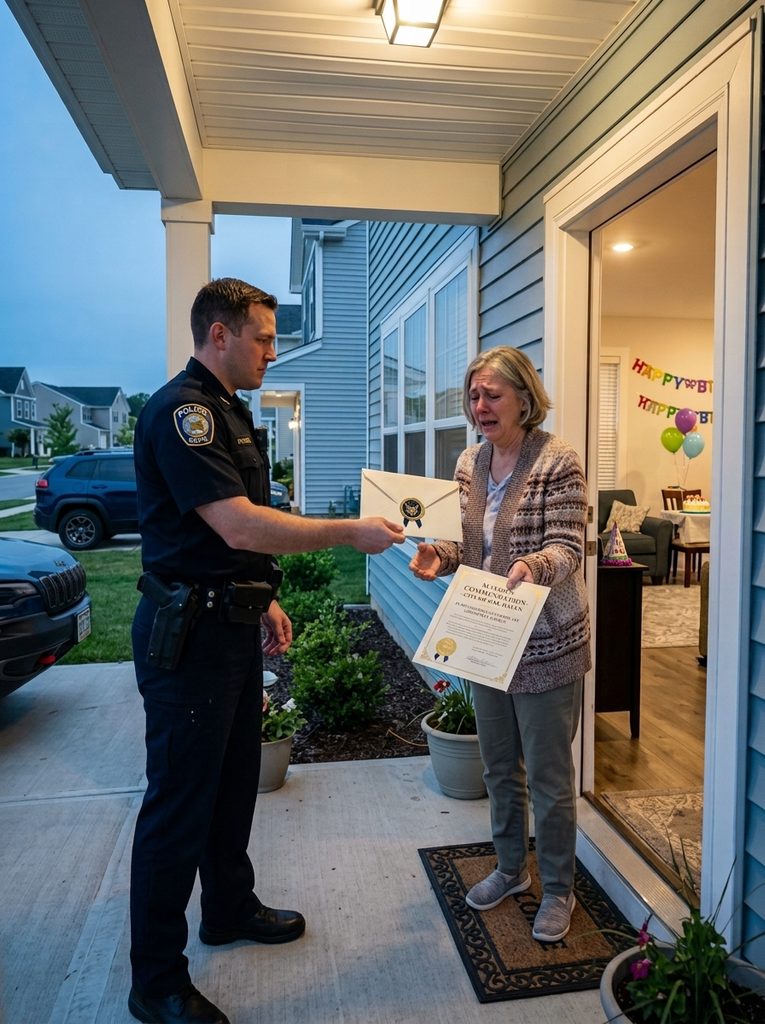
A police officer was standing on my porch.
Everything inside me changed.
Hope disappeared first.
Then came fear.
There are certain uniforms that make your mind race before anyone has spoken.
I looked at the officer’s face and immediately began searching for bad news.
I wondered whether something had happened.
I wondered which child.
I wondered where.
But he did not begin with an emergency.
He did not tell me someone was injured.
He did not tell me someone had died.
He simply held out a folded note.
My name was written across it.
My hands shook as I reached for it.
It was such an ordinary object.
A folded piece of paper.
No flashing lights.
No dramatic announcement.
No explanation attached to the moment.
Just a police officer standing on my porch and a note with my name on it.
And suddenly that ordinary piece of paper felt heavier than anything I had held all day.
Behind me, the birthday table remained untouched.
Sarah’s apple pie with extra cinnamon was still waiting.
The food was cold.
The six chairs were empty.
The candles had nearly disappeared into their own wax.
Whatever had happened, whatever explanation existed, whatever words had been written on that paper, all of it had somehow led this officer to my front door.
I reached for the note.
The officer let it go.
For four hours, I had waited for my children to arrive.
Now I was standing in my doorway, staring at a folded message and wondering why a police officer had been the one to bring it.
Some silences are empty.
Others are carrying something toward you.
I looked down at my name.
I felt the paper tremble between my fingers.
Then the note changed hands.