✨My name is Elise Whitmore.
And by the time Daniel turned into our driveway that evening, I had already made three phone calls I had been postponing for eight months.
The first was to my attorney.
The second was to my bank.
The third was to the accountant who had been quietly helping me understand how much of our marriage existed only because I kept rescuing Daniel financially.
I did not change the locks.
I did not throw his clothes onto the lawn.
I did not drain accounts.
Those things make satisfying stories.
They also create unnecessary legal problems.
Instead, I packed one suitcase.
Then another.
My clothes.
My work computer.
Important documents.
Medication.
A box of photographs belonging only to me.
And the little ceramic bird my mother had given me before she died.
Everything else stayed.
Because leaving a marriage did not require destroying a house on the way out.
At 6:18 p.m., Daniel texted me.
We’re leaving Mom’s.
Then:
Ava says she doesn’t want you talking to her tonight. Give her space.
I stared at the message.
Three hours earlier, his daughter had falsely accused me of shoving her.
He had given me an ultimatum before asking one person what they saw.
And somehow he was still assigning me instructions.
I wrote nothing back.
At 6:43, Daniel sent:
Are you making dinner?
That one almost made me laugh.
Not because funny.
Because habits reveal how completely people expect systems to continue after they damage the person maintaining them.
I forwarded the message to my attorney, Margaret Sloan.
She replied:
Do not engage tonight unless necessary. You have already said you are safe.
Good.
Permission not to fix.
At 7:06, headlights swept across the living-room wall.
Daniel was home.
Ava came in first.
Then Daniel.
His mother, Evelyn, had apparently sent leftovers because Ava carried aluminum pans.
I was upstairs.
Not hiding.
Finishing the suitcase.
I heard Ava say:
“Why is it so quiet?”
Daniel answered:
“She’s probably sulking.”
There.
That sentence made the decision easier.
He entered the kitchen.
Stopped.
On the counter sat one white envelope.
His name written across the front.
Next to it:
A copy of the financial authorization he had signed eight months earlier.
The one he probably hoped I had forgotten.
Then:
A second document.
Revocation of my personal guarantee for any future extension of his company’s credit line after its current term.
Not cancellation.
Not sabotage.
No existing loan called.
Just no future renewal from me.
Exactly what Margaret had advised.
Daniel shouted my name.
“Elise!”
I carried the suitcase downstairs.
Ava stood near the kitchen doorway.
Her face changed when she saw it.
Daniel stared.
“What is this?”
I placed my handbag on my shoulder.
“What does it look like?”
“Are you seriously leaving?”
“Yes.”
“Because Ava got upset?”
“No.”
Ava crossed her arms.
“She shoved me.”
I looked at her.
Not angry.
Tired.
“I bumped your arm accidentally.”
“You always have an excuse.”
I turned toward Daniel.
“You see?”
“What?”
“This.”
“Ava makes an accusation.”
“You accept it.”
“I defend myself.”
“You call that an excuse.”
“There is no version where I begin with equal credibility.”
Daniel’s jaw tightened.
“She’s my daughter.”
“Yes.”
“And I never asked you not to protect her.”
“Then what do you want?”
“For you to investigate before deciding who needs protecting.”
Silence.
He picked up the envelope.
Opened it.
Read the first page.
His expression changed.
“What does ‘notice of separation’ mean?”
“Exactly what it says.”
“You filed?”
“Not yet.”
“I retained counsel.”
“I am leaving tonight.”
“Tomorrow, we can begin discussing temporary arrangements.”
His eyes moved toward the financial document.
Then his face changed again.
“What is this?”
There.
The real shock.
Eight months earlier, Daniel’s construction consulting firm had almost collapsed.
One major client refused payment during a contract dispute.
Another project stalled.
Payroll became uncertain.
Daniel told me it was temporary.
He needed thirty days.
Then sixty.
Then ninety.
The bank offered a larger operating line if someone with stronger assets personally guaranteed part of it.
Daniel asked me.
I said no initially.
Not because I did not love him.
Because the house belonged to me before marriage.
My mother had left it to me.
My investments came from the sale of a small family company.
Separate assets.
I did not want business risk tied to them.
Daniel understood.
Or said he did.
Then three nights later, he sat at the kitchen table crying.
I had never seen him cry over work.
He said twenty-three employees might lose jobs.
People with mortgages.
Children.
Health insurance.
He said:
“I’m not asking you to save me.”
“I’m asking you to help me get through one quarter.”
I agreed to a limited personal guarantee.
Only one specific facility.
Only twelve months.
Maximum exposure clearly defined.
No authority over my other accounts.
Margaret reviewed it.
Everything documented.
That was supposed to be the end.
It wasn’t.
Three months later, I discovered Daniel had been telling people something very different.
At a dinner, his brother joked:
“At least the house finally did some work for you.”
I froze.
“What?”
Daniel changed subject.
Later, I asked.
He claimed his brother misunderstood.
Then I checked.
The bank had not taken my house as collateral.
Good.
But Daniel had told several people I had “put the house behind the company.”
Why?
Because it made the company look stronger.
And him look more important.
I hated that.
Still, not the worst part.
The worst part came when our accountant showed me Daniel had begun planning next year’s refinancing with my guarantee already assumed.
No conversation.
No request.
Just:
Elise guarantee renewal — expected.
Expected.
There.
My consent had become a line item.
I confronted him.
He apologized.
Said finance team drafted it.
Said he would fix it.
I believed him.
Mostly.
Then I discovered another document.
A loan package containing a projected household net-worth statement.
My separate assets appeared beside his as though everything belonged to one financial unit available to support his business.
Technically labeled household resources.
Legally not pledged.
But psychologically?
Already absorbed.
That was eight months ago.
The secret I had been keeping was not that Daniel was secretly bankrupt.
He wasn’t.
The company had recovered.
He had even repaid part of the operating line.
The secret was that I had already told Margaret to prepare documents ending my guarantee when its current period expired.
I had not delivered them.
Why?
Because each time Daniel improved, I told myself:
Maybe we are okay.
Maybe this marriage is still repairable.
Maybe Ava will warm up.
Maybe Daniel will start seeing me as partner again instead of infrastructure.
So I kept protecting him from the shock of hearing no.
Until the barbecue.
Daniel read the notice twice.
“You can’t do this.”
“Yes, I can.”
“The bank expects renewal.”
“I know.”
“We’re closing a bid next month.”
“I know.”
“This could affect bonding capacity.”
“Possibly.”
He stared.
“You’re willing to damage my company because Ava got upset?”
“No.”
“I am unwilling to keep guaranteeing your company because you treat my consent as automatic.”
“That has nothing to do with today.”
“It has everything to do with today.”
He looked confused.
So I explained.
“At the barbecue, you gave me two choices.”
“Apologize for something I didn’t do.”
“Or leave.”
“You did not ask what happened.”
“You did not ask your brother.”
“Your mother.”
“Your cousins.”
“You simply expected me to absorb the false accusation because that kept things easier.”
Then:
“You do the same thing with money.”
“With the house.”
“With my time.”
“With your daughter.”
“You assume I’ll absorb whatever prevents you from having the harder conversation.”
The room went silent.
Ava’s face changed.
Not remorse.
Defensiveness.
“You’re blaming me for his business?”
“No.”
“I’m saying your father and I have problems that existed before today.”
“You’re leaving because of me.”
I looked at her carefully.
“No.”
“I am leaving because your father told me leaving was preferable to him questioning whether you were telling the truth.”
That distinction mattered.
She did not like it.
Still true.
Daniel threw the papers onto the counter.
“So what, you’re just walking out?”
“Yes.”
“To where?”
“My sister’s tonight.”
“Then a furnished apartment.”
His face tightened.
“You already rented one?”
“No.”
“I had looked.”
There.
Another truth.
He stared.
“How long?”
“Two months.”
“You planned this.”
“I considered it.”
“Same thing.”
“No.”
“Considering an exit and choosing one are not the same.”
“Today made the choice.”
Then Daniel said the sentence that confirmed everything.
“You’re abandoning us.”
Us.
Not:
Me.
Not:
The marriage.
Us.
Meaning Daniel and Ava as one unit.
Me outside it.
A guest.
Exactly what I had realized beside that grill.
I lifted my suitcase.
“I am leaving the marriage.”
“I am not abandoning a sixteen-year-old who has two living parents and has spent three years telling me I am not one of them.”
Ava flinched.
Good.
Not because I wanted pain.
Because language has consequences.
Daniel said:
“You helped raise her.”
“Yes.”
“Then act like it.”
I almost laughed.
“Daniel, I drove her to practices.”
“Paid half the braces.”
“Sat outside her school when she had panic attacks.”
“Stayed awake when she had the flu.”
“And every time she wanted distance, you reminded me I wasn’t her mother.”
“Now that I leave, suddenly I’m responsible like one?”
Silence.
There.
No answer.
I walked toward the door.
Daniel followed.
“Elise.”
I stopped.
He lowered his voice.
“Don’t do this tonight.”
“What do you want?”
“Stay.”
“Why?”
“We can talk.”
“I tried to talk for eight months.”
“Not like this.”
“No.”
“Because nothing threatened your comfort before.”
He looked hurt.
That hurt me too.
I had loved him.
Still did, in some broken form.
Leaving does not switch love off.
It simply stops allowing love to outrank reality.
I opened the door.
Then Ava spoke.
“Elise.”
I turned.
For one second, I hoped.
Maybe:
I’m sorry.
Instead:
“Are you taking the car?”
I stared.
The car was mine.
Paid before marriage.
But that question told me where her mind was.
“Yes.”
Her face tightened.
“How am I getting to school Monday?”
Daniel answered:
“I’ll drive you.”
She looked at him.
“You have a meeting.”
“I’ll rearrange.”
There.
Something that had always been possible.
He simply had not needed to rearrange while I was available.
Good.
I left.
PART 3 — THE BACKYARD CAMERA DID NOT PROVE AVA WAS EVIL. IT PROVED DANIEL HAD MADE A DECISION BEFORE THE FACTS EXISTED.The next morning, I woke at my sister Julia’s house after three hours of sleep.
My phone had forty-one notifications.
Daniel.
Ava.
Daniel’s mother.
His brother.
Two friends.
And one message from Daniel’s cousin, Michael.
Elise, call me. There’s something you should see.
I almost ignored it.
Then he sent a video.
Security footage.
The barbecue.
Evelyn Whitmore had installed cameras after packages disappeared from her porch.
One covered part of the deck.
Nobody remembered.
Until Michael did.
The video was wide.
No audio.
But clear.
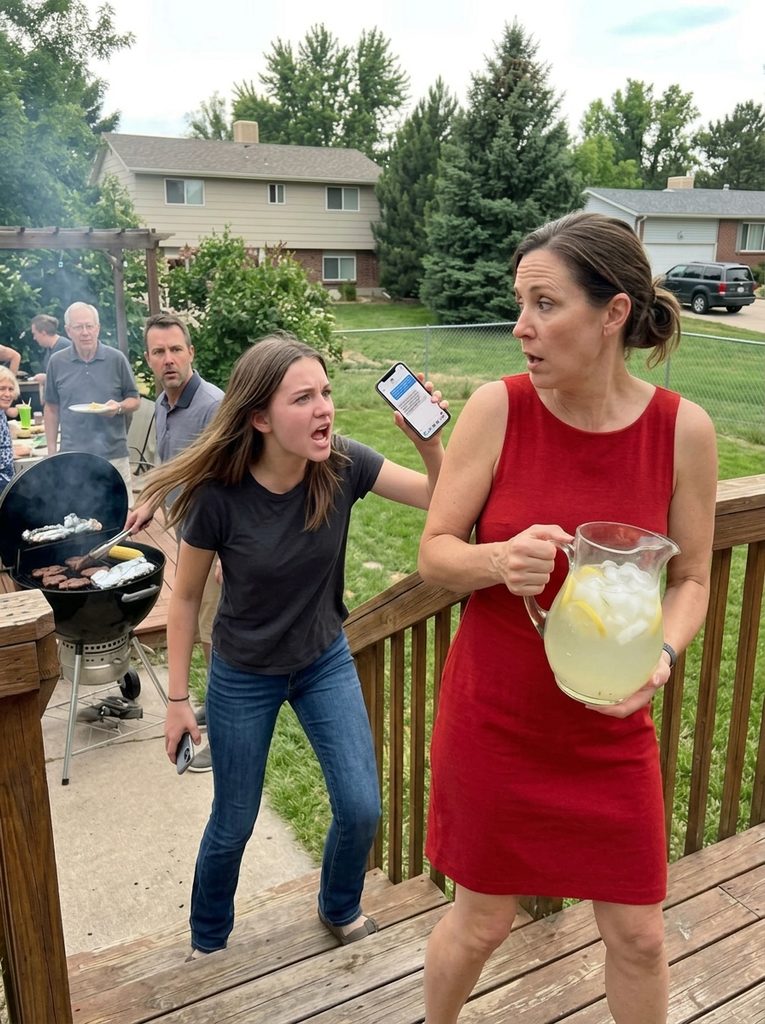
I emerged carrying lemonade.
Ava stepped backward.
Our shoulders touched.
The pitcher tilted.
I immediately stepped away.
Ava turned.
No shove.
No grabbing.
No aggressive movement.
Nothing.
Just accident.
Exactly as I said.
I watched three times.
Then stopped.
I did not feel vindicated.
I felt sick.
Because proof existed.
But Daniel had not needed proof when he decided against me.
That was the real wound.
Michael called.
“I’m sorry.”
“You didn’t do anything.”
“I was there.”
“So?”
“I should have said something.”
“Did you see it clearly?”
“Not really.”
“Then you did not know.”
He paused.
“Mom probably did.”
“Why?”
“She was facing you.”
Interesting.
Evelyn.
Daniel’s mother.
She had lowered her eyes when he gave me ultimatum.
Maybe because she saw.
Maybe because she simply hated conflict.
I did not assume.
Not yet.
I sent the video to Daniel.
No message.
Just video.
He called within two minutes.
I answered.
Silence.
Then:
“I saw.”
“Yes.”
“Why didn’t you tell me there was a camera?”
I almost laughed.
“That is your first question?”
“No.”
“I just…”
He stopped.
Then:
“You were right.”
There.
Not enough.
But a beginning.
I asked:
“What exactly was I right about?”
He was quiet.
“That you didn’t shove her.”
“Yes.”
Then:
“And?”
Another pause.
“I should have asked.”
There.
Better.
Then:
“I’m sorry.”
“For what?”
He exhaled.
“For telling you to apologize or leave.”
“Yes.”
“For believing her immediately.”
I corrected:
“Believing Ava immediately isn’t the entire problem.”
“What?”
“You can initially believe your child.”
“I understand that.”
“The problem is you decided my defense was irrelevant.”
“You could have said, ‘Ava, I hear you. Elise says it was accidental. Let’s figure out what happened.’”
“You didn’t.”
Daniel stayed silent.
Good.
He needed to hear difference.
Protecting a child does not require declaring another adult guilty before facts.
Then he asked:
“Will you come home?”
“No.”
Immediate.
He sounded stunned.
“But the video proves it.”
“Yes.”
“So?”
“So the video solves the barbecue.”
“It does not solve the marriage.”
There.
Later that day, Ava texted.
I saw the video.
Then:
I still felt like you bumped me hard.
I replied:
I believe you felt startled. I do not believe I shoved you. Both can be true.
She responded:
Dad says I should apologize.
I waited.
Then:
Only if you believe you should.
No forced apology.
I had received enough of those in my life.
Nothing came for an hour.
Then:
I’m sorry I said you shoved me.
I stared.
Specific.
Good.
Then another:
I was already mad at you.
There.
Interesting.
I asked:
Why?
No answer.
Until evening.
Then:
Because Dad said you might leave.
My heart stopped.
What?
I called.
Not text.
Ava answered after three rings.
“What do you mean?”
She sounded defensive.
“He said you two were having problems.”
“When?”
“Like two months ago.”
There.
Same time I had looked at apartments.
“How much did he tell you?”
“That you were mad about money.”
“That you didn’t like living with me.”
My chest tightened.
“I never said I didn’t like living with you.”
“He said you thought I made things hard.”
I closed my eyes.
Daniel.
Trying to explain marital tension to his daughter.
Probably protecting himself.
Maybe not malicious.
Still harmful.
Ava continued:
“And Mom said you were probably waiting until I went to college.”
Her mother.
Lauren.
There.
Another voice.
“How often do you talk to your mom about me?”
Ava hesitated.
“Sometimes.”
Fair.
She had a mother.
Then:
“She says stepmoms always act nice until they get what they want.”
“What do you think I want?”
Silence.
Then:
“Dad.”
That answer hurt.
Not because absurd.
Because after three years, Ava still viewed my marriage as competition between women for Daniel.
How much of that had adults taught her?
Probably too much.
I said:
“Ava, I never needed you to choose me over your mother.”
“I know.”
“Do you?”
She started crying.
“I don’t know.”
There.
Sixteen.
Not villain.
Child inside loyalty conflict adults had allowed to grow.
My anger shifted.
Not disappeared.
Changed.
We talked for twenty minutes.
She admitted she had been angry before the bump because she saw me hug Daniel near the grill.
That sounds ridiculous.
Until she explained:
Her mother had called that morning crying after an argument with her boyfriend.
Ava felt guilty enjoying a family barbecue while Lauren was alone.
Then she saw Daniel laughing with me.
Something twisted.
The accidental contact became outlet.
Not plan.
Not calculated lie.
Emotion looking for story.
She said:
“I knew you didn’t really shove me.”
There.
Important.
“When?”
“Almost immediately.”
“Then why didn’t you correct it?”
She cried harder.
“Because Dad was on my side.”
There.
Power changes confession.
Once Daniel validated accusation publicly, admitting exaggeration would mean losing the sudden certainty of being chosen.
A teenager took it.
That was wrong.
Also understandable.
Both.
I said:
“You hurt me.”
“I know.”
“Your apology matters.”
“But we are not pretending nothing happened.”
“I know.”
“And your father and I separating is not yours to fix.”
Silence.
Then:
“Are you divorcing him?”
“I don’t know yet.”
That was true.
I had retained counsel.
Not filed.
Still deciding.
Then:
“But whether we stay married will not be your responsibility.”
She whispered:
“Okay.”
Good.
Children should not carry marriage.
That evening Daniel came to Julia’s house.
I did not invite him inside.
We sat on porch.
He looked terrible.
Good suits gone.
Sweatshirt.
Unshaven.
More human.
He said:
“Ava told me what she told you.”
I nodded.
Then:
“I shouldn’t have discussed us with her like that.”
“No.”
“I thought she already knew.”
“She knew tension.”
“You gave it interpretation.”
“Yes.”
There.
Then I asked:
“Did you tell her I didn’t like living with her?”
He looked ashamed.
“Not exactly.”
“What exactly?”
“I said you were overwhelmed by tension at home.”
“And she was part of it.”
“Yes.”
There.
A child hears:
You are the problem.
Then protects herself by making me the problem.
Adults built this.
Again.
Not excuse.
Context.
Daniel said:
“I want counseling.”
I looked at him.
“For us?”
“Yes.”
“And family counseling.”
“Maybe.”
He leaned forward.
“I don’t want to lose you.”
“Then answer something.”
“What?”
“If there had been no camera, would you believe me now?”
He froze.
There.
That was the question.
He wanted to say yes.
I saw it.
Then he stopped himself.
Good.
Finally:
“I don’t know.”
Painful.
Honest.
I nodded.
“That is why I cannot come home.”
He closed eyes.
Because what I needed was not exoneration after video.
I needed a marriage where my word had weight before surveillance arrived.
PART 4 — THE REAL FINANCIAL SHOCK CAME WHEN DANIEL LEARNED HIS COMPANY COULD SURVIVE WITHOUT MY GUARANTEE, BUT HIS LIFESTYLE COULD NOT SURVIVE WITHOUT MY UNPAID LABOR.The bank did not collapse Daniel’s company.
That matters.
My guarantee expired four months later.
Daniel refinanced with a smaller facility.
Higher interest.
Stricter terms.
He brought in an outside investor.
The company survived.
Good.
I never wanted employees punished for our marriage.
What changed faster was Daniel’s daily life.
Ava’s volleyball.
Dentist.
School conference.
Groceries.
Dry cleaning.
House repairs.
Birthdays.
His mother’s appointments.
Family gifts.
Meals.
Travel plans.
Investor hosting.
The invisible system I had managed.
I did not stop doing it to punish him.
I stopped because I no longer lived there.
Reality did the rest.
Three weeks after I left, Daniel texted:
Do you know Ava’s orthodontist number?
I sent contact.
No sarcasm.
Next week:
Where are tax documents for house insurance?
I answered:
Shared drive > Home > Insurance.
Then:
Mom says you were supposed to order her prescription refill.
That one stopped me.
I replied:
I was not. She asked me last month and I helped once. Please contact her pharmacy.
There.
One favor had become job.
Again.
Daniel later told me he did not realize how many family members routed requests through me.
His mother.
Brother.
Ava.
Even him.
Because I answered.
Not because formally responsible.
Availability creates its own job description if nobody names boundaries.
At mediation, our accountant reviewed household spending.
Daniel discovered another uncomfortable truth.
I had paid substantially more than he remembered.
Not because he stole.
Because I often paid quietly.
School costs.
Home repairs.
Travel upgrades.
Insurance.
Medical deductibles.
And a portion of his business-hosting expenses when events happened in our home.
He had not tracked.
Why?
Because I did not present invoices.
I also discovered something about myself.
I used money to avoid conflict.
If Daniel wanted something expensive and I disliked arguing, I paid.
If Ava needed something Daniel thought Lauren should cover, I stepped in.
If Evelyn demanded a family dinner and Daniel complained about catering cost, I handled it.
Then I resented everyone.
Quiet generosity can become quiet control too.
I had to own that.
My therapist asked:
“Why didn’t you say no?”
I answered:
“Because then someone would be disappointed.”
“And?”
“I hate disappointing people.”
There.
Daniel feared disappointing his daughter and mother.
I feared disappointing everyone.
Our marriage had become an entire economy built around avoiding direct no.
No wonder resentment flourished.
Family counseling began without me first.
Daniel.
Ava.
Lauren, her mother, eventually joined remotely.
Good.
Because Ava’s conflict was not just about me.
It was about divorce that happened when she was nine.
Daniel and Lauren had spent seven years telling Ava:
“You’re our priority.”
Beautiful phrase.
Sometimes dangerous.
Why?
Ava learned that adult discomfort around her should disappear immediately.
If she felt rejected, someone must be wrong.
If Dad formed new marriage, Mom was hurt.
If Mom dated, Dad looked lonely.
She learned love as competition.
Nobody intended.
Still.
In counseling, Lauren admitted she had made dismissive comments about me.
Not because she thought I was abusive.
Because she hated seeing Daniel build a stable home after their marriage failed.
There.
Jealousy.
Human.
Harmful.
She apologized to Ava first.
For making her responsible for loyalty.
Good.
Then to me later.
Brief email.
I spoke about you in ways that put Ava between adults. I’m sorry.
I accepted.
No friendship needed.
Ava changed too.
Slowly.
At first, every counseling insight became a new way to accuse someone.
Normal teenager.
Then behavior softened.
One afternoon she asked to meet me.
Neutral café.
She arrived with backpack.
No Daniel.
We sat.
She said:
“I’m sorry again.”
I waited.
“For what?”
Good.
She rolled eyes.
Apparently everyone learned my question.
“For saying you shoved me when I knew it was mostly an accident.”
“Yes.”
“For liking that Dad chose me.”
There.
That one mattered.
Then:
“And for acting like if he loved you, he loved me less.”
I nodded.
“That was never true.”
“I know now.”
Then:
“I don’t know if I want you to be my stepmom.”
Honest.
I smiled sadly.
“You don’t have to decide that today.”
Good.
No forced relationship.
She asked:
“Do you hate me?”
“No.”
“Are you mad?”
“Yes.”
She looked relieved.
Interesting.
Why relief?
Because hatred feels permanent.
Anger can move.
Then she asked:
“Are you going back to Dad?”
I looked out window.
“I don’t know.”
“You still love him.”
“Yes.”
“Then why not?”
Because love does not answer structural questions.
I said:
“I need to know whether he can disagree with you without treating me like enemy.”
“And whether I can stop trying to earn a place by doing everything.”
Ava thought.
Then:
“That sounds exhausting.”
“It was.”
Good.
Meanwhile, Daniel sold one of the company cars.
Not because broke.
Because expenses mattered now.
He hired an operations manager instead of expecting me to coordinate events.
Paid market rates.
Again.
Systems.
The business improved.
Ironically.
Without me cushioning every last-minute issue, Daniel had to professionalize.
He later admitted:
“I thought you were helping.”
“You were.”
“But sometimes your help hid that the company needed staff.”
There.
Exactly.
My guarantee expired.
The bank refinanced.
No catastrophe.
That mattered to me.
Because for eight months I had feared saying no would destroy him.
It didn’t.
It inconvenienced him.
Cost money.
Forced adaptation.
There is enormous difference between harm and discomfort.
I had confused them.
So had Daniel.
PART 5 — SIX MONTHS AFTER I LEFT, DANIEL FINALLY APOLOGIZED WITHOUT ASKING ME TO COME HOME.That was the apology that mattered.
Not the first.
Not the video.
Not the flowers he sent and I returned.
Not the long messages explaining Ava’s history.
This one came six months later.
He asked for twenty minutes.
I agreed.
We met in our old backyard.
The same house.
Not the barbecue house.
Our home.
I had not been there in weeks.
Daniel had cleaned badly.
Ava’s shoes everywhere.
Laundry basket near stairs.
Normal.
No one dying.
No one ruined.
They had survived my absence.
Good.
That was healthy for everyone.
Daniel made coffee.
Then sat across from me.
He said:
“I’m not asking you to come back.”
Good start.
“I want to apologize.”
I waited.
He continued:
“I’m sorry I told you to apologize or leave.”
“Yes.”
“I’m sorry I treated Ava’s fear as automatically more credible than your account.”
“Yes.”
“I’m sorry I discussed our marital problems with her in a way that made her think you wanted away from her.”
Yes.
Then:
“I’m sorry I planned my business around your guarantee without asking again.”
There.
Good.
“I’m sorry I called your caution lack of support.”
Yes.
“I’m sorry I used the fact that you were competent as reason not to notice what you carried.”
There.
My eyes filled.
He continued.
“I thought being a good husband meant never making my daughter feel second.”
“That sounds noble.”
“It wasn’t always.”
“What was it?”
“Fear.”
There.
He looked toward yard.
“After Lauren and I divorced, Ava stopped speaking to me for almost two months.”
“I thought I had lost her.”
“She was nine.”
“I promised myself I would never choose a woman over her.”
I understood.
Then:
“Somewhere along the way, I turned that into never questioning her if a woman was involved.”
There.
Exactly.
“That wasn’t protection.”
“No.”
“It was making her responsible for proving my loyalty.”
He nodded.
“Yes.”
Good.
I asked:
“What if Ava and I disagree again?”
“I listen to both.”
“What if she cries?”
“I comfort her without deciding facts from tears.”
“What if she says she hates me?”
He smiled sadly.
“She’s sixteen.”
“She says she hates me twice a week.”
Fair.
Then:
“What if your mother asks me to organize Thanksgiving?”
“I tell her to ask everyone.”
“What if your company needs another guarantee?”
“I find financing.”
“What if you want to help?”
“I ask.”
“And if I say no?”
“You get to say no.”
There.
Simple.
Hard.
I believed he meant it.
Did that mean I returned?
No.
Not yet.
Apologies describe understanding.
Behavior proves it.
I had spent years accepting words.
I wanted time.
Daniel did not pressure.
That was new.
He stopped asking:
When are you coming home?
Instead:
Do you want dinner Thursday?
Would you like to attend Ava’s game?
Do you want me to bring mail?
Questions.
Options.
No assumptions.
That helped more than flowers ever did.
Ava invited me to regional volleyball final.
Not Daniel.
Her.
Text:
You don’t have to come. But I’d like you there.
I went.
Sat beside Lauren.
Awkward.
Fine.
Ava looked into stands before first serve.
Saw me.
Did not wave.
But her shoulders relaxed.
Small.
Real.
After game, she hugged Daniel.
Then Lauren.
Then stood before me.
For a second, neither knew what to do.
So I asked:
“Can I hug you?”
Her face changed.
Then she nodded.
“Yes.”
That was our first real hug in three years.
Because it was chosen.
Not because I was supposed to be mother.
Not because she was supposed to accept stepmother.
Choice.
Again.
Eight months after I left, Daniel and I began couples counseling.
Not reconciliation counseling.
Exploration.
Different.
We discussed money.
Parenting.
Lauren.
Evelyn.
My tendency to overfunction.
His tendency to triangulate Ava.
His company.
My resentment.
The barbecue.
Everything.
Some sessions ugly.
Good.
Honesty often is.
One session, therapist asked:
“Elise, why did you leave bracelet on table?”
I had forgotten.
The gold anniversary bracelet.
I answered:
“Because it felt like symbol of marriage I no longer recognized.”
Daniel looked down.
He still had it.
Apparently Evelyn picked it up after barbecue and gave it to him.
He carried it in desk drawer.
No romantic grand gesture.
Just kept.
The therapist asked:
“Do you want it back?”
I thought.
“No.”
Not because marriage definitely over.
Because that version was.
If anything new happened, it needed no relic pretending continuity.
Daniel nodded.
That hurt.
Still accepted.
Good.
At one year, I made decision.
Not divorce.
Not full return.
I moved back into house.
But under changed structure.
Some people will hate that.
They want clean endings.
Leave forever.
Or forgive instantly.
Life sometimes chooses third option.
I returned because Daniel’s behavior had changed consistently for months.
Ava and I had rebuilt some trust.
I still loved him.
And I wanted to try.
My choice.
Not obligation.
Before moving back, we signed financial agreement.
Yes.
Postnuptial.
Separate assets confirmed.
No future personal guarantees without independent legal review and explicit consent.
House ownership unchanged.
Household contributions defined.
Company completely separate.
Romantic?
Extremely.
After nearly losing marriage over assumptions, clarity felt intimate.
We also changed home responsibilities.
Daniel handled his mother’s logistics.
Ava’s appointments rotated with Lauren.
House cleaner twice monthly paid jointly.
Investor events no longer automatically at home.
I stopped being family secretary.
At first everyone complained.
Then adapted.
As humans do.
Evelyn took longest.
She called:
“Elise, what are you making for Thanksgiving?”
I answered:
“Nothing yet.”
“You always host.”
“Not this year.”
Silence.
Then:
“But everyone expects—”
I interrupted gently.
“Ask Daniel.”
She did.
Daniel said:
“We can host, but everyone brings something.”
Evelyn was offended.
Then brought pie.
World survived.
PART 6 — YEARS LATER, AVA TOLD HER OWN HUSBAND SOMETHING I WISH DANIEL HAD UNDERSTOOD THAT DAY IN THE BACKYARD.Seven years passed.
Ava was twenty-three.
Not sixteen.
Different person.
So was I.
So was Daniel.
She graduated college.
Became occupational therapist.
Worked with teenagers recovering from injuries.
Interesting career for someone once terrified of touch becoming conflict.
Life has patterns.
Not destiny.
Lauren and I became civil.
Then occasionally friendly.
No one expected.
We did not discuss Daniel much.
Better.
We discussed Ava.
Sometimes recipes.
Normal.
Good.
Evelyn softened too.
Age perhaps.
Consequences perhaps.
One afternoon she admitted:
“I saw the bump.”
There.
Seven years late.
I stared.
“At barbecue?”
“Yes.”
“You saw it was accidental?”
“I thought so.”
My chest tightened.
“Then why did you lower your eyes?”
She looked ashamed.
“Because Daniel had finally gotten close with Ava again.”
“I didn’t want to interfere.”
There.
Same pattern.
People refusing to speak because truth might disturb fragile peace.
I breathed.
“You let me become cost of keeping peace.”
“Yes.”
She cried.
“I’m sorry.”
Specific.
Late.
Still.
I accepted apology.
Not because history vanished.
Because she finally named it.
Daniel heard later.
He became angry at his mother.
I stopped him.
Not to protect her.
To protect accuracy.
“You made your decision.”
“She stayed silent.”
“Those are different responsibilities.”
He nodded.
Good.
Years earlier, he might have needed one villain.
Now he could hold multiple truths.
Growth.
Our marriage never became perfect.
Thank God.
Perfection is terrible goal.
We argued.
Sometimes badly.
But one thing changed:
Questions did not automatically become accusations.
If Ava said I hurt her feelings, Daniel listened.
Then asked me.
If I said his mother overstepped, he listened.
Then asked what happened.
If Daniel said I was controlling money, I listened.
Then checked whether I was using financial power instead of boundaries.
Mutual scrutiny.
Not comfortable.
Healthy.
My guarantee story became family joke eventually.
When Daniel’s company considered acquisition, he said:
“Don’t worry, your house is safe.”
I glared.
He raised hands.
Too soon?
Seven years.
Still.
Maybe.
We laughed.
Humor after accountability.
Not before.
The company grew.
Without my guarantee.
Imagine.
Daniel brought in professional CFO.
Independent board adviser.
Better controls.
He later told me:
“Your no made me build the company I should have built.”
I answered:
“Your company was never my rehabilitation project.”
He laughed.
“Also true.”
Good.
The house remained mine legally.
But emotionally became ours again.
Interesting distinction.
Ownership clear.
Belonging chosen.
No confusion required.
At twenty-six, Ava became engaged.
His name was Marcus Chen.
Engineer.
Quiet.
Kind.
The first time he came to dinner, Ava accidentally bumped him while carrying plates.
A glass tipped.
Marcus said:
“Sorry.”
Ava said:
“I bumped you.”
He laughed.
Then she froze.
I saw memory.
Barbecue.
Sixteen.
The lie.
The ultimatum.
Years.
Later that night she came to me.
“I thought about it.”
“I know.”
“I still hate that version of me.”
I shook my head.
“Don’t.”
“Why?”
“Because shame is useful only if it points somewhere.”
“Where?”
“Better behavior.”
There.
She nodded.
Before wedding, Ava asked me to help with dress.
Not Lauren?
Both.
We went together.
Three women.
Complicated history.
Saleswoman asked:
“Who’s mom?”
Ava answered:
“This is my mom Lauren, and this is Elise, my stepmom.”
Stepmom.
Not:
Dad’s wife.
Seven years later.
I pretended not to care.
Failed.
At wedding rehearsal, Marcus’s mother became upset about seating.
Small thing.
She raised voice at Ava.
Marcus immediately stepped in.
For one second, Daniel stiffened beside me.
History.
Then Marcus asked:
“Mom, what happened?”
Not:
Ava, apologize.
Not:
Mom is right.
He asked.
What happened?
I looked at Daniel.
Daniel looked at me.
No words.
Both understood.
After wedding, Ava called me from honeymoon.
Laughing.
“Marcus and I had first stupid fight.”
“What about?”
“Hotel room.”
“Good start.”
Then she became serious.
“He said something that reminded me of Dad.”
“What?”
“He thought I had done something.”
“And?”
“I told him what happened.”
“What did he do?”
“He asked questions.”
I smiled.
Good.
Then Ava said:
“I told him one rule.”
“What?”
“Never make me prove I’m loyal by agreeing with you before I know what happened.”
There.
The lesson traveled.
Not as trauma.
As principle.
Daniel retired from company at fifty-eight.
Too early.
He was bored within nine days.
Started consulting.
Of course.
I continued my own work.
By then I had become operations director for a nonprofit.
Separate identity.
No more being family infrastructure by default.
One evening, we sat in backyard.
Same kind of Colorado summer.
Corn on grill.
Smoke.
Grandchildren eventually running around.
Daniel said:
“Do you ever think about that barbecue?”
“Yes.”
“What if you had apologized?”
I thought.
“I probably would have stayed that night.”
“And?”
“We might have lasted another year.”
“Maybe longer.”
“Would that have been better?”
“No.”
He looked at me.
“Even though you came back?”
“Yes.”
He frowned.
So I explained.
“I needed to leave before coming back could be a choice.”
There.
If I had stayed under ultimatum, every repair afterward would have been built on surrender.
Leaving changed power.
Not because I punished him.
Because it proved I could survive outside the system.
Then returning became voluntary.
Important.
Daniel asked:
“Did you know you’d come back?”
“No.”
That hurt him slightly.
Good truth.
“I was prepared to divorce you.”
“I know.”
“Were you?”
“No.”
He smiled sadly.
“I thought you’d cool down.”
Of course.
“I didn’t understand you had actually changed your mind about what marriage required.”
There.
Then:
“What was the shock you meant when you said you stopped protecting me?”
I laughed.
He remembered.
“The guarantee.”
“The financial paperwork.”
“Was that really the biggest thing?”
“No.”
“What was?”
I looked toward house.
“You learning that my leaving did not destroy you.”
He stared.
Then nodded.
That was biggest truth.
I had spent years believing if I stopped helping, Daniel would fail.
He believed same.
So my care became compulsory.
When I stopped?
He adapted.
Ava adapted.
Evelyn adapted.
The company adapted.
Everyone did.
And I learned:
Sometimes continuing to rescue people prevents them from discovering they can stand.
That changed me.
Years later, Evelyn needed more support.
Not full-time care.
But rides.
Medication organization.
Appointments.
Everyone instinctively looked at me.
Old reflex.
I smiled.
“No.”
Not cruelly.
Then:
“Let’s make a schedule.”
Daniel Monday.
Ava Wednesday evening when possible.
Home-care worker Friday.
Evelyn paid from her funds.
I took occasional appointments because I wanted to.
Different.
No one called me selfish.
Progress.
At eighty, Evelyn moved into assisted living.
Her choice.
We asked.
She chose.
That mattered.
Before moving, she gave me the anniversary bracelet from that barbecue.
Daniel had given it to her for safekeeping after we reconciled.
Apparently she kept it all those years.
She placed it in my hand.
“I think this belongs to you.”
I looked at it.
Gold.
Thin.
Still beautiful.
Then:
“No.”
She blinked.
“What?”
“I don’t want it.”
“Why?”
“Because that marriage ended.”
Her face fell.
Then I smiled.
“The one Daniel and I have now is different.”
She understood.
We sold bracelet.
Donated money to local family counseling program.
Very dramatic for a small bracelet.
Still.
Good ending for object.
Ava eventually had a daughter.
Mia.
At five, Mia accused another child at birthday party of pushing her.
Parents froze.
Ava knelt.
“Are you hurt?”
“No.”
“What happened?”
“She pushed me.”
The other child cried:
“I bumped her.”
Ava paused.
Then:
“Okay.”
“Let’s figure it out.”
There.
No accusation.
No humiliation.
Protection without certainty.
I watched from across yard.
Ava caught my eye.
We both knew.
That might have been one of proudest moments of my life.
Not because she became perfect.
Because she interrupted pattern.
Daniel came beside me.
“You saw?”
“Yes.”
He whispered:
“She did better than I did.”
“Yes.”
He smiled.
“No argument.”
Growth again.
When people heard shortened version of story, they always expected dramatic home reveal.
They imagined:
I sold house.
Changed locks.
Cut Daniel off.
Called police.
Exposed Ava.
Destroyed business.
None happened.
The shock waiting at home was quieter.
A suitcase.
A financial boundary.
A lawyer’s envelope.
An empty place where I had always been.
That was enough.
Because Daniel had built his life around one assumption:
Elise will handle it.
The barbecue ended that assumption.
I did not leave because a teenager shouted at me.
Teenagers shout.
I left because my husband believed preserving his daughter’s immediate emotional certainty mattered more than giving his wife basic fairness.
I did not end my guarantee because I wanted revenge.
I ended it because financial consent is still consent when people are married.
I did not return because Daniel deserved a reward for apologizing.
I returned because months of behavior convinced me something new might be possible.
And I was willing to choose it.
Ava was never my enemy.
That took me time.
She was a frightened sixteen-year-old trapped inside loyalty conflicts adults had helped create.
She still lied.
That mattered.
She still apologized.
That mattered too.
People should not be frozen forever inside their worst fifteen seconds.
Especially children.
Daniel was not secretly evil either.
That would have made leaving easier.
He was loving.
Generous.
Afraid.
Conflict-avoidant.
Overprotective in the wrong way.
Entitled without noticing.
Capable of change.
All.
Again.
Families are harder than villains.
And I?
I was not simply victim.
I overfunctioned.
Used money to smooth problems.
Avoided saying no.
Stayed quiet until resentment became exit plan.
My responsibility did not excuse Daniel’s actions.
But understanding my pattern helped make sure I did not recreate it elsewhere.
That was my work.
The camera footage became irrelevant eventually.
I deleted my copy years later.
Why?
Because Daniel believed me now without needing it.
Ava owned what she had done.
I no longer needed evidence as emotional weapon.
The original probably stayed on Evelyn’s security archive until system replaced.
Fine.
Evidence serves truth.
Then sometimes it can rest.
On our twentieth anniversary—counting from original wedding, though Daniel joked we should subtract separation months—we had dinner at home.
No jewelry.
No big trip.
Daniel raised glass.
“To second chances.”
I shook my head.
“No.”
He frowned.
“What?”
“To better choices.”
He smiled.
“Fair.”
We drank.
That was what the entire story had become.
Not a story about one accidental bump.
A story about choices.
Ava chose accusation.
Then truth.
Daniel chose certainty.
Then curiosity.
Lauren chose jealousy.
Then accountability.
Evelyn chose silence.
Then honesty.
I chose to overgive.
Then boundaries.
Then, later, marriage again.
Not because anyone forced.
Because choice remained open.
If Daniel had come home that night and found every lock changed, perhaps everyone would remember the locks.
If I had destroyed his business, perhaps everyone would remember money.
If I had publicly exposed Ava, perhaps everyone would remember humiliation.
Instead, what changed us was harder.
I left quietly.
And suddenly, every invisible thing I had been carrying became visible because no one was carrying it.
Appointments.
Money.
Meals.
Emotional tension.
Family logistics.
Business assumptions.
Peacekeeping.
All.
My absence was not punishment.
It was information.
That information changed the family more than any revenge could.
Years later, Ava once asked:
“Would you have left if Dad had said, ‘Let’s figure out what happened’?”
I thought.
“Maybe not that day.”
She nodded.
Then:
“So I caused it.”
“No.”
“You triggered a moment.”
“That is different.”
“Our marriage was already carrying too much.”
She looked relieved.
Good.
Children—even adult children—need adults to keep adult responsibility where it belongs.
Then she asked:
“What should Dad have said?”
I answered:
“Something very simple.”
“What?”
“‘Ava, are you okay?’”
“Then to me: ‘Elise, what happened?’”
“That’s all?”
“That’s a lot.”
Because fairness often begins with second question.
Not assuming first story is final.
Not treating love as evidence.
Not confusing loyalty with agreement.
The bright Saturday when I left, I thought I was finally walking away from a family that had never fully made room for me.
Maybe that was true then.
But years later, I understood room is not always given once.
Sometimes families have to rebuild it.
Doors wider.
Rules clearer.
Assumptions named.
Some people stay.
Some leave.
Both can be right.
I came back eventually.
Not to same marriage.
Not to same daughter.
Not as same woman.
And Daniel understood something he had missed beside the grill:
Protecting his daughter never required sacrificing his wife.
Loving his wife never required diminishing his daughter.
Both relationships could exist without one winning.
But only if truth mattered more than proving loyalty.
That was the lesson waiting for all of them when they came home that night.
Not revenge.
Not an empty bank account.
Not a locked door.
Just the first clear boundary I had set in three years:
You told me to apologize for a lie or leave.
So I left.
And if you ever wanted me back—
you would have to learn the difference between keeping the peace and keeping me.
THE END.