My name is Lily, and when I was ten years old, I found something that changed everything I thought I knew about my family.
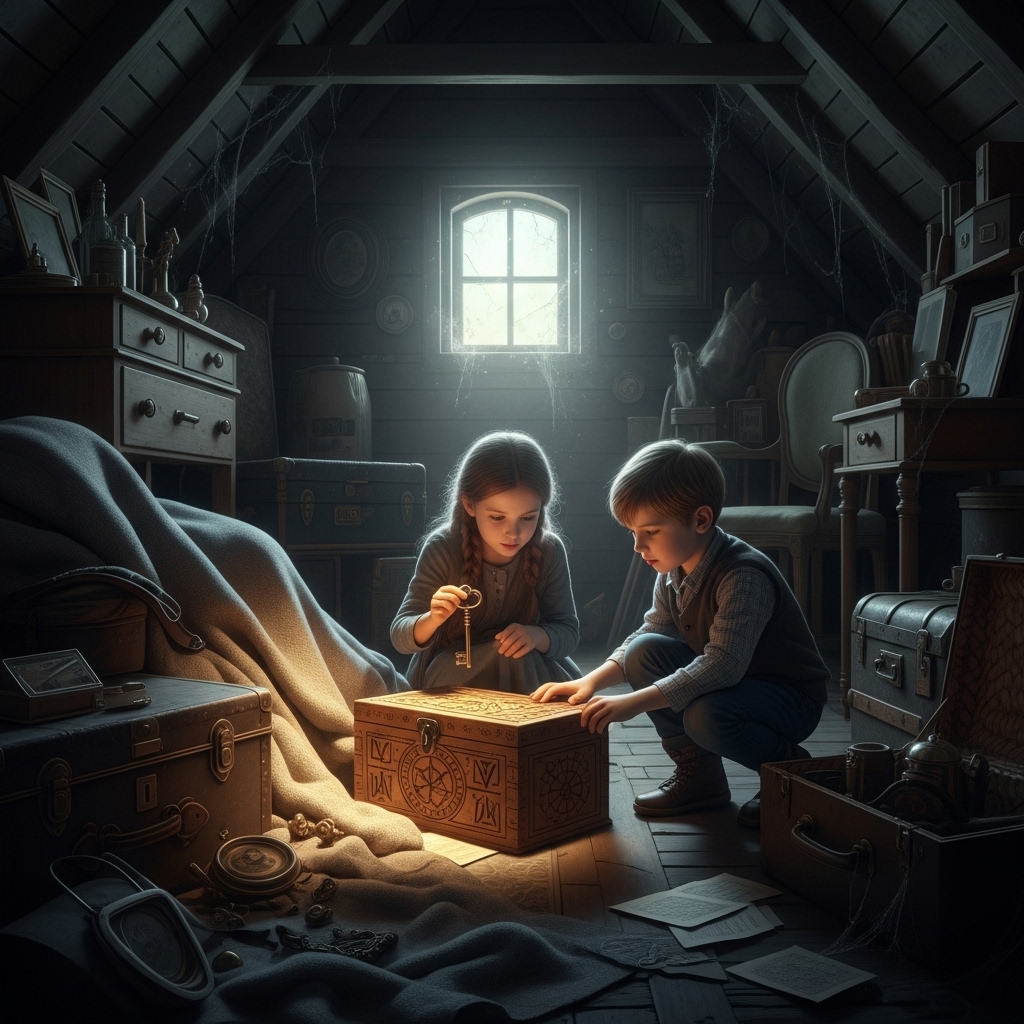
We lived in a big old house with my mom, dad, and Grandma Rose. Grandma lived upstairs in the rooms with the slanted ceilings. She was quiet most days, always knitting or reading old books. Mom said Grandma was tired from a long life, and we should let her rest. Dad just nodded and changed the subject whenever Grandma’s past came up.
I loved exploring the attic. It was full of dusty trunks, yellowed photographs, and forgotten toys. One rainy Saturday, while everyone was downstairs watching TV, I sneaked up there again. I had been hunting for Grandma’s old doll collection that Mom once mentioned.
In the far corner, behind a stack of boxes, I found a small wooden chest I had never seen before. It was locked with a tiny brass padlock. The wood was dark and smooth, like someone had touched it a thousand times. On the top, carved in careful letters, was a name: “Eleanor.”
That was strange. No one in our family was named Eleanor.
I carried the chest to my room and hid it under my bed. For days, I tried to open it. I used hairpins, paperclips, even a butter knife. Nothing worked. I started asking questions at dinner.
“Grandma, did we ever have anyone named Eleanor in the family?”
Grandma’s knitting needles stopped moving. She looked at Mom. Mom’s face went tight.
“No, dear,” Mom said quickly. “That’s not a family name. Where did you hear that?”
I lied and said from a school friend. But I saw the look they shared. Something was wrong.
A week later, I found the key. It was on a ribbon inside Grandma’s jewelry box when I was helping her tidy her room. The key was small and silver, shaped like a heart. Grandma was napping, so I took it.
That night, when the house was asleep, I opened the wooden chest.
Inside were letters—dozens of them, tied with faded blue ribbon. There were photographs too. A young woman with dark hair and bright eyes, holding a baby. On the back of one photo, in beautiful handwriting: “Eleanor and baby Lily, 1965.”
My name. But I was born in 2005.
My hands started shaking. I read the first letter.
“Dearest Eleanor,
I am sorry I cannot keep you with me. Mother and Father say it is for the best. You are too young, and the family name must stay clean. The home for girls will take good care of you and the baby. When you are older, perhaps things will change.
Forgive me.
Your sister, Rose”
Grandma Rose had written this. Grandma was Eleanor’s sister.
I read more. Eleanor was sixteen when she got pregnant. Her parents—my great-grandparents—sent her away to a home for unwed mothers. She had the baby—me, but not me. A different Lily. Eleanor wanted to keep her daughter, but the family forced her to give the baby up for adoption. Then they made Eleanor promise never to speak of it again.
The letters were from Eleanor to her sister Rose, begging for news of the baby. Rose wrote back at first, then less and less. The last letter was from Eleanor, twenty years later.
“I named her Lily after the flowers we picked as children. I wonder if she is happy. I wonder if she looks like me. Please, Rose, just tell me where she is. I will not cause trouble. I only want to know she is safe.”
There was no answer after that.
At the bottom of the chest was a small silver locket. Inside were two tiny photos: Eleanor young and smiling, and a baby with dark curls—baby Lily.
I sat on my floor until the sun came up, reading everything twice. My heart hurt in a way I could not name.
The next morning, I took the chest downstairs. Everyone was in the kitchen. I put it on the table.
Grandma saw it and went pale. Mom gasped. Dad looked confused.
“Where did you get that?” Mom whispered.
“From the attic,” I said. My voice was steady even though I was scared. “Why did no one tell me about Eleanor?”
Silence. Then Grandma started to cry—quiet, old tears that had waited too long.
Mom reached for the chest, but I pulled it back.
“She was your sister,” I said to Grandma. “And the baby was your niece. My… my aunt, I guess. You hid her like she was something bad.”
Grandma covered her face. “We were ashamed,” she said, voice breaking. “Mother and Father said if anyone knew, the family would be ruined. Eleanor was sent away. We were told never to speak her name again.”
Dad looked shocked. He had not known either. Mom admitted she found the box years ago but hid it again because it was “too painful.”
I opened the locket and showed them the pictures.
“This is family,” I said. “Hiding her doesn’t make her gone.”
That day changed everything.
Grandma told me the whole story over many afternoons. How Eleanor ran away from the home at seventeen and never came back. How the family searched for a while, then stopped. How Grandma kept the letters secret all her life, carrying the guilt.
We hired someone to search records. It took months, but we found her.
Eleanor was alive. She lived three states away, had married, had two sons. She had never stopped wondering about the baby she gave up.
I wrote her first. A simple letter: “My name is Lily. I am your great-niece. We found your box. We are sorry it took so long.”
She called the same day she got it. Her voice was warm and shaking. We talked for hours.
The next summer, she came to visit. She was older now, hair gray, but her eyes were the same as in the photographs. When she hugged Grandma, they both cried for a long time.
She met the Lily she had lost too—the one who had been adopted. That Lily was grown now, with children of her own. They met and talked and healed in their own way.
I learned that families can carry heavy secrets for generations. Sometimes the secrets are meant to protect, but they only hurt more over time.
Eleanor moved closer after that. She and Grandma spent their last years together, making up for all the missing ones. They planted lilies in the garden every spring.
And the wooden chest? It stays on the living room shelf now, open for anyone to see. No more locks. No more hiding.
Because the truth, even when it hurts at first, sets everyone free.