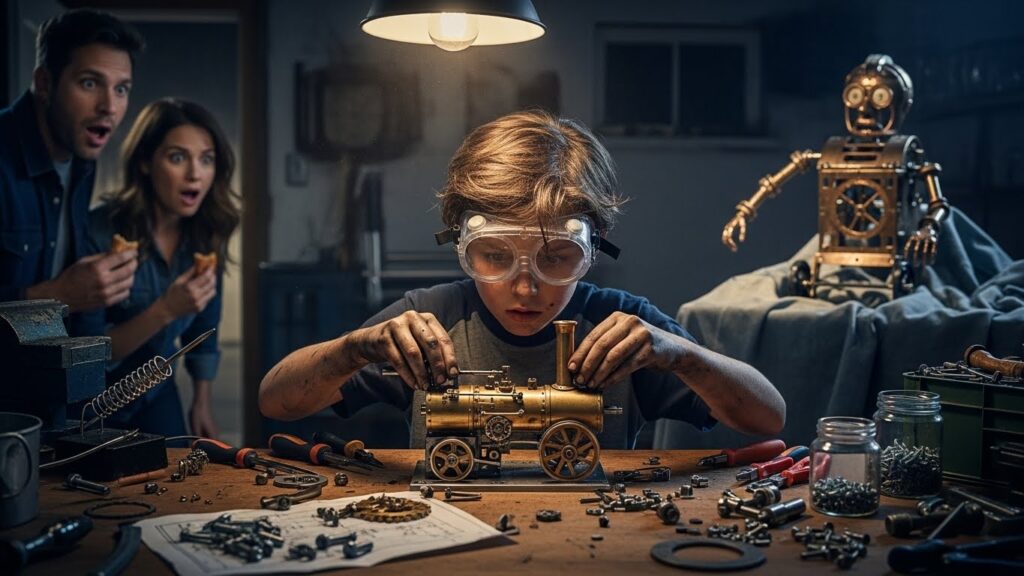
I always thought I knew my kid inside out.
I’m Dana, 42, mom to Ethan (now 12) and Lily (9). This happened when Ethan was 10, in late 2023 into 2024. We live in a quiet suburb outside Minneapolis — good schools, big backyards, the kind of place where kids still ride bikes until the streetlights come on.
Ethan has always been my quiet one. Introverted, observant, nose in a book or sketching in his notebook. He wasn’t into sports like the other boys — tried soccer once, hated it. No video games obsession. He liked building Lego sets and watching nature documentaries. Teachers said he was “gifted but shy.” We figured he’d grow up to be an artist or writer. Nothing wrong with that.
But he started acting… secretive.
In fall 2023, he’d disappear to his room right after school. Door closed — unusual for him. He’d emerge for dinner looking flushed, hair messy, eyes bright. When I’d ask, “What were you up to?” he’d shrug and say “Just homework” or “Playing.”
His room was always tidy — too tidy. Like he’d cleaned up fast before coming downstairs.
I chalked it up to pre-teen privacy. Knocked before entering, gave him space.
Then the packages started arriving.
Small Amazon boxes addressed to him — he’d ordered with his birthday gift cards. He’d intercept them at the door, mumble “Thanks,” and bolt upstairs.
I asked once: “What’d you get?”
“Art supplies,” he said quickly.
Okay. Fine. Creative kid.
The real discovery happened by accident in February 2024.
We had a carbon monoxide scare — detector went off at 2 AM. Fire department came, checked the house, said it was a faulty unit but advised fresh air and monitoring.
The next day, while the windows were open airing things out, I went into Ethan’s room to open his too.
His desk was pushed against the far wall, blocking part of the closet.
I moved it to get to the window — and saw the closet door was ajar.
Inside wasn’t clothes.
It was a full taxidermy workshop.
Shelves lined with small glass jars of borax, salt, alum. Tools: scalpels, forceps, pins, needles. A mini fridge humming quietly — inside, small animal specimens in plastic bags. Skins stretched on wooden boards. A completed squirrel mount on a driftwood base. A fox face in progress — eyes already inserted, glass ones staring back at me.
My heart stopped.
I sat on his bed, staring.
My 10-year-old son had secretly taught himself taxidermy.
I called my husband, Mark, home from work.
We waited for Ethan to get off the bus.
When he walked in, saw us in his room, his face went white.
“Mom… I can explain.”
He did.
For over a year, he’d been watching YouTube tutorials — channels by professional taxidermists teaching ethical small-animal preservation. Started with roadkill mice he found on bike rides (gloved, bagged, frozen). Moved to squirrels. Ordered supplies bit by bit so we wouldn’t notice big charges.
He wore gloves, mask, goggles. Froze specimens to kill parasites. Used borax to preserve. Studied anatomy books from the library.
He wasn’t hurting animals — swore on everything. Only ones already dead: roadkill, a neighbor’s cat that passed naturally and they let him have.
He said he loved making them “beautiful again.” Preserving them perfectly, like museum pieces. That it felt like art and science combined.
His voice shook: “Please don’t make me stop. It’s the only thing I’m really good at.”
We were stunned.
Part horrified — our sweet boy handling dead animals? In our house?
Part awed — the skill level was insane. The squirrel was flawless: fur glossy, pose natural, no visible seams. Better than some Etsy pieces I’d seen.
We didn’t yell.
We asked questions.
How did he learn safety? (He showed us detailed notes — sanitation protocols, disposal rules.)
Where did he put waste? (Sealed bags in outside trash right before pickup.)
Why hide it? (“Because I knew you’d think it was gross or weird.”)
He was right. My first instinct was “This isn’t normal.”
But then I watched him talk about it — eyes lighting up, explaining tannin solutions and eye placement like a pro.
This wasn’t a phase or morbid curiosity.
It was passion.
We set rules.
No more secrets. Full transparency. We’d oversee safety. Only ethical sources — no trapping, no buying online animals. Professional ventilation (we bought a fume hood for the garage). He’d take classes when old enough.
We moved the workshop to the garage — built him a proper station with lights, shelves, lockable cabinets.
He entered his squirrel in the state junior taxidermy competition (yes, that’s a thing) in fall 2024 — won first place in his age group.
Judges said his work was “exceptionally advanced.”
Now, at 12, he has a small Instagram (supervised by us) sharing his pieces — mostly birds and small mammals, all labeled “found deceased.” Thousands of followers. Messages from professional taxidermists offering mentorship.
He wants to study biology, maybe work in museum preservation.
Our family talks about it openly now. Some relatives are squeamish, others fascinated. Lily thinks it’s “cool but gross.”
We almost shut it down that day in his room — almost told him to find a “normal” hobby.
If we had, we’d have crushed the thing that makes him shine.
Instead, we leaned in.
Supported the weird.
And watched our quiet kid become confidently, unapologetically himself.
Parenting isn’t about making your child fit the mold.
Sometimes it’s about breaking the mold to fit your child.
Ethan’s secret hobby shocked us to our core.
But it also showed us who he really is.
And we couldn’t be prouder.
TL;DR: Discovered my 10-year-old son had secretly taught himself professional-level taxidermy in his closet using roadkill and online tutorials. After the initial shock, we supported his passion, moved his workshop to the garage, and watched him win competitions and find his true calling. The hidden hobby we almost shut down became the thing that makes him extraordinary.