I thought a community project would bring our street together. Instead, it dug up grudges we didn’t even know existed.
I’m Megan, 36 now. This happened in 2023–2024 on Willow Lane, a quiet cul-de-sac in a mid-sized Midwest town — 15 houses, mostly families, kids riding bikes, everyone waving. We’d lived here since 2018, knew most neighbors casually: backyard barbecues, trick-or-treating together, a loose email chain for snow-plowing schedules.
In spring 2023, the empty lot at the end of the street — overgrown, trash-strewn, owned by the city — became the talk.
A developer wanted to buy it for condos.
A group of us — me, my husband Alex, our next-door neighbors Tom and Lisa, the young couple across the street (Jake and Priya), and retired Mr. Ellis — started a petition to turn it into a community park instead.
Playground, benches, native plants, dog area.
We rallied the street.
Door-to-door flyers, group chat, town hall meeting.
Everyone signed — even grumpy Mrs. Harlan at number 12.
City approved a 12-month trial: we’d fundraise, build, maintain it ourselves.
We were thrilled.
Formed “Willow Lane Green Space Committee” — 10 of us.
Fundraisers: bake sales, GoFundMe (raised $18k), local business donations.
Volunteers for design, construction weekends.
Summer 2023: work began.
Clearing brush, leveling ground, installing playground equipment.
First sign of trouble: the tree.
A massive old oak — half-dead, leaning — right where the swings were planned.
Arborist said it was hazardous — needed removal.
Committee voted 8-2 to cut it down.
The two “no” votes: Mrs. Harlan and Mr. Ellis.
Mrs. Harlan claimed it was planted by her late husband in 1978 — “sentimental value.”
Mr. Ellis said it provided shade, habitat for birds.
We offered compromise: trim heavily, add swings elsewhere.
They refused.
Mrs. Harlan started a counter-petition: “Save the Heritage Oak.”
Got 40 signatures — mostly older residents off our street.
Accused us of “destroying history for plastic playgrounds.”
Mr. Ellis — who’d been our biggest cheerleader — flipped.
Stopped showing up to work days.
Posted on neighborhood Facebook: “Some people care more about their kids’ fun than preserving the past.”
The group chat turned toxic.
Messages like: “The tree is rotting — it’ll fall on a child!”
Vs. “You new people don’t respect what came before.”
(“New” meaning anyone under 60 or moved in after 2000.)
Then the real grudges surfaced.
During a heated committee meeting at my house, Mrs. Harlan dropped the bomb.
“The oak isn’t the issue. It’s that none of you cared when my husband died. No one brought meals. No one checked on me.”
Silence.
She’d lived alone 15 years — we’d waved, shoveled her walk sometimes, but yes… we hadn’t known her well.
Tom admitted: “We were new parents then. Overwhelmed.”
She: “I watched your kids grow up. You never invited me to a birthday.”
Mr. Ellis piled on: “And when my wife had cancer in 2015, the ‘old’ neighbors rallied. The new ones sent a card.”
Old vs. new.
The divide no one had named.
Long-timers (moved in 1980s–90s) vs. newcomers (post-2010).
Grudges from years ago: who didn’t help with snow removal in the blizzard of 2011, who let dogs poop without picking up in 2016, whose teenager partied loud in 2019.
All bubbling up now.
The project stalled.
Volunteers stopped showing.
Fundraiser money sat untouched.
City gave deadline: progress by spring 2024 or sell to developer.
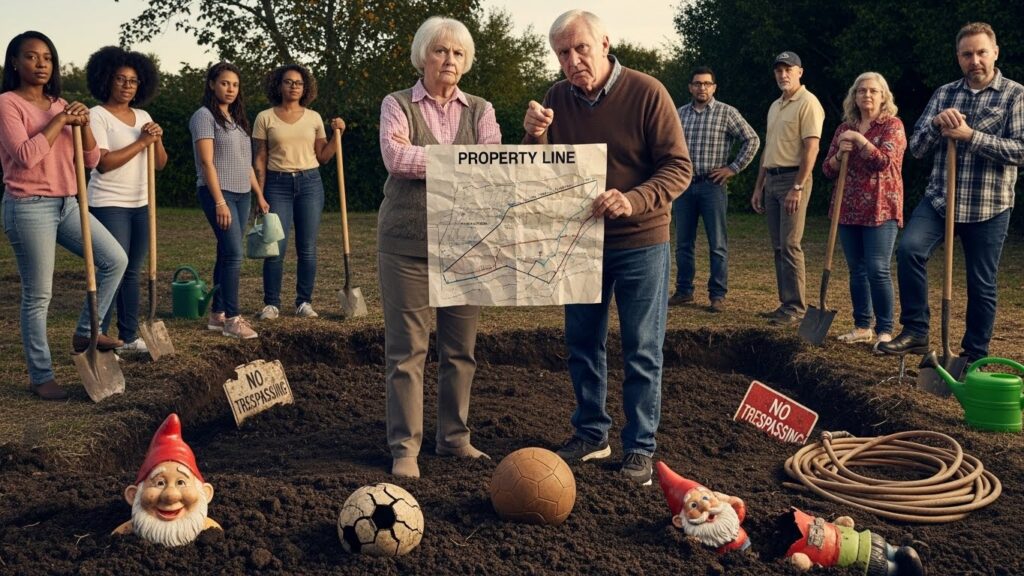
We tried mediation — picnic meeting, everyone air grievances.
Turned into shouting.
Mrs. Harlan to me: “You millennials think you can waltz in and change everything.”
I snapped back: “We’re trying to make it better for everyone — including you!”
Half the committee quit.
By fall 2023, only four of us left.
We pushed through alone — smaller playground, kept the tree (trimmed, fenced off).
Opened in May 2024 — modest, but nice.
Ribbon-cutting: 10 people showed.
No long-timers.
Mrs. Harlan put up a sign in her yard: “Murdered Oak Memorial.”
Mr. Ellis stopped waving.
The street fractured.
No more shared snow blowers.
Kids’ playdates segregated by “old” and “new” families.
Halloween 2024: half the houses didn’t turn on lights for certain kids.
Thanksgiving block party? Canceled.
The park sits mostly empty — newcomers use it, long-timers avoid.
City extended the trial — but no one cares anymore.
The community project didn’t expose hidden grudges.
It became the excuse to finally air them.
All the unspoken resentments — who felt overlooked, who felt overrun — poured out over a playground and a tree.
We thought we were building something for the kids.
Instead, we unearthed what adults had buried for decades.
And once out, it couldn’t be put back.
Willow Lane is still quiet.
But it’s not the same.
The swings creak in the wind.
No children laughing.
Just the old oak, still standing.
And neighbors who no longer speak.
All because we tried to make something beautiful together.
And learned some things are too broken to build on.
TL;DR: Neighborhood rallied to turn an empty lot into a community park. Disagreement over removing an old tree escalated into airing decades-old grudges between long-time residents and newcomers — who helped whom, who felt excluded. The project fractured the street into hostile camps, volunteers quit, traditions ended, and the once-friendly cul-de-sac became divided and silent.