Hello Readers, throwaway because some of my old friends still follow my main account. I’ve been carrying this for almost eight years now, and I finally need to say it out loud. This isn’t a story about dramatic revenge or a sudden epiphany. It’s about the slow, quiet realization that some wounds don’t heal just because years pass — and that waiting for time to fix something can be the biggest mistake you ever make..
I’m 34F now. Back in 2018, I was 26 and living what felt like the best chapter of my life. I had just moved to Portland with my fiancé, Nathan (28M at the time). We’d been together since college, five years of the kind of love people write songs about. We finished each other’s sentences, had a shared Spotify playlist that was basically our love language, and everyone said we were the couple most likely to make it.
We got engaged in spring 2018. Small proposal on a hike, just us, perfect ring he’d saved for. Wedding planning started immediately — nothing huge, maybe 80 guests, outdoor venue in Oregon wine country for fall 2019.
Then, four months before the wedding, everything shattered.
Nathan went on a bachelor weekend in Vegas with six of his oldest friends. I didn’t think twice about it — I trusted him completely. I had my own bachelorette in Seattle with my girls.
He came home Sunday night quiet, hungover, avoiding eye contact. I figured he’d just partied too hard. Monday he was distant. Tuesday he asked if we could “talk.”
He sat me down and told me he’d made “a terrible mistake.” He’d gotten black-out drunk, ended up in a club, and woke up in a hotel room with one of the strippers they’d hired for a private show. He swore it was only that one time, that he didn’t remember most of it, that he hated himself.
I don’t remember much of what happened next — just noise in my ears, throwing up in the bathroom, him crying and begging. I kicked him out that night.
The wedding was canceled. Deposits lost. Invites never sent. I moved into a studio alone. He moved back to his parents’ place two states away.
For the first year, I was destroyed. Therapy three times a week, antidepressants, couldn’t eat, lost 25 pounds. My friends and family rallied around me. Everyone said the same thing: “He’s garbage. You deserve better. Time will heal this.”
I clung to that idea like a life raft. Time will fix it. One day I’ll wake up and it won’t hurt anymore.
Nathan tried to reach out a few times — long apology emails, flowers on what would have been our wedding day, voicemails saying he was in therapy and would wait forever if that’s what it took. I never responded. Blocked him everywhere.
By 2020, the raw pain had dulled to a constant ache. I dated casually, moved apartments, got a promotion. I could talk about the engagement without crying. I told myself I was healing.
In 2022, a mutual friend told me Nathan had moved to Seattle, was in a serious relationship, seemed happy. It stung, but I thought, Good — I’m over it enough that I can wish him well.
I kept waiting for the day it would feel completely behind me.
It never came.
Last year, 2025, I turned 33. I’d been single for a couple years by choice — focusing on my career, traveling solo, building a life I genuinely loved. I bought a little house, adopted a dog, had a solid friend group. From the outside, I was thriving.
But every few months, something would trigger me. A song we loved would come on. I’d see a couple getting engaged on social media. I’d pass the venue we’d booked. And the pain would flood back — not just sadness, but rage, betrayal, grief for the future I’d lost.
I realized I wasn’t healed. I was just… managing.
The breaking point came in October 2025.
I was at a friend’s wedding — beautiful outdoor venue, string lights, wine country, almost identical to what ours would have been. I was a bridesmaid, happy for her, but halfway through the ceremony I had to excuse myself because I was having a full panic attack in the bathroom.
That night, alone in my hotel room, I finally admitted it to myself: Time hadn’t fixed this. Eight years later, I was still broken in a way I couldn’t patch over.
I started seeing a new therapist who specializes in betrayal trauma. The first session, she asked me what I wanted from healing. I cried and said, “I want to stop feeling like he stole my ability to trust love.”
She told me something that flipped everything: “Time doesn’t heal betrayal. Processed grief does. You’ve been waiting for the pain to expire, but it won’t until you actively work through it.”
I’d spent years avoiding the depth of it — avoiding Nathan’s apologies, avoiding the hard questions, avoiding dating anyone seriously because deep down I was terrified of being hurt again.
So I started the real work.
I wrote Nathan a letter — not to send, just for me. Every ugly feeling: the rage, the humiliation, the love I still had buried under it all. I read it out loud in therapy and burned it.
I started dating again, slowly, being brutally honest on first dates: “I was engaged once. He cheated weeks before the wedding. I’m still working through trust issues.” Some guys ran. A few stayed. One, in particular, has been patient and kind for the last four months.
I finally listened to Nathan’s last voicemail from years ago — the one I’d saved but never played. He didn’t make excuses. Just said he’d ruined the best thing in his life and would carry that regret forever. I deleted it after.
And most importantly, I stopped telling myself “I should be over this by now.”
Because here’s what I’ve learned: Some betrayals are so deep that “moving on” doesn’t mean the pain disappears. It means it stops controlling you.
I’m not fully there yet. Some days the scar tissue still aches. But I’m finally doing the work instead of waiting for time to magically erase it.
If you’re reading this and you’ve been telling yourself “time will fix it” about something — a breakup, a family rift, a loss — please don’t wait as long as I did. Time softens the edges, but it doesn’t do the repair work for you. Therapy, honesty, facing the feelings head-on — that’s what actually heals.
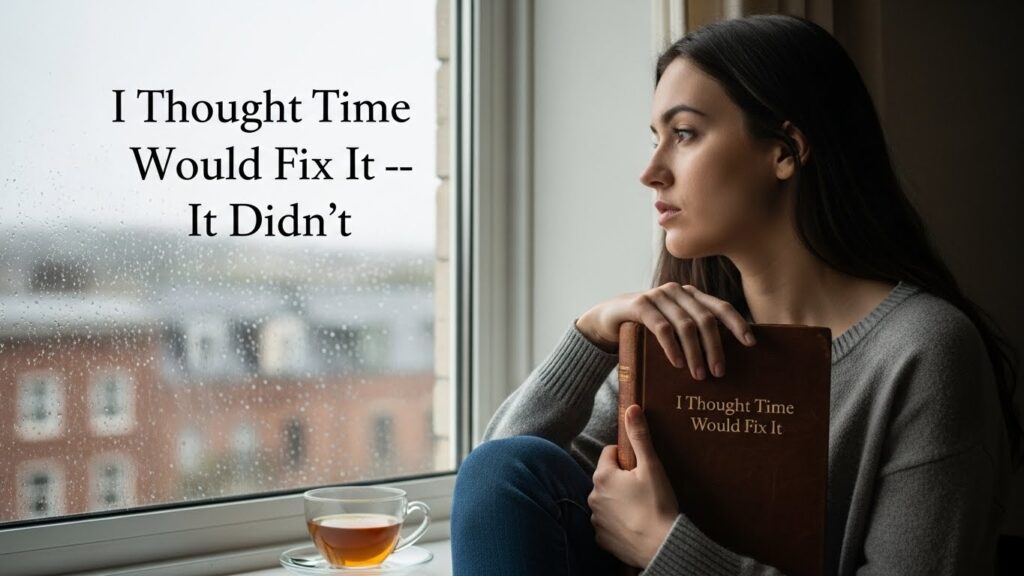
I thought time would fix it. It didn’t.
But I’m fixing it now, one painful, honest step at a time.
And for the first time in eight years, I believe I’ll get there.
Thanks for reading. I needed to say this somewhere.