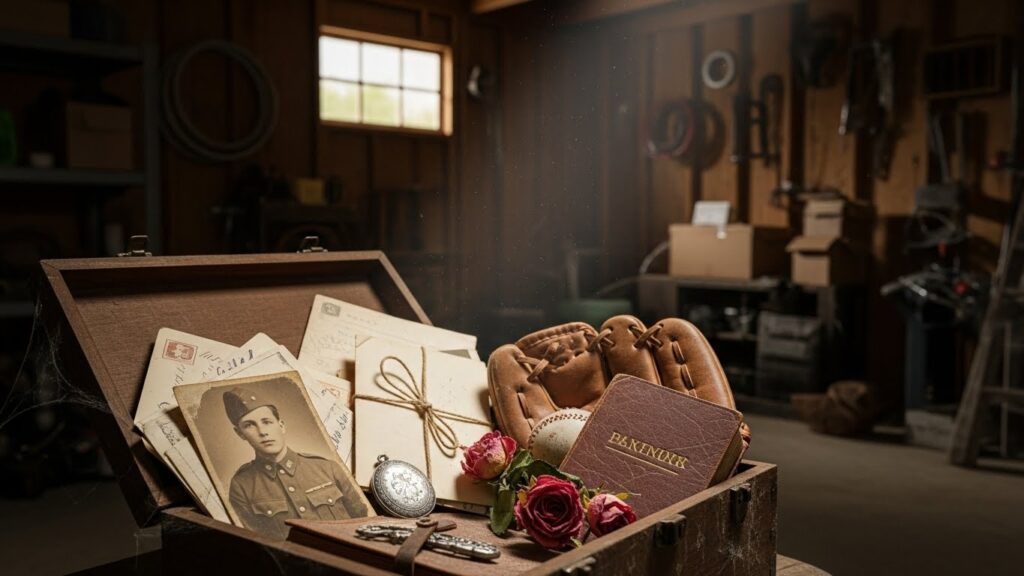
Hello Readers, throwaway because my family doesn’t know I found this yet. I’ve been sitting on it for five months, trying to figure out how to feel about it. In August 2025, while helping my parents clean out their garage for a move, I opened an old metal box my dad had always kept locked. Inside were things that finally explained why he’s been quiet my whole life—why he never talked about his childhood, why he flinched at loud voices, why he could sit for hours without saying a word. The box didn’t just hold papers. It held the reason he became the man he is.
I’m 35F, the older of two kids. My brother Luke is 32M. We grew up in a small town in central Pennsylvania—working-class, everyone knows everyone. Dad was a mechanic, owned his own shop, worked six days a week to keep us comfortable. Mom was a nurse. They’re still together, still quiet people who love each other in practical ways: coffee ready every morning, bills paid on time, hugs that linger a second longer than necessary.
Dad was always the silent type. Not cold—just quiet. He’d listen, nod, fix anything broken, but personal questions got short answers. “How was work?” — “Fine.” “What was your dad like?” — “He was a hard man.” End of discussion. We joked he had two volumes: low and off. He’d laugh at our teasing, but never explained.
I never pushed. I figured some people just are that way.
In July 2025, my parents decided to downsize—sell the big house we grew up in, move to a smaller place closer to Mom’s sister. They asked Luke and me to help sort 40 years of stuff. Luke came for a weekend; I stayed longer because I live closest.
We tackled the garage last—tools, holiday decorations, boxes of our old toys. Dad pointed out a gray metal lockbox on the top shelf, about the size of a shoebox. “That’s mine. Don’t need it anymore.”
It had always been there, locked, labeled “T. Reilly” in faded marker. I’d asked about it once as a kid; he’d said, “Just old papers,” and changed the subject.
The lock was rusted and snapped when I tugged it. Dad was inside the house, so I opened it.
Inside: a stack of yellowed envelopes, a small photo album, a folded American flag in a plastic case, and a thin manila folder.
The envelopes were letters—dozens—addressed to “Tommy Reilly” at a group home in Pittsburgh. Postmarks from 1978 to 1985. Written in a woman’s careful handwriting.
I opened one dated 1980.
“Dear Tommy,
I’m sorry I haven’t written in a while. Things are hard here. Your father drinks more now that I’m gone. I know you’re angry I left, but I couldn’t take the hitting anymore. I wanted to take you and your sister, but he said he’d kill me if I tried. The courts gave him custody because I had no money. I’m working two jobs to save for a lawyer. Please write back. I love you more than anything.
Mom”
My hands started shaking.
There were more—pleas for replies, updates about her life, promises to get him back. Some returned unopened, stamped “Recipient Refused.”
The photo album: pictures of a thin boy—Dad at maybe 8–14—bruises visible on his arms in some, black eye in one. Him with a younger sister. A woman who looked like him—my grandmother, I guess—smiling in early photos, then absent in later ones.
The folder: court papers.
Child services reports from 1977–1982. Allegations of physical abuse by the father—belts, punches, broken bones. Mom fled domestic violence in 1977, leaving Dad (then 11) and his sister (9) behind. Father got custody because Mom was “unstable.” Multiple removals to foster homes and group homes. Dad ran away twice. Sister placed permanently elsewhere at 14. Dad aged out at 18.
A final report, 1985: “Subject refuses contact with mother. States he has no family.”
The flag: a note from the VA. Dad’s father—my grandfather—died in 1992. Military funeral. Dad had claimed the flag.
I sat on the garage floor crying quietly.
Everything clicked.
Dad’s silence wasn’t personality. It was survival.
The flinch when voices rose—waiting for a hit. The long stares out the window—dissociating. The way he never talked about his parents—because one abandoned him, the other beat him. The way he worked himself to exhaustion—proving he’d never be powerless again. The gentle way he touched us—making sure we never felt what he did.
He’d built a safe life for us out of the wreckage of his own.
I closed the box, hands trembling. Put it back exactly as I found it.
That night at dinner, I watched him differently. He laughed at Luke’s joke, refilled Mom’s water without being asked, asked about my day.
I almost told him I knew.
But I didn’t.
A few weeks later, the move happened. Dad loaded the truck himself, same as always.
When it was done, he handed me the metal box.
“I don’t need this anymore,” he said. Voice steady. “You can throw it out, or keep it. Up to you.”
Our eyes met. He knew.
I hugged him—longer than usual.
“I’ll keep it safe, Dad.”
He nodded, eyes wet. “Some things are better left quiet.”
We haven’t talked about it since.
But he talks more now. Small things—stories about fixing cars when he was young, how he met Mom, what he hopes for his grandkids someday.
He’s still quiet. But the silence feels different now.
It’s not emptiness.
It’s peace he earned the hard way.
My dad’s old box in the garage explained his silence.
It wasn’t that he had nothing to say.
It was that he’d survived things no child should—and chose to protect us by never making us carry them.
I love him more now than I ever thought possible.
And I’ll keep his secret as long as he wants.
Because some stories aren’t meant to be told.
They’re meant to be outlived.
Thanks for reading. I needed to share this somewhere.