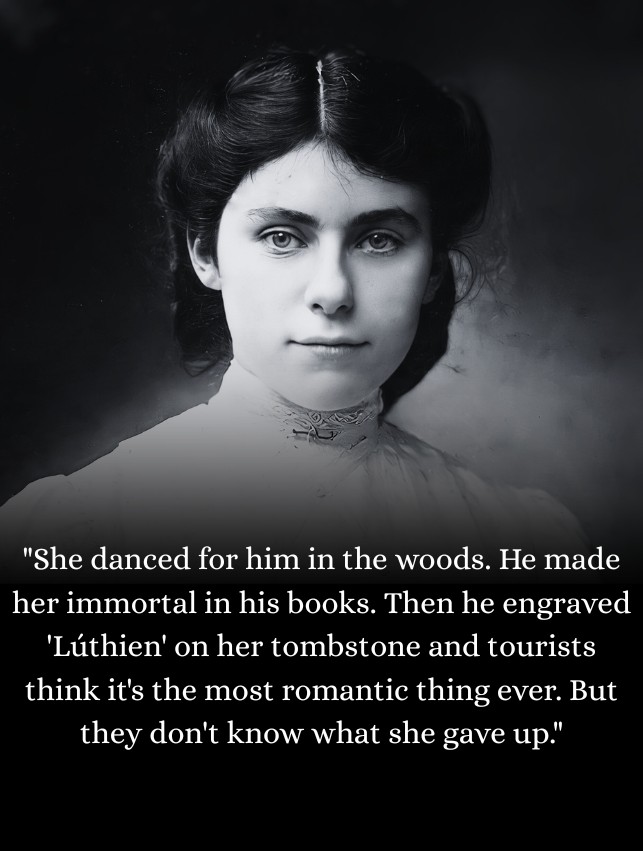
“She danced for him in the woods. He made her immortal in his books. Then he engraved ‘Lúthien’ on her tombstone—and tourists think it’s the most romantic thing ever. But they don’t know what she gave up. “Birmingham, 1908. Two orphans living in the same boarding house. Ronald Tolkien, 16, broke and brilliant, studying for Oxford on scholarship. Edith Bratt, 19, alone in the world, earning money giving piano lessons. They fell in love over tea and mischief—tossing sugar cubes into passing gentlemen’s hats from the balcony, laughing like children. For a year, they were inseparable. Then Father Francis Morgan, Tolkien’s guardian, found out. Morgan was horrified. Edith was older, Protestant, penniless—everything that could derail Tolkien’s academic future. He forbade them from seeing each other until Tolkien turned 21. No letters. No contact. Three years of silence.
Tolkien obeyed. Because defying his guardian meant losing his scholarship, his chance at Oxford, everything he’d worked for. Edith waited. For a while. By 1913, when Tolkien’s 21st birthday finally arrived, Edith was engaged to someone else. She’d assumed Tolkien had forgotten her. Moved on. Found someone appropriate. George Field was safe. Respectable. A farmer’s son who actually wrote to her. On the night of his birthday, Tolkien wrote to Edith. She replied that she was engaged. Tolkien traveled to see her immediately. He begged her to break the engagement. And somehow—against all reason—she did. They married in 1916. Tolkien was 24. Edith was 27.Four months later, he shipped out to the Battle of the Somme. That’s where the fairy tale should have ended—with him dying in the trenches like so many others. But Tolkien survived, traumatized and sick with trench fever, and returned to Edith. They built a life together. Four children. Academic jobs. Eventually, Middle-earth. But “happily ever after” is never the whole story. Edith converted to Catholicism before they married—Tolkien insisted on it. She did it for him. But it cost her. Her Protestant family disowned her.
Her friends abandoned her. She gave up her faith community, her support system, everything familiar, to become Catholic for a man who’d ignored her for three years. She never quite forgave the Church for what it demanded of her. The marriage was loving but lonely. Tolkien worked constantly—teaching, writing, building languages and mythologies in notebooks while Edith raised their children in small, drafty houses on a professor’s salary. She’d once been a talented pianist with dreams of performing. Marriage meant giving that up entirely. “I married Ronald,” she told a friend years later, “and he married his languages. “She wasn’t wrong. Tolkien disappeared into his writing—evenings, weekends, holidays. Middle-earth was always calling him away from the mundane work of parenting and marriage. Edith managed the household, dealt with the children’s illnesses, stretched the budget, while Ronald filled pages with elvish poetry. Sometimes she resented it. Of course she did.
She’d sacrificed her music, her faith, her independence. And for what? To watch her husband build imaginary worlds while she scrubbed floors? But she also understood him in ways no one else did. When Tolkien was invalided home from the war, suffering from what we’d now call PTSD, it was Edith who sat with him through nightmares. Who listened when he talked about the dead friends who inspired his stories. Who recognized that his writing wasn’t escapism—it was survival. In 1917, while recovering from trench fever, Tolkien took Edith on a walk through a small wood near their temporary home in Yorkshire. She danced for him among the hemlocks, her hair catching the light. Decades later, he wrote that image into The Silmarillion—the moment when the mortal hero Beren first sees the immortal elf Lúthien dancing in the forest. It’s a beautiful story. Romantic. Mythic. But here’s what Tolkien’s version leaves out: Edith was exhausted. They were living on borrowed money in temporary housing. She was pregnant with their second child. She was isolated from everyone she’d known before marriage, trapped in a new city with a traumatized husband and a toddler.
That dance wasn’t just romance. It was a moment of freedom in a life that had become very small. When Tolkien immortalized her as Lúthien—the most beautiful, powerful, beloved character in all his mythology—he was telling the truth. But he was also telling a story. The real Edith wasn’t an elf maiden. She was a woman who’d given up nearly everything for a man who loved her but was never fully present. Their marriage lasted 55 years. That’s extraordinary. But longevity isn’t the same as ease. Edith grew bitter about Tolkien’s Catholic devotion—the daily Mass, the prayers, the Church that had made her abandon her own faith. She felt left behind as his fame grew, as Oxford society celebrated him while she remained “Mrs. Tolkien,” invisible beside his brilliance. In the 1960s, after Tolkien retired, they moved to Bournemouth—Edith’s choice for once. She wanted to be near the sea, away from Oxford’s intellectual circles where she never felt she belonged. Tolkien hated it.
He was isolated from his friends, his colleagues, his world. But he went because after decades of prioritizing his work, he owed her that much. Edith died in 1971. She was 82.Tolkien had “Lúthien” engraved on her tombstone—the elf who chose mortal life for love, who died for her beloved and was resurrected through his devotion.It was beautiful. It was also incomplete. Because the real story wasn’t just about Tolkien’s love for Edith. It was about what Edith sacrificed—her music, her faith, her identity—to be loved by him. Lúthien chose mortality for Beren. Edith chose obscurity for Ronald. When Tolkien died in 1973, they added “Beren” to his side of the gravestone. The mortal hero beside his immortal beloved, finally reunited. Tourists visit that grave in Oxford and see proof of epic romance. And it was—but not in the way the mythology suggests. The truth is messier than Middle-earth. Edith wasn’t a perfect elf maiden. She was a complicated woman who resented her husband’s absences, mourned her lost music career, and spent decades feeling secondary to his genius. Tolkien wasn’t Beren the flawless hero. He was a traumatized veteran who disappeared into fantasy when reality overwhelmed him, who demanded religious conversion from his wife, who loved her deeply but often loved his work more. And yet they stayed. Through war, poverty, resentment, and loneliness, they stayed. That’s the real epic—not the mythology he built around her, but the daily choice to remain when leaving would have been easier. She danced in the woods in 1917. He made her immortal as Lúthien.
But Edith Tolkien was more than a muse. She was a woman who gave up everything—faith, music, independence—for a brilliant, difficult man who turned her into legend but sometimes forgot to see her as human. Their love was real. It was also hard. And maybe that’s more powerful than any fairy tale—the truth that great love requires sacrifice, forgiveness, and the courage to stay when the magic fades and all that’s left is two people choosing each other, again and again, despite everything. Every year, thousands of Tolkien fans visit that Oxford grave. They see “Beren” and “Lúthien” and sigh at the romance. They take photos. They post about true love. They quote the mythology. But how many know about the three years of silence? The forced conversion? The abandoned piano? The decades of loneliness while he wrote? How many know that the woman he immortalized spent much of her marriage feeling forgotten? Edith Tolkien deserves to be remembered not just as Lúthien—the perfect, immortal beloved—but as herself. A talented musician who never performed again. A Protestant who converted for love and never stopped resenting it. A woman who raised four children largely alone while her husband built worlds she’d never fully enter. A wife who stayed for 55 years, not because it was easy, but because she’d already sacrificed too much to leave. That’s not the fairy tale. But it’s the truth. And the truth is: she danced for him once in a forest, young and free and full of possibility. He wrote her into immortality. But immortality came at a price she paid alone.