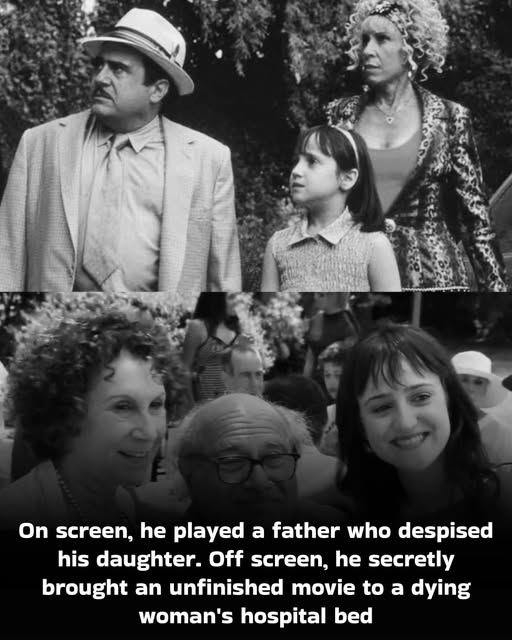
In 1996, Danny DeVito played one of cinema’s most despicable fathers in Matilda. His character, Harry Wormwood, treated his brilliant daughter like a nuisance—mocking her intelligence, ignoring her gifts, wishing she had never been born.
Behind the cameras, DeVito was doing the exact opposite.
The story begins in 1995, when eight-year-old Mara Wilson was cast as the lead in Matilda. DeVito, who was also directing the film, had seen her performances in Mrs. Doubtfire and Miracle on 34th Street. He believed she was perfect for the role of the telekinetic child genius who stands up to the cruel adults in her life.
Mara’s mother, Suzie Wilson, was thrilled. She had read Roald Dahl’s Matilda to her daughter and believed it featured exactly the kind of strong female character she wanted Mara to play. Suzie encouraged the audition. When Mara got the part, her mother was there on set, guiding her through five months of filming.
Then, on March 10, 1995, while production was still underway, Suzie received devastating news: she had been diagnosed with breast cancer.
Mara was eight years old.
The next months were a blur of chemotherapy, hospital visits, and uncertainty. Mara’s father took on the heavy responsibilities of caregiving. Production on Matilda continued, but the joy had been drained from it. Every scene, every take, was now shadowed by fear.
It was here that Danny DeVito and his wife, Rhea Perlman—who played Mara’s vile on-screen mother—stepped in.
They noticed that Mara’s father was stretched thin, shuttling between the hospital and the set. They saw that Mara needed normalcy, laughter, distraction from the terror of what was happening to her mother. And so, without fanfare or announcement, they became her surrogate family.
DeVito and Perlman invited Mara to their home. They took her to pool parties. They brought her to movies and plays. They made their house a refuge where an eight-year-old could, for a few hours at a time, forget that her mother was dying.
Years later, Mara wrote about this in her memoir, Where Am I Now?:
“It was very hard… and they were very nice. While my mom was sick and in the hospital, they would invite me over and take care of me and get my mind off things. I felt very familial.”
In interviews, she described DeVito as “like my favorite uncle.” The man who screamed at her on screen gave her a hug every single day before filming. The couple who played the worst parents in movie history were, in real life, among the kindest people she had ever known.
But that was only the beginning of the story.
Filming wrapped in early 1996. Post-production continued—editing, scoring, final touches. Suzie’s condition grew worse. She was now confined to a hospital bed.
Mara was terrified of one thing above all others: that her mother would die without ever seeing the finished film.
Matilda had been Suzie’s project as much as Mara’s. She had read the book to her daughter. She had encouraged the audition. She had been on set every day until she couldn’t be anymore. The film represented something precious—a collaboration between mother and daughter, a shared dream captured on screen.
On April 26, 1996, Suzie Wilson died. She was surrounded by family. Mara was devastated.
The film was released on August 2, 1996—four months after her mother’s death. When Mara saw the end credits, she noticed a simple dedication: “For Suzie.”
It was Danny DeVito’s idea. He had insisted on it. A final gift to a family he had come to love.
But Mara still carried a weight of grief. Her mother had never seen the finished movie. All that work, all that hope, and Suzie had missed the final result.
Years passed. Mara grew up. She left Hollywood, wrote about her experiences, built a new life. She and DeVito stayed in touch—pool parties gave way to occasional check-ins, a friendship that endured across decades.
Then, one day, DeVito told her something she had never known.
Before Suzie died, while she was still in the hospital, DeVito had visited her. And he hadn’t come empty-handed.
He had brought an unfinished cut of Matilda—the film wasn’t fully edited yet, but it was close enough—and he had played it for her. He had set up a screening in her hospital room so that a dying mother could watch her eight-year-old daughter star in the movie they had both dreamed about.
Suzie had seen Matilda. She had seen her daughter’s performance. She had known, before she died, that the project had worked—that Mara had become exactly the strong, brilliant character they had both wanted her to be.
DeVito had never told anyone. Not the press. Not even Mara. He had done it quietly, without expectation of recognition, because he believed a mother’s peace mattered more than anything else.
When Mara learned the truth, she was floored.
In her memoir, she wrote:
“I was floored when he told me he’d brought my mother the film while she was in the hospital. It hadn’t been fully edited, but she had been able to see what we had. I feel such a sense of peace knowing that, and I’ll always be grateful to Danny for it.”
Sometimes the most important acts of kindness are the ones no one knows about.
Danny DeVito could have publicized what he did. He could have turned it into a heartwarming story for the entertainment press. Instead, he kept it to himself for years—and only revealed it privately, to the one person it truly mattered to.
He wasn’t seeking credit. He was seeking comfort for a dying woman and peace for the little girl who would grow up without her.
Today, Mara Wilson and Danny DeVito remain close. In 2024, they reunited to perform Matilda live with a symphony orchestra—the movie projected on screen while DeVito narrated and the original cast joined in celebration. Nearly thirty years after filming, the bond endures.
If you watch Matilda now, knowing this story, the film takes on a different meaning.
Yes, Harry Wormwood is a monster. Yes, he treats his daughter with contempt. But the actor behind the monster was holding the real Matilda’s hand through the worst year of her life. He was inviting her to pool parties. He was sneaking an unfinished film into a hospital room so that a dying mother could see her child shine.
The credits still say “For Suzie.”
And now you know what that dedication really means.
Some people are heroes on screen. Some are heroes behind it. Danny DeVito managed to be both—and he never asked for anyone to notice.
That’s what makes it remarkable.