My name is Rachel, I’m 42 years old, and I live in Portland, Oregon. I take the city bus every morning to work, and like most regular riders, I’ve seen just about everything—arguments, kindness, indifference, and the occasional moment that reminds you how fast people judge each other.
This happened on a rainy Tuesday.
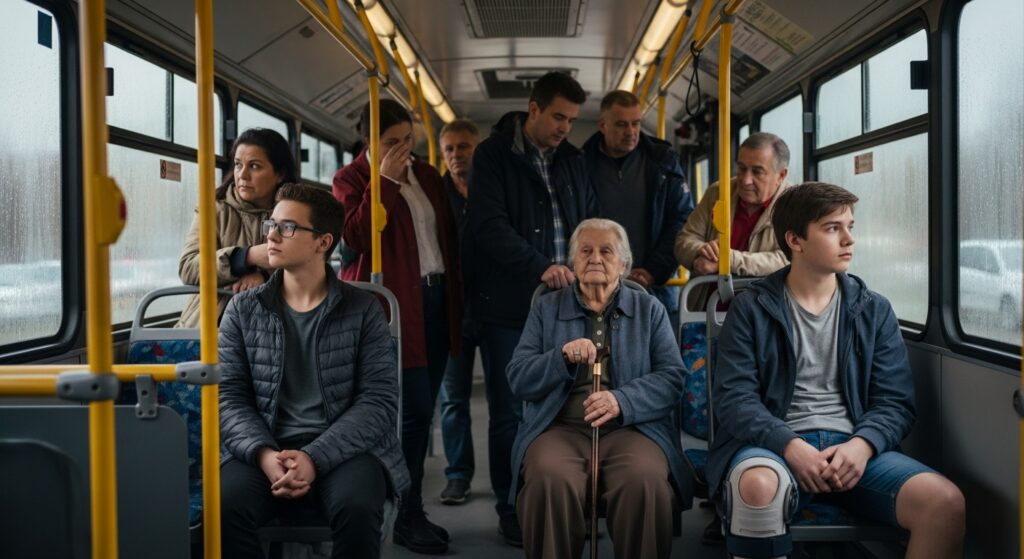
The bus was crowded, standing-room only, coats damp and moods impatient. At one stop, an elderly woman got on, leaning heavily on a cane. She scanned the aisle, clearly looking for a seat.
A teenage boy was sitting in the priority section, headphones on, hood up, staring at his phone.
Someone near the front snapped, “Hey, kid. Give her your seat.”
The boy didn’t move.
Another passenger chimed in louder, “You should be ashamed. That seat’s for her.”
The teen finally looked up. Calm. Tired. He shook his head and said, “I can’t.”
Groans rippled through the bus. A woman muttered something about “kids these days.” The driver glanced back but didn’t intervene yet.
The elderly woman stood silently, gripping the pole, looking embarrassed.
Then something unexpected happened.
The woman raised her voice—not angrily, but firmly. “Stop,” she said.
The bus quieted.
She looked directly at the teen and asked gently, “Why can’t you stand?”
The boy hesitated, then slowly rolled up his pant leg. His knee was wrapped in a thick medical brace, straps digging into swollen skin.
“I just got out of physical therapy,” he said. “I dislocated it last month. If I stand too long, it locks.”
The bus went completely silent.
Before anyone could react, the elderly woman turned—not toward him, but toward the rest of us.
“Shame on you,” she said. “You assumed instead of asking.”
Then she surprised everyone.
She turned to a man standing nearby, younger and perfectly steady, and tapped his arm. “You,” she said. “You look strong. Would you mind?”
He flushed, nodded immediately, and stood up without a word.
The woman sat down carefully, then looked back at the teen and smiled. “You did nothing wrong.”
The boy put his headphones back on, eyes fixed on his phone, but his shoulders relaxed just a little.
For the rest of the ride, no one said much. People stared out windows. A few avoided eye contact entirely.
When the teen got off at his stop, the elderly woman called out, “Take care of that knee.”
He smiled for the first time.
That moment stayed with me. Not because someone refused to give up a seat—but because of who spoke up, and how. The woman didn’t demand respect. She modeled it.
We talk a lot about courtesy in public spaces, but that morning reminded me of something more important: empathy starts with curiosity, not accusation.
Sometimes the most powerful lesson on a crowded bus doesn’t come from the loudest voice—but from the one that chooses understanding first.