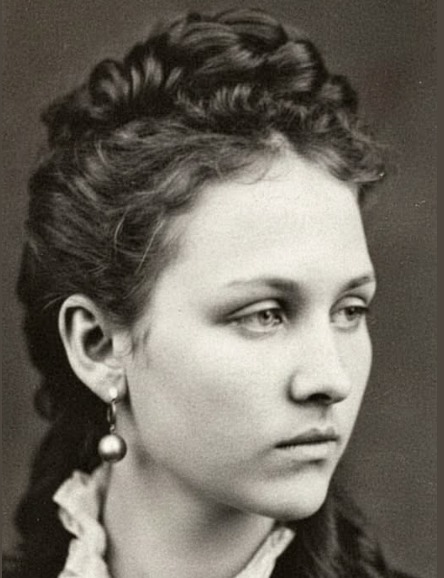
She was Jesse James’ first cousin, his wife, and the woman who buried him. Then history erased her—until now. Zerelda Amanda Mimms—everyone called her Zee—was born in 1845 into a world that would soon tear itself apart. She grew up alongside her cousin Jesse in Missouri, where families were close and the war was coming. When the Civil War exploded, it didn’t just divide the nation. It shattered families. Jesse joined the Confederate guerrillas at fifteen—riding with Bloody Bill Anderson, learning violence before he learned to shave. Zee waited. When the war ended, Jesse came home destroyed. Shot in the chest, physically broken, unable to surrender without risking execution. Zee nursed him back to health. Somewhere in those months—changing bandages, watching him heal, knowing what he’d become—she fell in love with the boy she’d known before the war swallowed him whole.
They courted quietly. Everyone knew Jesse and his brother Frank couldn’t live normal lives. The James brothers were already legends—bank robberies, train holdups, gunfights that made headlines across America. In 1874, Zee married him anyway. She knew exactly what she was choosing. Think about that. She married America’s most wanted outlaw. She married a man who couldn’t stay in one place, couldn’t use his real name, couldn’t promise he’d come home. She married him knowing every knock at the door could be the law. Or worse. They had two children: Jesse Jr. in 1875, Mary in 1879. Imagine raising babies while your husband is running from Pinkertons and bounty hunters. Imagine explaining to your son why daddy has different names in different towns. Why you move in the middle of the night. Why mommy jumps every time someone rides past. The Pinkerton Detective Agency firebombed the James family home in 1875, killing Jesse’s eight-year-old half-brother and blowing off their mother’s arm. That’s the world Zee lived in. That’s what it meant to love Jesse James. But here’s what history doesn’t tell you: Zee wasn’t weak. She wasn’t some helpless frontier wife wringing her hands. She kept the family together while Jesse was gone for months. She moved from town to town, creating new identities, new stories. She protected her children while living under aliases—Mrs. Howard, Mrs. Davis, whoever they needed to be to survive.
And she never broke. Never betrayed him. Never turned him in for the reward money that could have made her wealthy. By 1882, the pressure was unbearable. The gang was dead or scattered. Rewards for Jesse totaled tens of thousands of dollars—a fortune. Even his own men couldn’t be trusted. On April 3, 1882, Jesse was in his home in St. Joseph, Missouri, living as “Thomas Howard.” He was hanging a picture on the wall. Robert Ford—a man Jesse trusted, a man eating at his table—shot him in the back of the head. Jesse died instantly. At 34 years old. Zee heard the gunshot. Ran into the room. Found her husband dead on the floor while his killer stood there, gun still in hand. Ford had done it for the reward money and a pardon. Everything Zee had built—the fragile safety, the quiet life, the hope that maybe they’d survive this—ended in a single bullet. She was 36 years old. A widow with two young children and a name that would follow her forever. The world mourned Jesse James—the outlaw, the legend, the symbol of rebellion against Northern oppression or the cold-blooded killer, depending who you asked. Nobody asked what Zee lost. She lived for eighteen more years. Raised her children alone. Jesse Jr. became a lawyer. Mary became a teacher. They were good people who lived quiet, law-abiding lives—the opposite of their father.
Zee never remarried. Never stopped being Jesse James’ widow. Some say she still loved him. Some say the name was too heavy to escape. Some say she was loyal to a memory that wouldn’t let her go. She died in 1900 at age 55. Buried beside Jesse in Missouri. History remembers her as “Jesse James’ wife.” A footnote. A widow in black. But think about what she actually was: A woman who chose the hardest love imaginable. Who raised children in hiding. Who survived firebombings and manhunts and constant terror. Who held her family together while the world tried to tear it apart. Who watched the man she loved die violently, just like she always knew he would. And who kept going anyway. The history books are full of outlaws and gunfights and daring robberies. They’re full of men. But behind every famous outlaw was someone who stayed home. Who waited. Who raised children in the shadow of violence. Who loved someone the world called a monster and somehow survived the cost. Zee Mimms James lived 55 years. Only nine of them as Jesse’s wife. But those nine years defined everything that came after. She wasn’t a victim. She wasn’t a saint. She wasn’t passive. She was a woman who made impossible choices and lived with impossible consequences. And history barely remembers her name. How many women like Zee are buried in footnotes—women who lived entire lives in the shadows of famous men? Women who were stronger than anyone ever acknowledged, because strength doesn’t always look like guns and glory? Women who survived what history doesn’t bother to record? Zee James died in 1900. But she lived a life that demands to be told. Not as Jesse James’ wife. As Zerelda Amanda Mimms James. A woman who chose love over safety, loyalty over comfort, and survival over surrender. And who deserves more than a footnote.