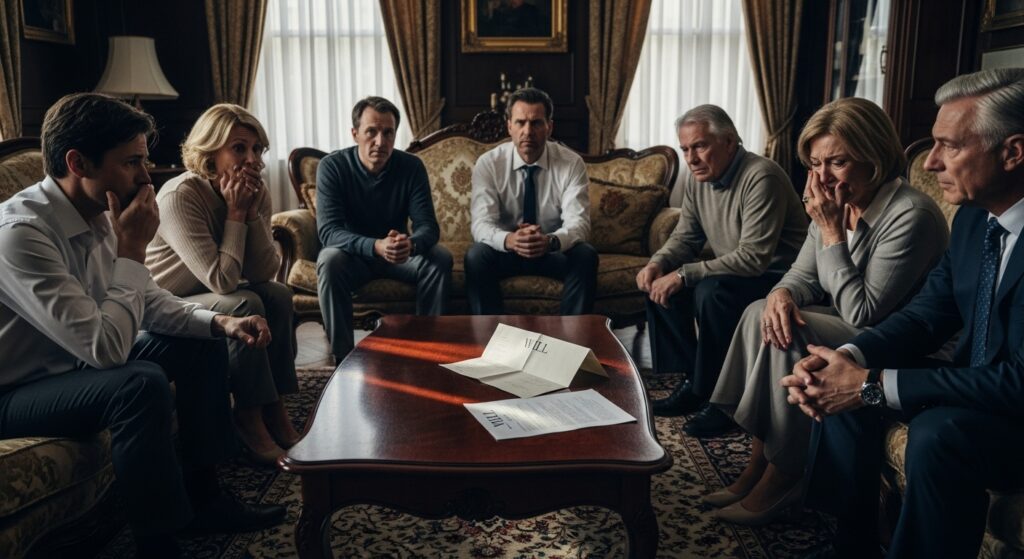
No one expected the reading of the will to change everything.
We gathered in the living room just days after the funeral. The house still smelled faintly of flowers. Family members sat close together, united by grief—or so it seemed. At that moment, we believed loss was the hardest thing we would face.
We were wrong.
The lawyer cleared his throat and began reading. At first, everything sounded normal. Assets listed. Accounts mentioned. Small personal items assigned. Heads nodded quietly around the room.
Then came the part no one was prepared for.
One family member was named as the primary beneficiary. Another was excluded entirely. Long-held assumptions about fairness and equality vanished in a few sentences.
The room shifted.
Someone asked if there had been a mistake. Another laughed nervously, assuming clarification would follow. It didn’t.
The lawyer explained calmly that the document was valid, updated recently, and legally binding. There would be no revisions. No discussions.
Voices rose almost immediately.
Old grievances surfaced—stories from years ago, moments that had once seemed insignificant now reinterpreted as proof of favoritism or betrayal. Every decision made in the past was suddenly on trial.
One sibling accused another of manipulation. Another claimed sacrifices had never been acknowledged. A quiet resentment, apparently shared by many, finally found its voice.
What hurt most wasn’t the money.
It was the realization that love had been measured, compared, and weighed behind closed doors. That relationships we thought were solid had been quietly eroding for years.
Within weeks, communication stopped. Family group chats went silent. Invitations were no longer extended. Holidays were split, then skipped entirely.
The inheritance was eventually distributed exactly as written.
But the family never recovered.
The divide wasn’t caused by the will itself—it was caused by what the will revealed. Long-standing tensions. Unspoken expectations. A belief that fairness was assumed instead of discussed.
Because when money enters grief, it doesn’t create conflict.
It exposes it.