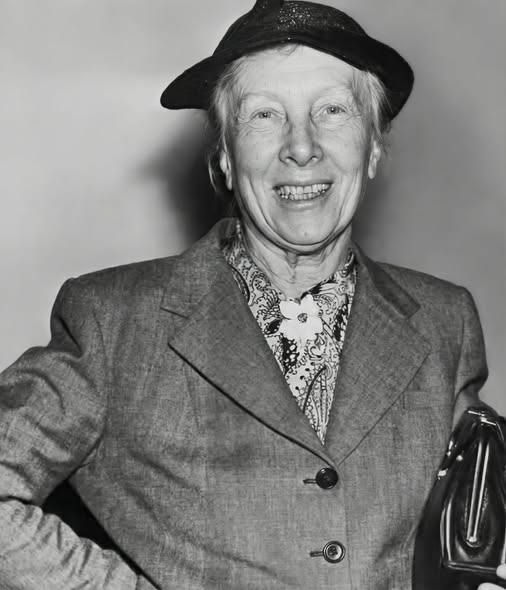
When Lillian Moller Gilbreth was born in 1878 in Oakland, California, no one expected her to change the way the world worked. She was the oldest of nine children in a Victorian household where daughters were prepared for marriage, not minds sharpened for science. Books fascinated her, questions poured out of her, but higher education was considered unnecessary—almost improper—for girls. She had to argue, insist, and quietly defy expectations just to be allowed into classrooms.
She won those battles one by one. In 1900, she stood before a crowd at the University of California, Berkeley, becoming the first woman ever permitted to speak at a commencement ceremony. It was only the beginning. She earned a master’s degree, then pushed further, into territory women were told did not belong to them. She earned a PhD in industrial psychology and engineering, a field dominated almost entirely by men who doubted her presence before she even opened her mouth.
In 1904, she married Frank Gilbreth. He had no formal education but possessed a sharp, practical brilliance and, more importantly, something rare for the time—he saw Lillian as his intellectual equal. They worked side by side, not as husband and helper, but as partners. Together, they became obsessed with a single idea: work did not have to be punishing to be productive.
They filmed workers with early motion picture cameras, studying every movement frame by frame. They broke labor down into its smallest components, identifying unnecessary strain, wasted motion, dangerous habits. They named these motions “therbligs,” spelling their name backward as a quiet signature. Their work transformed factories, hospitals, offices. Productivity rose. Injuries fell. People went home less exhausted.
But where Frank focused on speed, Lillian watched faces. She noticed slumped shoulders, tired eyes, aching backs. She asked questions no one else bothered to ask. Are people comfortable? Are they in pain? Does efficiency steal dignity, or can it restore it? She believed deeply that good design should ease human suffering, not ignore it.
Their reputation grew. Companies lined up for consultations. Books were published—often without her name on the cover, because publishers believed a woman author would damage credibility, even when she was the one with the doctorate. At home, they raised twelve children. Their household became a strange and loving experiment, where tooth brushing, dishwashing, and bed making were timed and refined. The children grew up laughing about it, eventually turning their childhood into the memoir Cheaper by the Dozen.
Then, in June 1924, everything stopped.
Frank died suddenly of a heart attack at fifty-five. Lillian was forty-six. Eleven of their children were still at home. The youngest was barely out of toddlerhood. Overnight, she lost her husband, her collaborator, her closest friend, and her primary source of income. The grief was crushing, but it was followed quickly by something colder.
Clients canceled contracts. Calls stopped coming. Companies that had praised “the Gilbreths” were unwilling to work with a woman alone. A widow. An engineer. A mother of eleven. In 1924, that combination was considered impossible.
Many would have folded under the weight of it. Lillian adjusted her grip instead.
If industry refused to see her as an engineer, she would go where they allowed women—and bring engineering with her. She turned her attention to homes, to kitchens, to the endless, invisible labor performed there every day. Work that exhausted women’s bodies without recognition, without optimization, without mercy.
She interviewed thousands of women. She watched how they cooked, cleaned, reached, bent, lifted. She discovered kitchens had been designed almost entirely by men who never used them. Countertops were too high or too low. Appliances were placed without logic. Movement was inefficient, painful, and draining.
So she redesigned the kitchen.
She created the L-shaped layout to minimize walking between sink, stove, and refrigerator. She studied counter heights and recommended variation to reduce back strain. She redesigned mixers, stoves, and can openers to make them safer and easier to use. She invented refrigerator door shelves—places for eggs, butter, milk—items used constantly, placed where hands naturally reached.
And then there was the trash can.
At the time, trash cans had lids lifted by hand. Lillian saw the problem immediately. Dirty hands touching food. Food hands touching garbage lids. Disease traveling silently through kitchens. Her solution was simple and brilliant: a foot pedal. Open the lid without using your hands. Cleaner. Faster. Safer. A tiny change that reshaped sanitation everywhere.
In 1929, she unveiled a fully ergonomic kitchen at a women’s exposition in New York. It became the blueprint for modern kitchen design. Suddenly, the world remembered her.
Her career surged again. She advised General Electric, Johnson & Johnson, Macy’s. President Hoover appointed her to a national committee during the Great Depression. During World War II, she helped optimize military production. At fifty-seven, she became the first female engineering professor at Purdue University.
She never slowed down. She worked into her eighties, lectured at MIT, consulted internationally, designed kitchens for people with disabilities, and continued refining the idea that good design was a moral act. She collected honors that once seemed unimaginable: election to the National Academy of Engineering, the Hoover Medal, more than twenty honorary degrees.
Lillian lived to ninety-three. She watched women gain the right to vote. She watched them enter professions she had been barred from. She watched her ideas quietly embed themselves into everyday life.
Today, when you open your refrigerator and reach into the door shelf, you are touching her work. When you step on a trash can pedal, when your kitchen layout saves you steps, when your counter doesn’t break your back, you are living inside her thinking.
Most people don’t know her name. They know a charming book about a big family. They don’t know the widowed mother of twelve who rebuilt her career from a kitchen when the world told her she no longer belonged.
Lillian Gilbreth believed efficiency should make life more human, not less. And without ever demanding recognition, she proved it—one small, thoughtful design at a time.