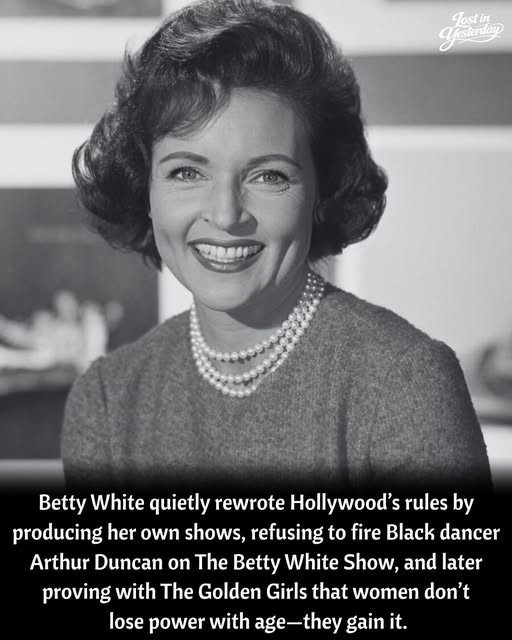
Betty White spent more than 80 years making America laugh—and quietly dismantling everything Hollywood thought women were allowed to be.
Long before she became the nation’s favorite grandmother, before she was crowned America’s sweetheart, Betty White was already a rebel.
In the 1940s and ’50s, when women were expected to wait for roles and stay grateful, she didn’t wait at all. She wrote. She produced. She controlled her own shows at a time when women weren’t even welcome in writers’ rooms.
While other actresses waited to be chosen, Betty White built her own power—armed with timing, intelligence, and a deceptively sweet smile.
Then came the moment that revealed exactly who she was.
In 1954, Betty starred in her own variety program, The Betty White Show. One of her regular performers was Arthur Duncan, a gifted Black tap dancer who lit up the screen.
The backlash came fast.
Letters poured in—especially from Southern stations—demanding that Duncan be removed. Networks applied pressure. Fire him or face consequences.
Betty White didn’t argue.
She didn’t negotiate.
She smiled and said, on television, “He stays.”
Then she gave him more airtime.
The show was canceled not long after.
Betty White didn’t flinch.
“You don’t quit,” she said later. “You just find another door.”
And she did—over and over again.
In the 1970s, she reemerged on The Mary Tyler Moore Show as Sue Ann Nivens, the syrupy TV homemaker whose sweetness concealed a razor-sharp wit.
Executives worried the character was “too mean.”
Betty’s response was simple:
“I’m not mean. I’m accurate.”
Sue Ann became iconic—proof that women could be charming and lethal at the same time.
Then came The Golden Girls.
Four women over fifty. Living together. Talking openly about sex, dating, aging, and friendship.
Networks hesitated. A show about older women? Who would watch?
Everyone did.
The series ran seven seasons, won multiple Emmys, and shattered the myth that women become invisible with age. Betty’s Rose Nylund—sweet, naïve, and secretly devastating—turned innocence into a weapon. Her comic timing was surgical.
And then, when most actresses her age had long vanished from screens, Betty White became more famous.
In 2010, at 88 years old, a grassroots campaign pushed NBC to let her host Saturday Night Live. She became the oldest host in history—and stole the show.
She nailed physical comedy. Delivered filthy jokes with grandmotherly charm. Reminded the world exactly why they loved her.
She kept working into her 90s.
Pulled long days.
Never complained.
Became a social-media icon without even trying.
Behind that gentle smile was steel.
Betty White didn’t survive sexism and ageism—she outsmarted them. She outlasted them. She refused to let them define her worth.
When she died on December 31, 2021, just weeks shy of her 100th birthday, the world mourned more than a comedian. It mourned a quiet revolutionary who hid courage inside kindness.
Her legacy isn’t just laughter—though she gave us plenty.
It’s standing firm without shouting.
It’s refusing injustice with grace.
It’s proving that women don’t lose power with age—they gain it.
Betty White showed generations that you don’t have to choose between being kind and being strong.
You can be both.
You can smile while refusing to back down.
You can change the world without ever losing your humor.
“You don’t quit,” she said. “You just find another door.”
Betty White found every door.
And walked through all of them—smiling, joking, and absolutely certain she belonged.
The world is quieter without her.
But infinitely funnier, kinder, and braver because she was here.