Katie was five years old and had never seen a single episode of Mister Rogers’ Neighborhood.
She knew it by sound.
The gentle music.
The trolley’s hum.
That steady, reassuring voice that felt like it was speaking just to her.
Katie was blind from birth, and the show was one of the few places where the world felt calm and understandable.
Except for one thing.
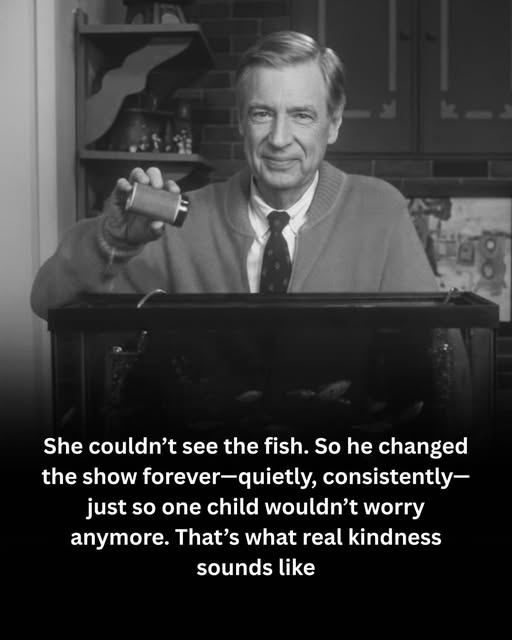
The fish.
Mister Rogers had a fish tank on his set. Katie knew that because sometimes he talked about it. Sometimes he didn’t. And when he didn’t, her mind filled in the silence.
Were the fish still there?
Did they get fed today?
Were they waiting?
Katie couldn’t see them swimming. Couldn’t see the food drop into the water. All she had was sound—and when there was no sound, she imagined the worst.
She worried until it hurt.
She worried until she cried.
So with her father’s help, she wrote a letter.
It was simple. Polite. Honest.
She asked Mister Rogers if he could please say when he fed the fish—because she couldn’t see it, and she needed to know.
At the bottom, her father added a quiet explanation:
Katie is blind. She becomes very upset when she doesn’t hear that the fish have been fed.
The letter reached Fred Rogers.
And instead of responding with sympathy…
He responded with change.
From that moment on, something subtle but permanent happened on the show.
Every time Fred Rogers fed the fish, he said it out loud.
“I’m feeding the fish.”
Not once.
Not as a special episode.
Not as a lesson about disability.
Every time. For years.
Sometimes he added gently,
“I have some friends who worry about the fish if I forget to say it.”
He never said Katie’s name.
He never explained why.
He never took credit.
He just quietly adjusted his world so one small child could rest easy.
That’s what made Fred Rogers different.
He didn’t see kindness as something performative. He didn’t wait for applause. He didn’t ask whether the need was common or rare, visible or invisible.
He noticed.
And then he acted.
Katie never saw him feed the fish.
But because of him, she always knew they were cared for.
And sometimes, that’s all inclusion really is—
three simple words, spoken out loud, so no one is left wondering in the dark.