US president meets NATO chief, expresses disappointment over member states failing to back war on Iran.
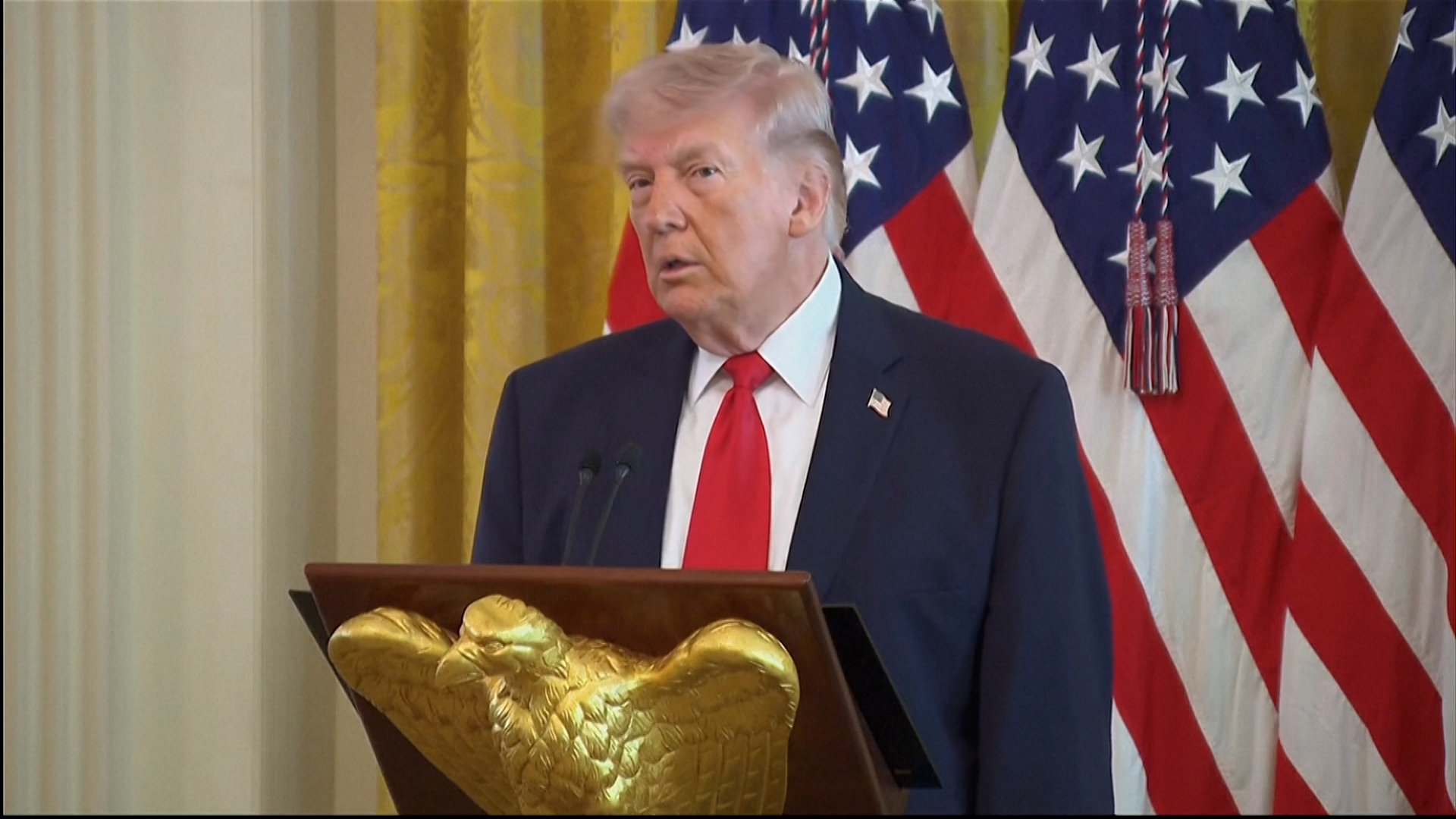
United States President Donald Trump has lashed out at NATO over its reluctance to join Washington’s war on Iran, and appeared to revive threats over Greenland, following a meeting with the alliance’s secretary-general.
Writing on his TruthSocial platform on Wednesday, Trump said in capitalised letters that “NATO wasn’t there when we needed them, and they won’t be there if we need them again”..

The remarks came after a two hour meeting with NATO’s Mark Rutte at the White House, a day after the US and Iran agreed to a ceasefire.
Ahead of the meeting, White House spokesperson Karoline Leavitt said that member states had “turned their backs on the American people”, who fund their nations’ defence. She said Trump would have a “very frank and candid conversation” with the NATO chief and quoted the US president as saying: “They were tested, and they failed.”
The rhetoric has raised seats in the West that Trump could move to withdraw the US from the transatlantic alliance, which he has repeatedly called a “paper tiger”. Several NATO members refused to open their airspace to US military aircraft or send naval forces to help reopen the Strait of Hormuz, a vital energy route that Iran has effectively closed.
Trump – following his meeting with Rutte – also appeared to revive his threat to seize Greenland from NATO member Denmark – a move had roiled the alliance before he launched his war on Iran
“Remember Greenland, that big, poorly run, piece of ice!!!”, he wrote.
Rutte, known in Europe as the “Trump whisperer” for his skill in maintaining a productive relationship with the US president, told the CNN broadcaster that Trump was “clearly disappointed with many NATO allies”.
Rutte said he had “very frank” and “very open” discussions with Trump during the meeting, and that while he understood the US president’s frustrations, he had pushed back against some of the broader criticism.
“I was also able to point to the fact that the large majority of European nations have been helpful, with basing, with logistics, with overflights, with making sure that they live up to the commitments,” Rutte said.
“What the US did with Iran, they could do because so many European countries lived up to those commitments. Not all of them, and I totally understand his disappointment about that, but it is, therefore, a nuanced picture,” he added.
Rutte also rejected the notion that NATO members considered the war on Iran “illegal”, arguing that there was widespread support in Europe for degrading Iran’s nuclear and ballistic missile capabilities. He also said that prolonged diplomacy risked a “North Korean moment” – where talks drag on until a country acquires nuclear capacity and it becomes too late to act.
The NATO chief declined to answer directly when asked multiple times if Trump had said he would leave the alliance.
NATO, which includes European countries, the US and Canada, was formed in 1949 to counter the Soviet Union and has been the cornerstone of the West’s security ever since.
The alliance has only activated its mutual defence clause on one occasion, following the September 2001 attacks on the World Trade Center in the US.
It was not clear what role Trump had expected it to play in the Middle East.
The Wall Street Journal, meanwhile, reported that Trump was looking at punishing some NATO members he believed were unhelpful during the conflict by moving US troops out of their countries.
The plan, reported by the Wall Street Journal, would fall short of Trump’s hinted threats to pull the US out of NATO entirely – a move for which he would need the approval of the US Congress.
Rutte did not answer directly when asked about that report.
“The large majority, including France, of European nations, has been doing what they committed before they will do in a case like this,” he said instead.
“So Europe, as a platform of power projection for the United States, was in full play over the last six weeks.”