PART 1
My name is Alex Rivera, and for almost two years I lived in a decent townhouse complex in Austin, Texas, where the walls were thinner than they should have been and common courtesy seemed to have died years ago. I work as a sound engineer for a local recording studio and value sleep more than most people. My job requires me to be sharp and creative during the day, so when my neighbor decided to make 3 a.m. his personal concert hour every single weekend, it became pure torture.
The neighbor’s name was Derek Vance — a 34-year-old wannabe DJ who lived directly behind me. Every Friday and Saturday night, without fail, at exactly 2:55 a.m., his bass-heavy EDM music would start thumping through the shared wall like a jackhammer. It wasn’t just loud. It was seismic. The bass frequencies were so deep and powerful that my picture frames rattled, my bed vibrated, and my dog hid under the couch shaking. I tried everything a reasonable person would do. I knocked on his door politely. I left notes. I texted him. I even offered to buy him headphones or help soundproof his place. Derek’s response was always the same: a smirk and “It’s not that loud, bro. You’re exaggerating.”
After six months of this, I was exhausted, irritable, and slowly losing my mind. I filed noise complaints with the police and the HOA. The police showed up a few times, told him to turn it down, but as soon as they left, the music crept back up within an hour. The HOA sent warnings that Derek ignored completely. He knew the system was slow and the fines were small. He enjoyed the power.
One particularly brutal Saturday night in July, when the temperature was still 92 degrees at midnight and I had an important client meeting the next morning, the music hit a new level. The bass was so intense it felt like someone was punching me in the chest every four seconds. At 3:47 a.m. I finally snapped.
I had been preparing for this moment for weeks.
PART 2
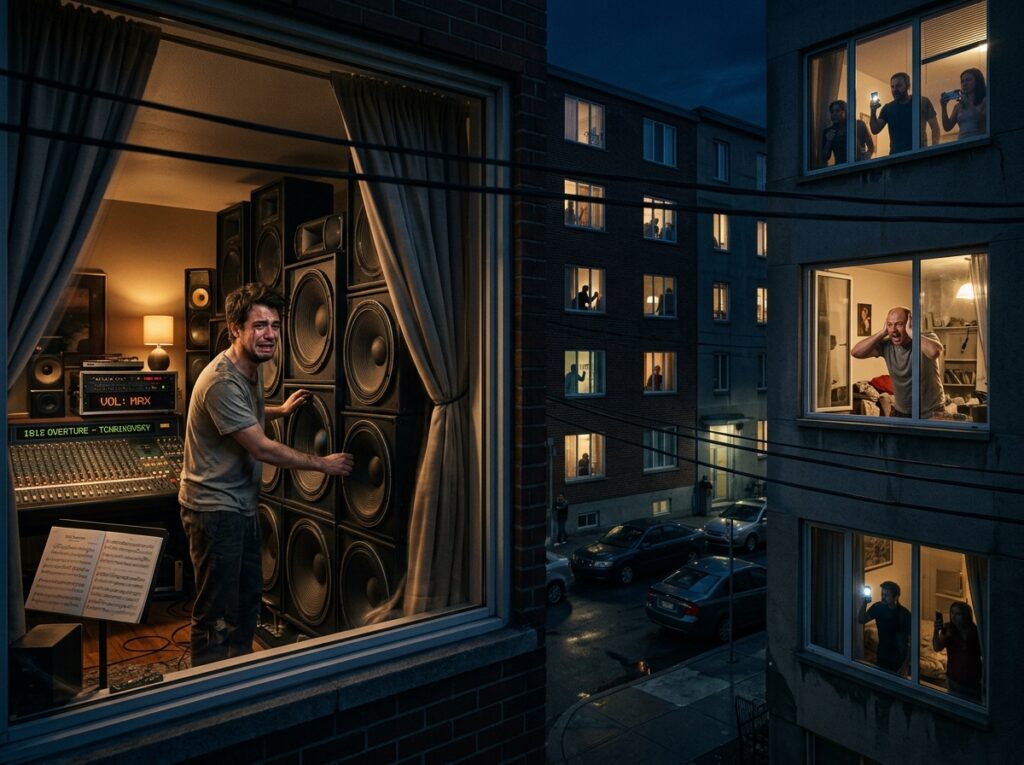
In my garage, I had quietly assembled what could only be described as a weapon of acoustic destruction. Two massive 18-inch subwoofers, custom-built, paired with high-powered amplifiers capable of producing clean, earth-shaking low frequencies at extreme volumes. As a sound engineer, I knew exactly how to weaponize sound. I also had a secret weapon: a high-quality recording of Tchaikovsky’s 1812 Overture — the version with real cannon fire at the finale.
I waited until the following weekend. Derek started his usual 3 a.m. rave. The walls began vibrating again. Instead of knocking on his door, I calmly set up my system in my backyard, aimed the subwoofers directly at the back wall of his townhouse, and waited for the perfect moment.
At 3:22 a.m., when his music reached a particularly loud drop, I hit play.
The opening notes of the 1812 Overture rolled out — deep, orchestral strings and brass. Then came the slow build. When the first massive cannon blast hit (recorded at near-concert levels), it shook the entire block. The low-frequency energy from my 18-inch subs traveled through the ground and walls like an earthquake. Derek’s music was completely drowned out and overpowered. Windows rattled. Car alarms started going off down the street. Dogs began barking wildly.
I let the full 15-minute piece play at maximum volume, ending with the thundering final cannon barrage that made the ground physically tremble. Then I turned everything off and waited in silence.
For the first time in nearly two years, Derek’s music stopped completely that night.
The next morning, he was at my door looking pale and furious. “What the hell was that last night? You woke up the entire neighborhood!”
I smiled calmly. “Funny. I’ve been saying the same thing to you for two years. How did it feel?”
He stormed off, but the message was clear. That weekend he turned his music down significantly. For a few weeks, things got better. Then, like clockwork, his ego returned and the volume crept back up.
That’s when I went full orchestral warfare.
PART 3
I upgraded my setup. I added four more 18-inch subs, positioned them in a line along the fence, and synchronized everything through a professional audio interface. I also installed outdoor weatherproof speakers for the higher frequencies. I created a playlist that started with soft classical music and built into the full 1812 Overture with real cannon recordings mixed in at chest-rattling levels. I timed it perfectly so it would start exactly when his music usually began.
The next Friday at 3 a.m., when Derek’s speakers started thumping again, I unleashed hell.
The entire neighborhood woke up to the dramatic swells of Tchaikovsky mixed with seismic bass that made windows flex in their frames. The cannon fire sounded like actual artillery going off in the backyard. At one point during the finale, the pressure waves were so strong that Derek’s own patio furniture vibrated across his deck.
This time, multiple neighbors came outside. Instead of being angry at me, they started cheering. People had been suffering from Derek’s noise for just as long as I had. One older couple even brought out lawn chairs to watch the “show.”
Derek finally burst out of his back door at 3:28 a.m., wearing only boxer shorts, holding his hands over his ears and screaming, “TURN IT OFF! PLEASE! I’LL STOP! I’LL STOP!”
I let the piece finish dramatically before turning my system off. The sudden silence was deafening.
The next day, Derek came over looking completely defeated. His eyes were bloodshot. He apologized — actually apologized — and promised to keep his music at reasonable levels from now on. He even offered to pay for some soundproofing for his own walls. The entire street had united against him, and he knew it.
From that night forward, the 3 a.m. parties stopped. If he ever played music late, it was quiet enough that you could barely hear it inside his own house. The neighborhood thanked me. Some people started calling me “The Conductor.”
Six months later, Derek moved out. The new neighbors are quiet, respectful, and actually friendly. I still have the subwoofer system, but now it’s only used for the occasional backyard movie night or Fourth of July parties — always ending before 11 p.m.
Sometimes the sweetest revenge isn’t about being louder forever. It’s about delivering one perfectly timed, earth-shaking, cannon-filled message that forces someone to finally understand what they’ve been doing to everyone else.
The 1812 Overture never sounded more satisfying.
The End