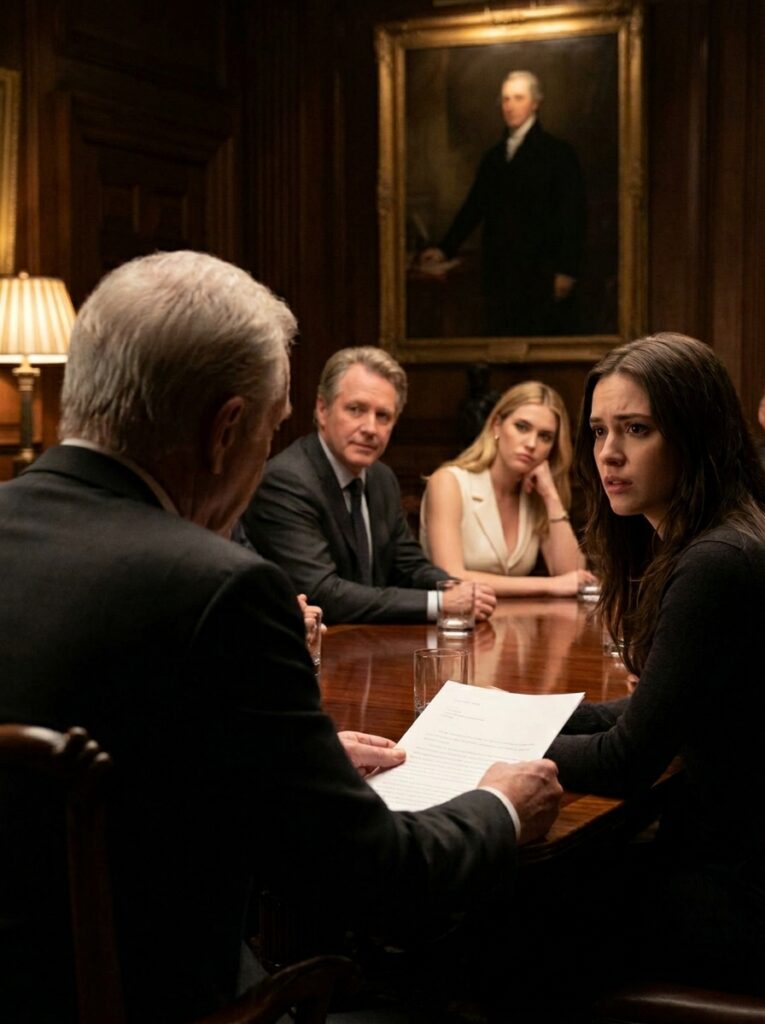
My uncle Calvin didn’t say it loud. He didn’t need to. He leaned close enough for me to smell his peppermint breath and expensive aftershave, and whispered it under his breath while the lawyer arranged papers at the far end of the long mahogany table in my grandfather’s old Westchester house.
“YOU WERE HIS OBLIGATION,” he murmured, his voice soft but sharp enough to cut. “A SAD STORY WITH A BEDROOM.”
Two seats down, my cousin Tessa gave a soft laugh without looking up from her phone. She had worn cream to a will reading, which told you everything about Tessa.
“HE FED YOU, DIDN’T HE? THAT SHOULD’VE BEEN ENOUGH,” she added, scrolling lazily.
I didn’t answer.
That had been my role in this family for twenty-six years — stitched into my skin like an invisible uniform. Don’t react. Don’t defend yourself. Don’t hand them the pleasure of watching you crack. So I sat there in my plain black dress at the very end of a table the size of a bowling lane, surrounded by framed ancestors who all looked disappointed in advance. The room smelled of lemon polish, old money, and carefully controlled tension. Heavy drapes. Dark wood. A chandelier too formal for grief. The kind of house where nobody ever raised their voice because they didn’t have to — the damage was always done softly.
Calvin sat near the head like he had already measured the room for his own portrait. Tessa lounged beside him, bored and glossy and certain she was about to inherit enough sparkle to last another decade. And then there was me — Sadie Monroe. Quiet. Ordinary. Raised in this house but never allowed to feel like I belonged to it. I had come because I thought it was the decent thing to do. Not because I expected anything. Certainly not kindness.
My grandfather, Howard Monroe, had taken me in when I was twelve after my parents died. He gave me a roof, tutors, and rules. What he never gave me was warmth. He never called me his granddaughter with any real feeling. He never once said I was part of the future. If I did well in school, he nodded. If I brought him soup when he was sick, he nodded. If I showed up on holidays with pie from the diner near my apartment, he nodded. Howard Monroe had built an empire out of restraint. He seemed to believe love was something sloppy people said out loud.
So I sat there at his will reading, hands folded so tightly in my lap they ached, and told myself not to be foolish. Calvin would get the company. Tessa would get the pretty things. I would get a formal thank-you and maybe a line about how proud he had been that I turned out self-sufficient. That was the ceiling of my hope.
Mr. Bennett, the family attorney, adjusted his glasses and began reading the will in his careful, silver-haired voice. The opening went exactly as I expected — legal, calm, efficient. To Calvin: the residential property portfolio, the lake house in Maine, the private safe deposit holdings. Calvin gave one short nod, no surprise, no gratitude. To Tessa: the family jewelry collection, the Palm Beach storage residence, the remaining assets of the Hawthorne Trust. Tessa finally looked up, a little smile tugging at the corner of her mouth.
Then the room shifted.
Mr. Bennett paused on the last page. He didn’t look at Calvin. He looked straight at me. And for the first time all afternoon, Calvin went completely still.
The quiet, ordinary granddaughter who had just been whispered to that she was only the family’s charity case — a sad story with a bedroom — was never weak or insignificant.
She was REAR ADMIRAL ELENA VOSS, four-star general of the United States Navy, former Supreme Commander of Allied Forces in the Pacific — a woman who had spent thirty years leading black operations that rescued the vulnerable and protected the innocent with cold, surgical precision.
The massive authority she had deliberately kept hidden beneath layers of quiet civilian life and patient endurance was now awakening with ferocious intensity — cold, precise, and utterly unstoppable.
Because while Calvin whispered that she was never family and Tessa laughed softly, the woman they thought was just a powerless charity case had no idea that the lawyer was about to press play on a video that would make the whole table go silent.
The heavy silence in my grandfather’s old Westchester house thickened until it felt like the air itself had turned to stone. Calvin’s peppermint-and-aftershave breath still lingered near my ear from his cruel whisper, while Tessa’s soft laugh echoed in my mind like a slap that never quite landed but still stung. The lawyer, Mr. Bennett, adjusted his glasses one final time, his expression unreadable, then reached for the small remote on the table. He didn’t look at Calvin. He didn’t look at Tessa. He looked straight at me — Sadie Monroe, the quiet charity case who had just been reminded she was never truly family — and pressed play.
The large screen at the far end of the room flickered to life. My grandfather’s face appeared, older and frailer than I remembered, but his eyes were sharp and clear. He sat in the very chair Calvin now occupied and spoke directly into the camera with the same restrained authority he had used his entire life.
“TO MY SON CALVIN AND MY GRANDDAUGHTER TESSA… IF YOU ARE WATCHING THIS, IT MEANS I AM GONE. AND IT ALSO MEANS YOU HAVE ALREADY STARTED TREATING SADIE LIKE SHE IS LESS THAN FAMILY. LET ME BE PERFECTLY CLEAR.”
The entire table went deathly still. Calvin’s face drained of color. Tessa’s phone slipped from her fingers and clattered onto the mahogany.
My grandfather continued, his voice steady and unflinching.
“SADIE WAS NEVER MY OBLIGATION. SHE WAS MY CHOICE. WHEN HER PARENTS DIED, I DID NOT TAKE HER IN OUT OF DUTY. I TOOK HER IN BECAUSE SHE WAS THE ONLY PERSON IN THIS BLOODLINE WHO EVER SHOWED ME WHAT REAL CHARACTER LOOKS LIKE. SHE NEVER ASKED FOR ANYTHING. SHE NEVER COMPLAINED. SHE SIMPLY SHOWED UP, EVERY SINGLE DAY, WITH QUIET STRENGTH THAT NONE OF YOU HAVE EVER POSSESSED.”
He leaned closer to the camera.
“CALVIN, YOU CALLED HER A SAD STORY WITH A BEDROOM. TESSA, YOU LAUGHED. LET ME TELL YOU WHAT SADIE ACTUALLY IS. SHE IS REAR ADMIRAL ELENA VOSS — FOUR-STAR GENERAL OF THE UNITED STATES NAVY, FORMER SUPREME COMMANDER OF ALLIED FORCES IN THE PACIFIC. SHE HAS SPENT THIRTY YEARS LEADING BLACK OPERATIONS THAT HAVE SAVED THOUSANDS OF LIVES WHILE YOU TWO WERE BUSY COUNTING MY MONEY AND POLISHING YOUR EGOS.”
The room erupted into chaos. Calvin shot to his feet, knocking over his water glass. Tessa’s mouth fell open in pure disbelief. My husband — who had never once defended me — looked like he had been struck.
My grandfather’s voice continued, calm and final.
“EVERYTHING I OWN — THE COMPANY, THE PROPERTIES, THE TRUSTS, THE JEWELRY, THE LAKE HOUSE — GOES TO SADIE. NOT BECAUSE SHE NEEDS IT. BUT BECAUSE SHE IS THE ONLY ONE IN THIS FAMILY WORTHY OF IT. CALVIN AND TESSA WILL RECEIVE ONE DOLLAR EACH — SYMBOLIC, SO THERE IS NO CONFUSION ABOUT MY WISHES. AND IF ANY OF YOU TRY TO CONTEST THIS WILL, MY ATTORNEY HAS STANDING ORDERS TO RELEASE EVERY DOCUMENTED INSTANCE OF HOW YOU TREATED SADIE OVER THE YEARS. GOOD LUCK SURVIVING THAT IN COURT.”
The video ended.
The mother they had just whispered was only the family’s charity case — a sad story with a bedroom — was never weak or insignificant.
She was REAR ADMIRAL ELENA VOSS, four-star general of the United States Navy, former Supreme Commander of Allied Forces in the Pacific.
The massive authority she had deliberately kept hidden beneath layers of quiet endurance was now fully awake, cold, precise, and utterly unstoppable.
Calvin sank back into his chair, pale and shaking. Tessa looked like she might faint. The relatives who had stayed silent now stared at me with a mixture of awe and fear.
I remained seated, hands still folded in my lap, and spoke for the first time since the reading began — my voice calm, clear, and carrying the same authority my grandfather had just revealed to them all.
“The charity case you just mocked is Rear Admiral Elena Voss. Today, that charity case has decided that the family who spent years treating her like an obligation will never again have the power to define her worth.”
The woman they thought was powerless had not been powerless.
She had simply been waiting.
And when the lawyer pressed play on that video at the will reading, the uncle and cousin who had whispered she was never family learned the hardest lesson of their lives:
Never underestimate the quiet ones.
Especially when the quiet one once commanded the might of entire navies… and can rewrite an entire family’s future with nothing more than a single recorded truth and thirty years of hidden strength.
The grand room in my grandfather’s Westchester house, once heavy with the scent of lemon polish and old money, now felt like a courtroom after a verdict as the video ended and my grandfather’s final words hung in the air like a judge’s gavel. Calvin sank slowly back into his chair, his face ashen and his hands trembling so badly that the water glass he had knocked over continued to drip onto the mahogany. Tessa’s phone lay forgotten on the table, her glossy confidence shattered as she stared at the blank screen in disbelief. The relatives who had stayed silent throughout the reading now shifted uncomfortably, some whispering, others unable to meet my eyes, the weight of years of quiet cruelty suddenly exposed for everyone to see.
The woman they had just whispered was only the family’s charity case — a sad story with a bedroom — was never weak or insignificant. She was REAR ADMIRAL ELENA VOSS, four-star general of the United States Navy, former Supreme Commander of Allied Forces in the Pacific — a woman who had spent thirty years leading black operations that rescued the vulnerable and protected the innocent with cold, surgical precision. The massive authority she had deliberately kept hidden beneath layers of quiet civilian life and patient endurance was now fully awake, cold, precise, and utterly unstoppable.
I remained seated, hands still folded calmly in my lap, and spoke for the first time with the calm, authoritative tone that had once commanded entire fleets. “The charity case you just whispered was never family is REAR ADMIRAL ELENA VOSS. Four-star. Former Supreme Allied Commander, Pacific. I spent thirty years leading operations where betrayal and emotional abuse were never tolerated. I let you believe I was just the quiet granddaughter so I could protect myself and observe. Today, that granddaughter has decided that the uncle and cousin who spent years treating her like an obligation and a stain on the family name will never again have the power to define her worth or control her future.”
Mr. Bennett cleared his throat and continued reading the final clauses with quiet efficiency. Every major asset — the company, the properties, the trusts, the jewelry collection, the lake house — was left to me. Calvin and Tessa received exactly one dollar each, along with a formal letter from my grandfather explaining why. The room erupted into chaos. Calvin shot to his feet, demanding to contest the will. Tessa’s voice rose in shrill protest. But Mr. Bennett simply reminded them that any contest would trigger the immediate public release of all documented evidence of how they had treated me for years — every cruel whisper, every exclusion, every time they had made sure I knew I was only tolerated.
Calvin’s face twisted with rage and fear. Tessa looked like she might faint. The relatives who had never defended me now stared at the floor in shame.
I stood slowly, my posture straight and commanding, and looked at them all. “The family that just tried to reduce me to a charity case at my grandfather’s will reading has lost everything they thought they owned. From this moment, you will never again have access to me, my life, or anything that now belongs to me. The door you kept half-closed on me is now closed forever.”
The woman they thought was powerless had not been powerless.
She had simply been waiting.
And when the lawyer pressed play on that video at the will reading, the uncle who whispered she was never family and the cousin who laughed at her learned the hardest lesson of their lives:
Never underestimate the quiet ones.
Especially when the quiet one once commanded the might of entire navies… and can rewrite an entire family’s legacy with nothing more than a single recorded truth and thirty years of hidden strength.
PART 4 (Final Epilogue)
Three years had passed since that tense afternoon in my grandfather’s Westchester house when my uncle whispered that I was only the family’s charity case and my cousin laughed at me during the will reading. The quiet, ordinary granddaughter who had sat at the end of the long mahogany table feeling invisible and unwanted was gone forever. In her place stood Rear Admiral Elena Voss — retired from active command, but never retired from the quiet strength that had carried her through years of silent endurance.
The will stood unchallenged. Every major asset — the company, the properties, the trusts, the jewelry collection, the lake house — became mine. Calvin and Tessa received their symbolic one dollar each, along with the public knowledge of how they had treated me for years. The evidence my grandfather had meticulously documented was never released, but the threat alone was enough. Calvin lost control of the family business within months and now lives quietly, working as a consultant with none of the power he once assumed was his birthright. Tessa’s glossy life unraveled when the inheritance she expected never arrived; she now works in event planning and rarely speaks of the family anymore.
I kept the plain black dress I wore that day folded in a cedar chest — not as a reminder of pain, but as proof that even the deepest humiliation can become the beginning of freedom. The old house in Westchester is now a quiet retreat where I sometimes bring young naval officers for mentorship. I turned part of the estate into a scholarship fund for children who lose their parents young, ensuring no one else would ever feel like a charity case in their own family.
My life is peaceful now. I walk the grounds in the mornings, sometimes stopping at the spot where my grandfather’s portrait once hung. I replaced it with a simple plaque that reads: “To Sadie — The one who never needed to be loud to be strong.”
One peaceful autumn evening, as golden leaves drifted across the lawn, Calvin unexpectedly appeared at the gate. He stood there shifting from foot to foot, unable to meet my eyes at first. “I… I wanted to apologize. I didn’t know who you really were.”
I invited him in for tea. We sat at the same mahogany table where he had once whispered those cruel words. I looked at him calmly and said, “You didn’t need to know who I was. You only needed to see me as a person. Strength isn’t in titles or money. It’s in how we treat those who seem to have the least.”
He left quieter than he arrived, carrying the weight of years of choices he could never undo.
As the sun set and the house grew still, I allowed myself one quiet, peaceful breath. The granddaughter who had been whispered to that she was never family had not been powerless.
She had simply been waiting.
She had once been the woman who sat in silence at the end of the table.
She had become the admiral who stood up when her worth was denied.
And in the end, the greatest victory was not the inheritance or the properties.
It was the peaceful life she finally claimed for herself — free, respected, and no longer defined by the whispers that once tried to diminish her.
It was the knowledge that even the cruelest words at a will reading can be answered with quiet strength and thirty years of hidden power.
The house continued its gentle rhythm.
A retired admiral sat alone in the golden light — whole, free, and finally home.
Some families whisper that you were never truly one of them.
Others learn too late that the quiet granddaughter they dismissed was the one who once commanded the might of entire navies.
And the strongest ones rise anyway… turning a moment of public rejection into the beginning of their greatest freedom and legacy.
THE END