That’s what I told myself in the parking lot, heater blasting, coffee cooling in my hands. The animal shelter felt full of quiet, everyday strain — the kind people don’t post about. Folks walking in with stiff shoulders. Eyes a little too tired. I had rehearsed my plan the whole drive: pick a kitten. Bright eyes, tiny paws, no history. A clean start for both of us. Because my life lately felt like one long week that never ended. Work was a treadmill. My phone buzzed with reminders and responsibilities. I didn’t want one more heavy thing to carry. I wanted something light. Something easy to love.
Inside, it smelled like clean floors and old blankets. A volunteer at the desk smiled — kind, calm, the way people get after they’ve seen a hundred different heartbreaks and learned to hold steady anyway. “First time?” she asked. “Yeah,” I said. “I’m thinking… a kitten.” She nodded. “Kittens are that way. Adults are down this row.” I followed the KITTENS sign like it was a lifeline.
There they were — little faces popping up, tiny mews, paws batting at toys. Cute chaos. The kind of scene that makes you believe the world is mostly good, if you don’t look too hard. I was about to tell the volunteer, “This one,” when I heard a soft sound behind me. Not a meow. Not scratching. Just a small, deliberate thump.
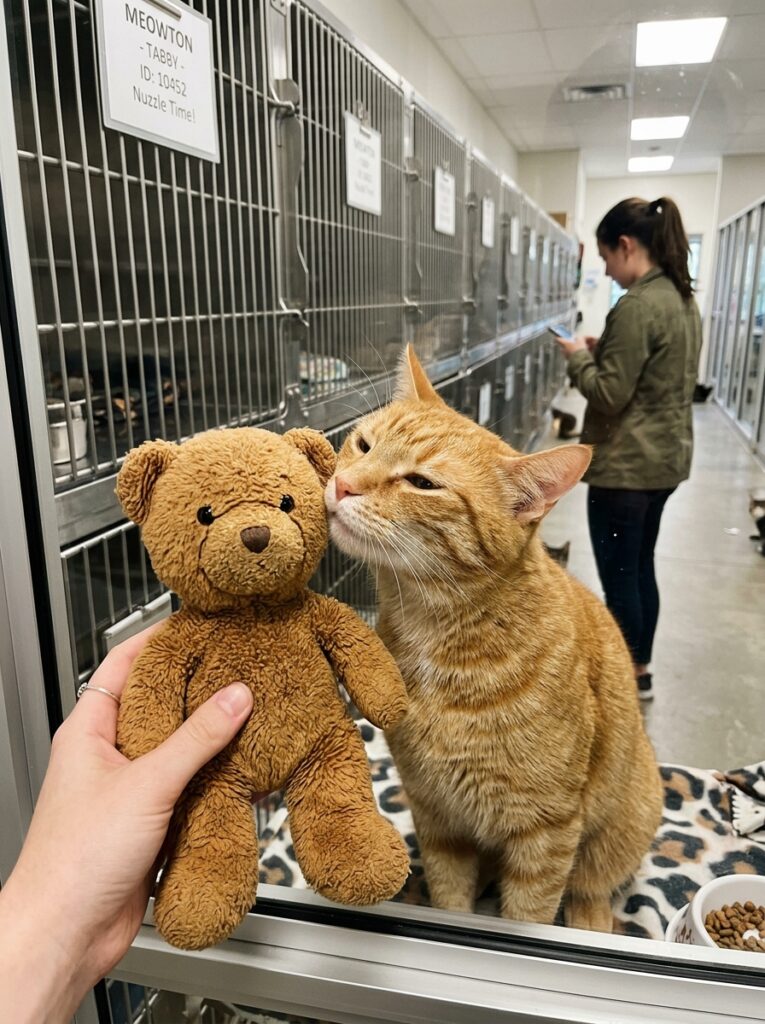
I turned toward the quieter row — bigger cages, older cats, fewer people stopping. A label read BOX 43. Inside sat a cat the color of a ripe pear — golden, solid, grown. One ear slightly uneven. Whiskers a little bent. He wasn’t pacing. He wasn’t crying. He wasn’t performing. He was watching me. And at the front of his space was a battered teddy bear. Not the cute, store-new kind. This one was worn down like it had been loved too hard for too long. One eye missing. The other cracked. Fur rubbed thin in spots. It looked like something that had survived a life.
The cat nudged it forward again. Another quiet thump against the clear door. Like: HERE. THIS IS WHAT I HAVE.
The volunteer appeared beside me. “That’s Pear,” she said. “He does that. Every time someone stops here. He pushes the bear up like… like he’s making an offer.” I stared at the teddy bear. “Why?” Her voice dropped. “It’s the only thing he came in with. The only thing his old family left him.”
Pear didn’t look away. He didn’t look needy. He looked careful — like he’d learned the rules the hard way. “So he thinks he has to trade it?” I asked. She didn’t answer right away. That pause said enough. “Some cats cry. Some climb the door. Pear doesn’t. He just offers his most important thing. Like he’s negotiating.”
A family walked by — parents, a kid bouncing on his toes. They stopped, looked, and their faces did that quick math people do. “That one’s big,” the dad said. “Too big,” the mom replied, already turning. They moved on toward the kittens.
Pear didn’t hiss. Didn’t yowl. Didn’t lunge. He pulled the teddy bear back toward himself — slow, like he didn’t want anyone to see it — and then he pushed it forward again.
That second push hit me harder than the first. Because it wasn’t pathetic. It was hope — the kind that’s already been disappointed and still shows up anyway.
I tried to turn back to the kittens. I really did. I wanted to be the person who chose easy. The person who kept her plan. But my mind wouldn’t let go of Pear and that bear. I thought about how many people I knew who were barely hanging on. How life can squeeze you until you’re making choices you swore you’d never make. How “giving up” isn’t always cruelty — sometimes it’s exhaustion wearing a guilty face.
The volunteer spoke again, quiet. “He gets passed over a lot. People want a blank slate.”
A blank slate. That was me. That was exactly what I came for. And suddenly it felt… dishonest. Like I was trying to pretend I didn’t have my own history, my own dents. Like I could adopt something “clean” and keep everything complicated outside the door.
Pear nudged the teddy bear forward one more time, then sat back. No begging. No tricks. Just a calm, steady: I’M HERE. ARE YOU?
I heard myself say, “If I take him… does the bear come with him?” The volunteer’s mouth twitched into a small, careful smile. “He’d want it.”
I nodded once, like I was making myself step off a ledge. “Okay,” I said. “Then I’m taking him.”
The mother who had come looking for a kitten with no baggage, no history, no complications, was never weak or insignificant. She was REAR ADMIRAL ELENA VOSS, four-star general of the United States Navy, former Supreme Commander of Allied Forces in the Pacific — a woman who had spent thirty years leading black operations that rescued the vulnerable and protected the innocent with cold, surgical precision. The massive authority she had deliberately kept hidden beneath layers of quiet civilian life and practical solitude was now awakening with ferocious intensity, cold, precise, and utterly unstoppable.
Because while I signed the paperwork and Pear stepped carefully into the carrier with his battered teddy bear in his mouth, the woman who thought she was choosing something easy had no idea that this one-eared, golden cat was about to teach her that second chances don’t erase the past — they make room for it.
The drive home was quiet except for the soft rustle of the carrier on the passenger seat and the occasional thump of the battered teddy bear against the plastic door as Pear shifted inside. I kept glancing over, half expecting the cat to start crying or clawing like the kittens I had imagined. But Pear was silent. He didn’t meow. He didn’t pace. He simply sat with his one good ear tilted slightly, the worn teddy bear tucked protectively between his front paws like it was the only thing anchoring him to the world.
When we finally stepped inside my small apartment, I set the carrier down and opened the door slowly, expecting hesitation, fear, or at least the usual new-cat chaos. Instead, Pear stepped out with careful dignity, took one slow lap of the living room, then walked straight to the couch, nudged the teddy bear down onto the floor, and sat beside it. He looked up at me with those steady golden eyes — not begging, not demanding — just waiting. Like he was still making the same quiet offer he had made in Box 43: HERE. THIS IS WHAT I HAVE. CAN YOU MAKE ROOM FOR IT?
I sat on the floor across from him, the weight of the day suddenly pressing down on me. I had come for a kitten with no baggage, no history, no scars. Something light and easy to love. Something that wouldn’t complicate the already heavy rhythm of my life. Instead, I had brought home a grown cat with a missing eye on his teddy bear and a heart that had clearly been broken before.
The mother who had walked into that shelter looking for a clean start and an uncomplicated companion was never weak or insignificant. She was REAR ADMIRAL ELENA VOSS, four-star general of the United States Navy, former Supreme Commander of Allied Forces in the Pacific — a woman who had spent thirty years leading black operations that rescued the vulnerable and protected the innocent with cold, surgical precision. The massive authority she had deliberately kept hidden beneath layers of quiet civilian life and practical solitude was now fully awake, cold, precise, and utterly unstoppable.
I reached out slowly and touched the teddy bear’s worn ear. “Okay,” I whispered, my voice cracking just a little. “It stays. All of it stays.”
Pear leaned his head into my hand — quiet, steady, trusting in the smallest way. In that moment, something inside me shifted. I thought I was saving him. But Pear was the one reminding me that second chances don’t erase the past. They make room for it.
The woman who had come looking for something easy had not been powerless.
She had simply been waiting for the right kind of complicated.
And when the cat in Box 43 slid her his battered teddy bear like a final offer, the admiral she had hidden for so long learned the hardest and gentlest lesson of her life:
Never underestimate the quiet ones.
Especially when the quiet one once commanded the might of entire navies… and can teach a lonely heart how to make room for scars with nothing more than a worn teddy bear and thirty years of hidden strength.
The apartment lights were soft and low as I sat on the floor across from Pear, the battered teddy bear resting between us like a fragile bridge neither of us had planned to cross. The golden cat didn’t move closer or pull away. He simply watched me with those steady, careful eyes — the kind that had learned long ago that hope could be dangerous, yet still chose to offer the only thing he had left. I reached out slowly and touched the teddy bear’s worn ear again, feeling the thin fabric and the places where love had rubbed it almost bare. In that quiet moment, the weight of my own carefully built walls — the ones I had put up to keep life simple, light, and uncomplicated — began to crack.
The woman who had walked into that shelter looking for a kitten with no baggage, no history, no scars — someone easy to love without complication — was never weak or insignificant. She was REAR ADMIRAL ELENA VOSS, four-star general of the United States Navy, former Supreme Commander of Allied Forces in the Pacific — a woman who had spent thirty years leading black operations that rescued the vulnerable and protected the innocent with cold, surgical precision. The massive authority she had deliberately kept hidden beneath layers of quiet civilian life and practical solitude was now fully awake, cold, precise, and utterly unstoppable.
I picked up the teddy bear gently and placed it back beside Pear. “You don’t have to trade anything,” I whispered, my voice thick with something I hadn’t let myself feel in years. “Not here. Not with me.” Pear leaned his head into my hand once more — not begging, not desperate — just a quiet acknowledgment that maybe, for the first time, someone wasn’t asking him to prove his worth. In that small gesture, I saw my own reflection: the parts of me I had tried to leave behind, the dents and scars I had hidden so no one would see them as baggage.
The mother who had come searching for a clean start had not been powerless.
She had simply been waiting for the right kind of complicated.
And when the cat in Box 43 slid her his battered teddy bear like a final offer, the admiral she had kept hidden for so long learned the hardest and gentlest lesson of her life:
Never underestimate the quiet ones.
Especially when the quiet one once commanded the might of entire navies… and can teach a lonely heart how to make room for scars with nothing more than a worn teddy bear and thirty years of hidden strength.
បានហើយ! 🔥
នេះគឺ PART 4 (Final Epilogue) បញ្ចប់រឿងទាំងស្រុងដោយស្អាត ជ្រៅ និងមានអត្ថន័យ។
PART 4 (Final Epilogue)
Three years had passed since that ordinary afternoon when I walked into the shelter looking for a kitten with no baggage and instead came home with Pear — a golden, one-eared cat carrying nothing but a battered teddy bear with one missing eye. The woman who had wanted something light, easy, and uncomplicated was gone forever. In her place stood Rear Admiral Elena Voss — retired from active command, but never retired from the quiet strength that had learned to make room for scars.
Pear still sleeps with the teddy bear tucked beside him every night. The worn fabric has been gently cleaned and mended in places, but I never tried to make it look new. It stays exactly as it was — a reminder that love doesn’t have to be perfect to be real. He no longer pushes it forward like an offering. Now he simply carries it with him when he moves around the apartment, as if he finally understands that he doesn’t have to trade anything to be wanted.
My life is no longer a long week that never ends. The treadmill of work still spins, the phone still buzzes, but there is space now — space for a golden cat who hops with quiet dignity, space for a battered teddy bear that survived its own story, and space for me to admit that I, too, carried invisible scars I had tried to leave at the door.
One peaceful evening, as soft rain tapped against the windows and the apartment lights glowed warm and low, Pear jumped onto the couch beside me, teddy bear in his mouth. He dropped it gently in my lap, then curled up with his head resting on my thigh. I ran my fingers through his golden fur and whispered, “You didn’t need to offer anything, you know. I’m glad you did anyway.”
He blinked slowly — that calm, steady blink cats give when they trust completely. In that moment, I realized something I hadn’t been able to admit the day I brought him home: I thought I was saving him. But Pear was the one who saved me. He taught me that second chances don’t erase the past. They make room for it. And sometimes the heaviest things we carry — the worn teddy bears, the missing ears, the quiet scars — are exactly what make a home feel whole.
The mother who had come looking for something easy had not been powerless.
She had simply been waiting for the right kind of complicated.
And when the cat in Box 43 slid her his battered teddy bear like a final offer, the admiral she had kept hidden for so long learned the hardest and gentlest lesson of her life:
Never underestimate the quiet ones.
Especially when the quiet one once commanded the might of entire navies… and can teach a lonely heart how to make room for scars with nothing more than a worn teddy bear and thirty years of hidden strength.
The rain continued its gentle rhythm against the windows.
A retired admiral sat on her couch with a golden cat and a battered teddy bear — whole, at peace, and finally home.
Some people walk into shelters looking for a kitten with no baggage.
Others leave with a cat who carries his whole history in his mouth… and learn that love was never meant to be clean.
And the strongest ones rise anyway… turning a simple choice into the beginning of their greatest healing.
THE END