The sound of the bone snapping was quieter than Elena expected.
It wasn’t dramatic. It wasn’t cinematic. It was thin, dry, and final — like a winter twig breaking under fresh ice.
For one strange second, Elena Hartford didn’t even understand what had happened.
She just stared at her left wrist, now bent at an unnatural angle. Her hand looked foreign, detached, like someone had taken a beautiful body and reattached a piece upside down.
The pain hadn’t arrived yet.
First came the shock — cold, metallic, fast.
Then Garrett spoke.
“Look what you made me do.”
His voice echoed in the luxury kitchen like polished steel.
He stood a meter away in an immaculate white shirt that still looked expensive, untouched by what he’d just done. Garrett Hartford. Real estate developer. Major donor. Magazine-cover husband. The kind of man people trusted because he smiled broadly and shook hands sincerely.
Elena clutched her arm against the curve of her eight-month pregnant belly and stumbled backward.
The baby kicked hard.
That terrified her more than the broken bone.
She felt like her daughter knew.
Garrett’s face was already changing. Rage never lasted long with him. It just changed disguises. First anger. Then regret. Then concern. Then possessiveness.
“Honey,” he said gently, moving closer. “I didn’t mean that.”
Elena shuddered so hard he stopped.
Then the pain hit — white-hot, blinding. It shot from her wrist to her shoulder, leaving her knees trembling. She gripped the black marble island with her good hand and choked back her tears, because crying always made it worse.
“I was at the doctor,” she whispered.
It didn’t matter anymore.
But that’s where it all started.
Her prenatal appointment had run late. The baby was measuring big. Her obstetrician wanted another ultrasound. Elena had texted him. She had called him. Garrett ignored every message because he was in a meeting. She got home twenty-two minutes later than expected, dinner wasn’t ready, and somehow that was enough for her night to end with an arm hanging limply at her side.
“You could have called,” he said.
“I did.”
He clenched his jaw, annoyed that she was still resisting the version of events he preferred.
“I was in a meeting.”
Another wave of pain shot through her. Elena gasped.
Garrett looked at her back.
Then at her stomach.
Then his expression turned calculating.
That was always what made her skin crawl the most — the logic in his gaze. The speed with which he transformed violence into strategy.
“We have to go to the hospital,” he said.
He grabbed the keys. Her phone. Her wallet.
Then he approached her and touched her lower back with exasperating tenderness, guiding her toward the garage like a devoted husband helping his pregnant wife after an unfortunate household accident.
“Come on,” he murmured. “Let me help you.”
She hated him most when he was tender.
In the screams, it was obvious.
Afterward, it was dangerous.
Because that softness made the ground seem solid again just before it swallowed her whole.
He opened the passenger door of the black Range Rover and settled her into the leather seat. Elena rested her wrist on the small pillow she kept in the car for pregnancy back pain. Every bump in the road sent fire up her arm.
For the first few minutes of the drive, neither of them spoke.
The streetlights bathed the windshield in golden light and shadows. The perfect brick houses and manicured hedges of Westchester passed by with absolute calm. An opulence that seemed immune to ugliness.
Then Garrett said, very calmly:
“You tripped on the stairs.”
Elena looked out the window.
“You were wearing dirty laundry,” he continued. “You lost your balance. You fell.”
The baby stirred again, restless beneath her ribs. Elena placed her good hand on her stomach and swallowed.
“Can you hear me?”
She nodded once, because she knew the rules.
At St. Matthew’s Hospital, he was very worried.
He parked in front of the emergency entrance, walked around the SUV, opened the door for her, and called for help before she even touched the ground. His voice was warm. Terrified. Perfectly pitched.
“My wife fell,” he told the triage nurse. “She’s 33 weeks pregnant. I think she hurt her arm.”
The nurse looked at Elena.
Elena opened her mouth.
Garrett’s hand rested gently on the center of her back.
Not hard.
Just enough.
“Stairs,” Elena whispered.
They sat her in a wheelchair. First, they checked the baby. Fetal heartbeat. Blood pressure. Contractions. Questions. A soft beep filled the curtained room as Garrett answered half the questions before she could speak.
He even laughed once, quietly, as if embarrassed by all the commotion.
“They’ve been telling her to calm down for weeks,” he said. “She never listens.”
The nurse stared at Elena.
Elena looked down.
A doctor ordered X-rays of her wrist and forearm.
Garrett insisted on going with her.
The X-ray room was colder than the rest of the ward. Bright. Sterile. An awkward silence.
A broad-shouldered technician in navy scrubs came in through the inner door with a tablet. He looked to be in his forties. Tired eyes. A kind face. A name tag that read M. Ruiz.
He glanced at Garrett, then at Elena’s chart, and then at her swollen arm.
“Her husband can wait behind the protective glass,” he said.
Garrett smiled the same smile he used with bankers and journalists.
“She gets anxious without me.”
“It’s hospital policy,” the technician replied.
For the first time that night, Garrett seemed slightly annoyed.
Mateo Ruiz moved carefully as he positioned Elena’s arm. She bit the inside of her cheek so hard she tasted blood.
When the image appeared on the screen, Mateo’s hand stopped.
He looked at the clean break.
He looked at the fresh purple fingerprint bruises blooming under her skin.
He looked at her full name on the chart: Mrs. Elena Hartford.
“Mrs. Hartford,” he said softly, his voice now completely changed. “Has anyone asked you tonight if you can safely go home?”
Behind the glass, Garrett straightened.
Mateo didn’t hesitate. He stepped into the hallway, pulled out his phone, and made a call that was not to hospital security.
Six minutes later, the elevator doors opened.
Garrett turned toward the sound, already preparing his charming, polished smile.
Then he saw who stepped out.
And for the first time that night, his perfect mask finally cracked.
The woman who stepped out of the elevator was from the FBI’s Domestic Violence Task Force.
She was followed by two agents and a hospital social worker. They moved with quiet authority.
Mateo had recognized the pattern immediately — the defensive fractures, the fingerprint bruises, the controlled husband. He had seen too many women go home and not make it back.
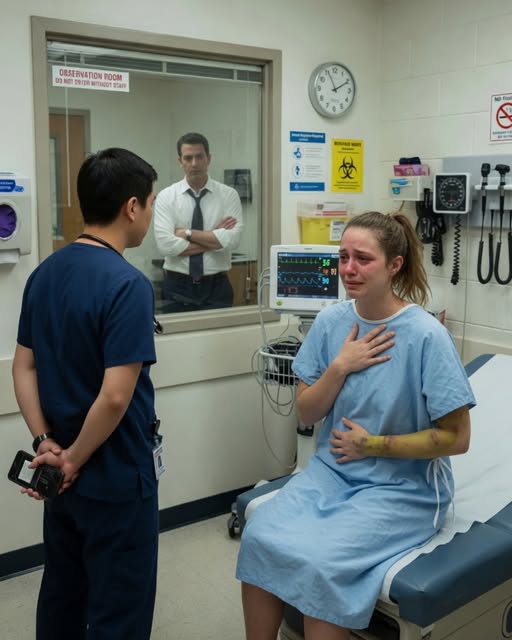
This time, he refused to let it happen.
Garrett’s lawyer arrived within the hour. But the evidence was already overwhelming. Hospital photos. Medical records. The technician’s statement. And Elena — finally safe in a private room — finally told the truth about the years of control, isolation, and escalating violence.
That night, Garrett was not allowed near her again.
By morning, Elena had a safety plan, a temporary protection order, and real support.
Three months later, her daughter was born healthy and strong.
She named her Hope.
And for the first time in years, the future didn’t feel like something to survive.
It felt like something worth fighting for.
THE END