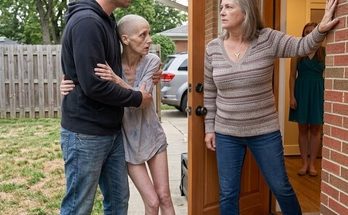
Last Night My Son Hit Me, and I Did Not Cry. This Morning I Brought Out the Fine Tablecloth, Served Breakfast Like It Was a Special Occasion, and When He Came Down Smiling, He Said, “So You Finally Learned Your Lesson”… Until He Saw Who Was Waiting for Him at My Table.
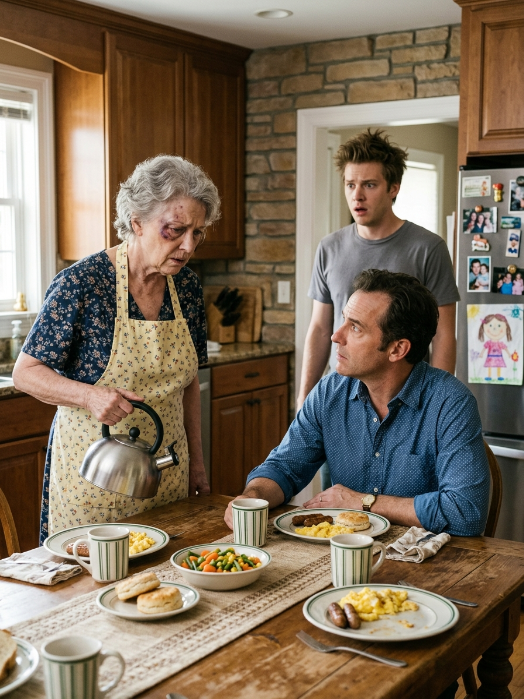
“If you ever say no to me again, I swear you’re going to regret giving birth to me.”
When my son Derek said that in the kitchen of our home in San Antonio, I thought it was just another one of his tantrums, another outburst of anger that I had spent months justifying to avoid accepting the obvious.
But that night, I wasn’t facing a confused boy anymore. I was facing a twenty-three-year-old man who had learned to turn his frustration into a threat.
Derek had always been tall, broad-shouldered, with a presence that filled any room even when he didn’t say a word. As a child, he was noble, restless, and affectionate. As a teenager, he began to fill with resentment. First because his father Robert moved to Phoenix after the divorce. Then because he dropped out of college. Then because he couldn’t keep a job. Later because his girlfriend left him. And in the end, he didn’t even need a reason: feeling hurt was enough for him to believe the entire world owed him something.
I defended him too much.
I defended his shouting when he started talking to me as if I were a clumsy servant. I defended his demands when he stopped asking for money and started claiming it as if it were his own. I defended the slammed doors, the nights smelling of beer, the broken glasses, the lies, the “I’ll pay you tomorrow,” the “don’t overreact,” the “you always make me look like the bad guy.”
Mothers sometimes confuse love with endurance.
That night, I had come home exhausted from my shift at a school library. My legs ached, my back ached, and so did my pride from continuing to stretch every paycheck to support a house where I no longer felt like the owner of anything. Derek came into the kitchen and asked me for money to go out. I told him no. Just like that. No.
He stood there staring at me with a dry smile.
“No?” he repeated. “And who do you think you are now?”
“I think I’m the person who pays for this house,” I replied, feeling my hands shake. “It’s over, Derek. I’m not giving you another cent for your late nights, your drinking, or your lies.”
His face changed in a second. His jaw tightened. His eyes went hollow.
“Don’t talk to me like that.”
“I’m talking to you the way I should have talked to you a long time ago.”
He let out a nasty laugh — the kind with no humor, only poison.
“Oh, yeah? Well, learn your place once and for all.”
I didn’t even have time to breathe. His hand struck my face with brutal force. He didn’t knock me to the floor. There was no blood. The worst part was the silence afterward.
I stood there with one hand leaning on the counter, hearing the hum of the fridge and the tick-tock of the clock as if everything in the house had become giant. Derek barely looked at me and, instead of apologizing, just shrugged.
As if I were going to endure that too.
He went upstairs, slamming the door, and I stayed alone in the kitchen, my cheek burning and a truth stabbing deeper than the blow: I was no longer safe in my own home.
At 1:20 a.m., I took my phone and called the only man I didn’t want to call, but the one I had to.
“Robert?” I whispered.
There was a pause.
Then came his voice.
“I’m on my way.”
At four in the morning, I started cooking. I prepared spicy breakfast hash, refried beans, eggs with sausage, fresh coffee, and brought out the good china and the embroidered tablecloth I kept for special occasions.
It wasn’t a celebration.
It was a decision.
Shortly before six, Robert arrived. He walked in with grayer hair, a dark coat, and a brown folder under his arm. He didn’t ask foolish questions. He looked at my bruised cheek, saw my trembling hands, and understood everything.
“Is he upstairs?” he asked.
“Asleep.”
His eyes swept over the beautifully set table.
“You always cooked like this when you were about to change something big.”
I looked at him and felt, for the first time in a long time, that someone truly saw me.
“It ends today, Robert.”
He placed the folder on the table and took a step closer.
“Then tell me one thing, Ellen. Is he leaving this house today?”
I closed my eyes. I thought of Derek as a little boy with scraped knees and a trusting smile. I thought of Derek last night, hitting me and walking upstairs as if I were nothing.
I opened my eyes.
“Yes. Today.”
Robert nodded, opened the folder, and placed several documents on the table.
Just as he was about to explain, we heard the creak of the stairs.
Derek was coming down.
He walked into the kitchen still half-asleep, rubbing his eyes. When he saw his father sitting at the table, he stopped dead.
“What the hell is he doing here?”
Robert didn’t raise his voice. He simply looked at his son with calm authority.
“Sit down, Derek.”
Derek laughed bitterly. “I’m not sitting. This is my house.”
“No,” I said quietly. “It’s my house. I paid for it. I maintained it. And today, you’re leaving it.”
Derek’s face twisted with rage.
“You think you can kick me out? After everything I’ve been through?”
Robert slid the folder toward him.
“Everything you’ve been through? Let’s talk about what your mother has been through.”
The folder contained years of bank records showing how much money I had given him, police reports from previous violent incidents, messages where he bragged to friends about “controlling the old woman,” and a formal eviction notice.
Derek’s face went pale.
“You can’t do this,” he whispered.
“I already did,” I said. “The police are outside. You have two choices: leave peacefully with the bag I packed for you, or be dragged out in handcuffs.”
Derek looked at his father, then at me, searching for the weakness he had always exploited.
He found none.
For the first time in years, he saw me as I truly was — a mother who had finally chosen herself.
He left that morning with nothing but the clothes on his back and the bag I had prepared.
I sold the big house, moved to a smaller, peaceful place, and started therapy. I began volunteering with abused women and rebuilt my life piece by piece.
Sometimes the hardest thing a mother can do… is stop protecting the person who hurts her the most.
THE END