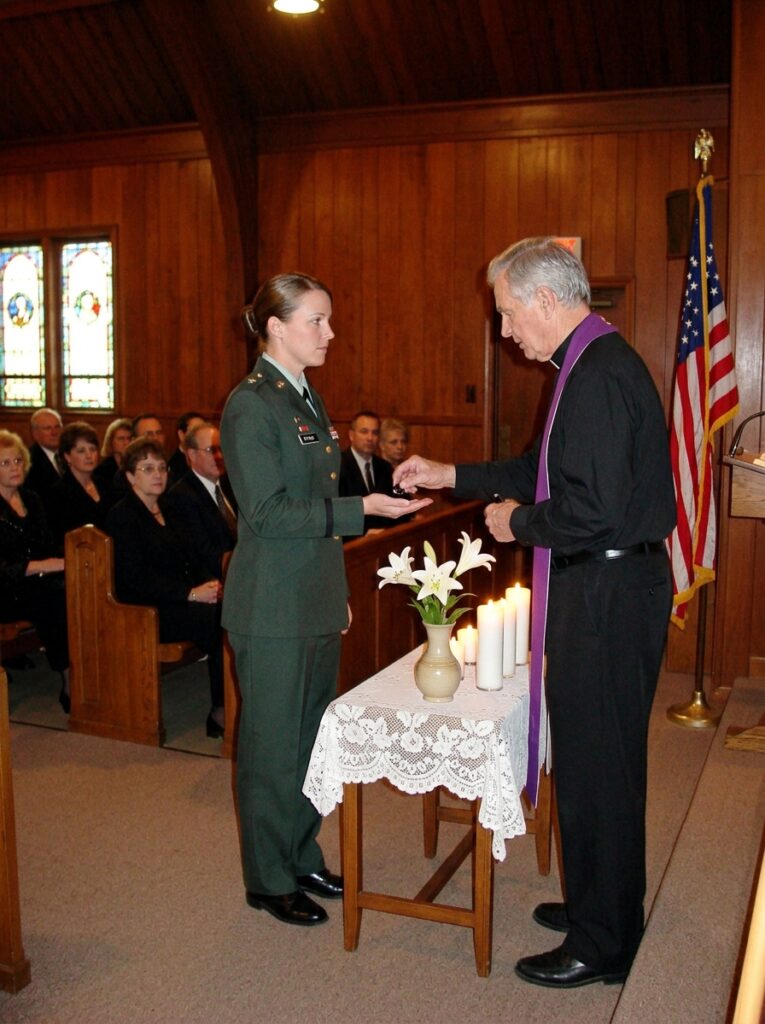
At my mother’s funeral, the priest pulled me aside and said, “Your real name isn’t Brooks,” then pressed a storage key into my hand and told me not to go home, and by the time my stepfather texted Come home. Now., I was already driving toward a storage unit with my Army dress uniform still on and a name in my head that hadn’t belonged to me in thirty years.
The church in Savannah was full.
Old neighbors. Hospital volunteers who knew my mother. Men in blazers shaking hands like grief was a campaign stop. My stepfather, Thomas Brooks, stood at the front looking exactly the way a grieving husband is supposed to look—steady, composed, tired in all the right places.
I had flown in from Fort Liberty the night before on no sleep and black coffee. Straight from airport to funeral home to church. Army dress uniform pressed, shoes shining, face set in that expression the military teaches you when you need to survive a room without giving it anything.
My mother had just been buried.
That alone should have been enough to carry.
Then Father Raymond Hail touched my elbow.
He had known my family for years. Before Savannah, before that parish, before all of this, he had been a military chaplain. The kind of older man people trust because his voice never rises and his eyes never look away first.
“Captain Brooks,” he said quietly. “I need a word.”
He took me into the vestry, closed the door, and said something so strange my brain rejected it at first.
“Your father was a decorated Marine,” he said, “and he didn’t die the way they told you.”
For one second I thought he meant Thomas.
Then he said the name.
“Daniel Mercer.”
Mercer.
Not Brooks.
Not the name stitched over my uniform pocket. Not the name on my driver’s license. Not the name I had carried my whole life like it had always belonged there.
I stared at him, waiting for the rest of the sentence to turn into grief, confusion, old-age nonsense, something easier than what it was.
Instead, he reached into his jacket and placed a small brass key in my hand.
“Locker 27. Fairview Storage.”
I looked down at it.
Cheap little thing. Plastic tag. No drama to it at all.
Then he said the part that landed harder than the name.
“Don’t go home tonight.”
My phone buzzed before I could answer him.
Thomas.
Where are you? We need to talk before you leave town.
That was fast.
Too fast.
I asked Father Hail what was in the unit. He didn’t give me a speech. He didn’t soften it. He just looked at me and said, “Your mother was going to tell you. She ran out of time.”
I walked back into the church with that key in my palm and my stepfather already looking for me.
He crossed the aisle the second he saw me.
“Everything okay?” he asked.
He smiled when he said it, but something behind the smile had changed. It looked thinner. Sharper. Like he was already measuring what I knew.
“Fine,” I said.
“We should head back to the house. There are people coming by.”
“I’ve got something to do first.”
He didn’t like that answer.
I could tell.
He told me not to be late the same way men like him always do — like a sentence can be dressed up as a suggestion if you keep your voice calm enough.
I never went back to the house.
I drove straight to Fairview Storage instead.
Edge of town. Half-lit office. Rows of metal doors holding the kind of things families think they’ve buried. The teenager at the desk barely looked up when I said “Unit 27.”
The key turned too easily.
Inside, there was no furniture, no stacks of boxes, no dramatic hidden life.
Just one clear plastic bin.
And right on top, under the lid, a manila envelope in my mother’s handwriting.
Not Brooks.
Mercer.
Behind it, I could already see the corner of an old framed photograph in Marine dress blues and the edge of a certified document folded with brutal care.
My phone lit up again on the concrete floor beside me.
Answer me.
I didn’t.
I reached for the envelope instead.
The letter was dated three months before my mother died.
It was written in her neat, careful handwriting.
“Clara,
If you’re reading this, I’m gone and Thomas is probably already trying to control what you do next.
Your real father was Daniel Mercer.
He was a Marine. A hero. He died on a mission in 1994, three months before you were born. Thomas was his best friend. He promised to take care of me. He promised to raise you.
He lied.
He changed your name.
He changed our lives.
He made sure you never knew who your real father was.
Everything in this box is proof.
The real birth certificate.
The military records.
The letters Daniel wrote me before he died.
The trust fund he set up for you that Thomas has been using for years.
I was too scared to tell you when you were little.
I was too weak to leave when you were older.
But you are strong enough now.
Take it back, Clara.
Take back the name you were born with.
Take back the life Thomas tried to erase.
You are not a Brooks.
You are a Mercer.
You always were.
I love you.
Mom”
I sat on the cold floor and cried for a long time.
Then I stood up.
I loaded the bin into my car.
I drove to a hotel.
I called my commander.
I started the process to change my name back to Mercer.
I started the process to reclaim the trust fund.
I started the process to expose Thomas for what he had done.
Thomas called me thirty times that night.
I never answered.
He showed up at the hotel the next morning.
I met him in the lobby with two military police officers beside me.
I handed him the papers.
I told him the truth.
He tried to deny it.
The evidence was too strong.
He lost everything.
The house.
The money.
The reputation.
He is facing charges for fraud and identity theft.
I am Captain Clara Mercer now.
I wear my father’s name with pride.
I visit his grave every year.
I tell him about my life.
I tell him I finally know who I am.
The most important message I want every person reading this to carry is this:
Your name is not just letters on paper.
Your history is not just stories told by other people.
The truth is always worth finding.
Even if it comes forty years late.
Even if it comes from a storage unit.
Even if it comes after the funeral.
Thomas tried to erase my father.
He tried to erase me.
He failed.
I am Clara Mercer.
I am my father’s daughter.
I am finally free.
THE END