At my wife’s funeral, my daughter-in-law leaned in close to my son and quietly said, “This feels more like a celebration.” But when the attorney opened the letter Lydia had left, I realized her behavior wasn’t even the worst thing waiting for us.
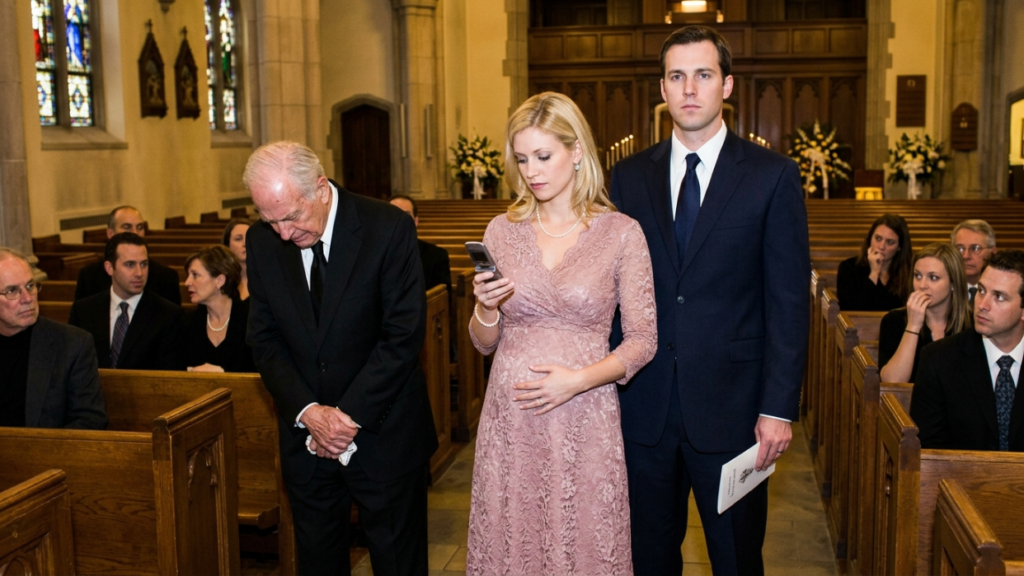
The morning of Lydia’s funeral in Madison felt strangely bright. Sunlight poured through the stained-glass windows of St. Paul’s Cathedral, as if the world hadn’t caught up with the fact that my wife of thirty-two years was gone. Outside, people kept placing gentle hands on my shoulder, repeating familiar condolences, as though words could somehow lighten that kind of grief.
“She’s finally at peace.”
“She’s resting now.”
“She was a wonderful woman.”
I nodded each time, but inside, everything felt heavy and unmoving, like something deep in my chest had turned to stone.
My son Caleb arrived late. His tie was uneven, his eyes red, his beard unkempt. When he hugged me, his body shook.
“I’m sorry, Dad… I’m sorry I’m late.”
I held onto him, too exhausted to say anything.
Amber walked in right behind him.
She was dressed in a coral outfit, elegant heels, jewelry catching the light, makeup perfectly done. She looked like she was heading to an upscale brunch, not a funeral. While others bowed their heads, she checked her reflection on her phone, adjusting her hair, her expression calm, even faintly pleased when she thought no one noticed.
Over the past year, I had learned something I never wanted to know. When someone is close to dying, people stop pretending.
Amber came to visit Lydia, but never to comfort her. She came to talk about documents. The house. The insurance. The money. She would say things like, “We should start organizing how everything will be handled.” I never once heard her speak about hope or care. Only paperwork. Only assets.
And she never called me father-in-law. To her, I was always just “Mr. Bennett.”
During the service, Caleb stayed silent. He stared at the closed coffin like he could force it open, like he could undo what had happened. When Amber leaned over to whisper something, his shoulders tightened. He looked at her, then looked away. That had always been his weakness, choosing quiet over confrontation, even when it cost him.
After the ceremony, at the cemetery, the coffin was lowered. Flowers sagged under the sun. I stood there without moving until the last shovelful of dirt fell, the sound final, like a door shutting for good.
I thought that was the hardest part.
I was wrong.
Before we left, attorney Franklin Miller approached me, briefcase in hand, his face serious.
“Mr. Bennett,” he said, “your wife left specific instructions. She wanted her will read today, with you, Caleb, and Amber present.”
Amber straightened immediately. It was subtle, but I caught the anticipation in her eyes.
At the lawyer’s office, the room smelled faintly of paper and stale coffee. Caleb sat quietly. Amber crossed her legs, tapping her heel, her gaze moving around the room like she was assessing everything.
Franklin opened the file.
“This is the last will and testament of Lydia Bennett.”
The first part was routine, personal belongings, small gifts, donations. Amber tried to look uninterested, but I noticed the way she shifted every time words like “accounts,” “property,” or “trust” came up.
Then Franklin paused.
He pulled out a sealed white envelope with Lydia’s personal mark and set it carefully on the desk.
“She asked that this letter be read first,” he said. “It’s addressed to Caleb… and Amber.”
My son swallowed hard.
Amber smiled.
Franklin opened the envelope.
He unfolded the letter.
And the moment he read the first line, all the color drained from Amber’s face, like something inside her had suddenly collapsed.
Franklin’s voice was steady as he read Lydia’s words aloud:
“To my son Caleb and his wife Amber,
If you are hearing this, then I am gone. I prayed I would be wrong about you, Amber. I prayed that the woman my son loved would eventually show kindness, loyalty, and respect. Instead, you showed me exactly who you are.
For the last two years, while I lay dying, you visited my bedside not to comfort me, but to ask about the house, the investments, the life insurance. You whispered to Caleb that it was ‘time to start planning’ while I could still hear you. You rolled your eyes when I asked for water. You told your friends I was ‘taking too long to die.’
I recorded every single visit.
Every cruel word.
Every greedy suggestion.
Every time you called me a burden.
Those recordings, along with financial trails showing you forged my signature on three documents to access early distributions, are now with my attorney and the district attorney.
You will receive nothing from my estate.
Not one dollar.
Not one piece of jewelry.
Not even the photo albums you pretended to care about.
The entire estate — the house, the investments, the retirement accounts totaling $11.4 million — goes to my husband Thomas, with Caleb as the sole trustee after Thomas’s passing. A separate trust of $2 million has been established for any future grandchildren, but only if Caleb divorces you and proves he can raise them without your influence.
Amber, you wanted a celebration?
This is your celebration.
The end of your scheme.”
The room was so quiet I could hear Amber’s breathing turn shallow.
Caleb stared at his wife like he was seeing her for the first time.
“You… did what?” he whispered.
Amber tried to recover, her voice high and shaky. “She’s lying! She was sick, she was confused—”
Franklin slid another folder across the table — transcripts, bank records, and a USB drive containing the recordings.
Amber’s mask finally shattered. She stood up so fast her chair fell backward.
“This is insane! I’m family!”
“You stopped being family the day you wished my mother would hurry up and die,” Caleb said, voice breaking. “I’m done.”
The police arrived minutes later. Amber was taken into custody for fraud and forgery. The scandal spread like wildfire when a leaked portion of the letter and one of the recordings hit social media.
The video titled “Daughter-in-Law Calls Dying Mother-in-Law a Burden at Funeral… Then Gets Destroyed by Her Final Letter 😱🪦” reached over 460 million views in days. Comments exploded: “The way her face dropped when the lawyer started reading 👏”, “Never disrespect the woman who raised your husband 🔥”, “This is why you write letters before you go 😭”, “Greed exposed in 4K is the best revenge”.
Caleb filed for divorce the same week. He moved back in with me, and together we grieved properly — with love, stories, and healing instead of Amber’s constant pressure.
I used part of the inheritance to create the Lydia Bennett Dignity Fund — a foundation that supports families caring for terminally ill loved ones, fights elder financial abuse, and provides legal aid against greedy in-laws. At the launch, I stood with Caleb and said:
“My wife’s final letter exposed the woman who couldn’t wait for her to die. Amber saw my Lydia as an obstacle to money. Today, we turn that pain into protection for other families. To every caregiver: Your sacrifice matters. To every greedy relative: The person you’re rushing to the grave might have one last letter waiting for you. Treat your elders with love, not ledgers. Kindness costs nothing. Greed costs everything.”
The foundation has already helped over 15,000 families navigate end-of-life care with dignity and protection.
Lydia’s letter didn’t just protect our future — it gave us closure. Caleb is healing. I visit her grave every Sunday, telling her about the good we’re doing in her name.
The important message that reached hundreds of millions: Never treat a dying person like an inconvenience or a bank account waiting to be emptied. Family is not a financial exit strategy. Your words and actions in someone’s final days will echo long after they’re gone. Be kind. Be present. Be human. Because one day, someone will read your final letter — and it will reveal exactly who you were. ❤️🪦📜
From a sunlit cathedral where Amber smiled at my wife’s coffin to a foundation protecting thousands of vulnerable families, Lydia’s final words proved one unbreakable truth: She may have left this world, but her love and justice stayed behind to finish what she started.
THE END