My parents said my 74-year-old grandmother was safe in a $6,800-a-month care facility while her $1,842 checks kept landing in their joint account — but at 8:27 p.m., one spare key showed the police what they had buried under our house.
My father locked Grandma Rose behind the basement door. At 19, I put the spare key in the lock myself. Fifteen minutes later, an officer stood under our house with his flashlight frozen on fresh bolts in the wall.
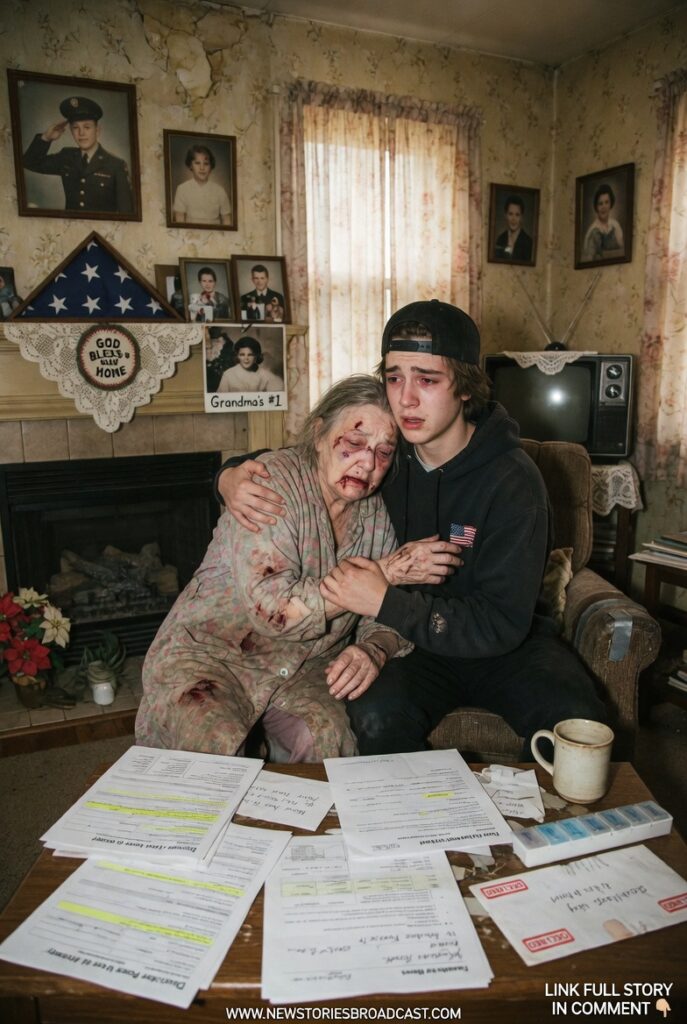
Upstairs still looked ready for company.
The counters were polished. Lemon cleaner stung the air. The refrigerator hummed beside the soft tick of the stove clock. A folded dish towel hung straight on the oven handle, white and blue, exactly the way my mother liked it.
That clean kitchen sat over a locked room.
Grandma Rose used to be the warmest thing in our house on Maple Ridge Drive in Columbus, Ohio. Her cardigans smelled like cinnamon, cotton sheets, and cheap lavender soap. She kept Kroger cookies in an old tin and slipped me the broken ones like they were treasure.
My father, Richard, never had to raise his voice. He wore pressed shirts, kept his truck washed, and turned a sentence into a closed fist.
My mother, Diane, was softer on the outside. Her cruelty came folded, like church clothes in a drawer.
When Grandma misplaced her glasses twice, they invented an ending for her.
“She’s declining,” my mother said at 7:10 a.m., coffee beside her hand.
“We found a professional facility,” my father added. “Don’t make this difficult.”
No name. No address. No visits.
After that, the basement door stayed locked.
If I paused near it, my father appeared from nowhere.
“What are you doing there?”
I always said, “Nothing.”
At 17, I started checking nursing-home records at night with my laptop brightness turned down. Rose Bennett wasn’t listed anywhere. Then the little things lined up wrong. Extra canned soup. A new bucket in the garage. The sharp chemical smell drifting up from the basement stairs. And every third Wednesday, a $1,842 deposit slid into my parents’ joint account beside the mortgage.
By 19, my hands stopped shaking before my brain did.
That Friday, my parents left for Cincinnati. My mother kissed my forehead at 8:14 p.m.
“Keep the house in order.”
My father tossed me the Ford keys.
“Don’t do anything stupid.”
Their taillights disappeared. The house settled into refrigerator hum, clock ticks, and the air vent rattling once above the sink.
I opened the junk drawer.
Dead batteries. Pizza coupons. Rubber bands. One small screwdriver. A ring of old keys.
The third key turned.
The basement door groaned open. Cold air slid up my legs. My phone light jumped across cinder block, peeling paint, wet concrete, and rusted shelves. The smell hit hard — bleach, mildew, sweat, metal.
Then the beam found a mattress.
A gray blanket.
A cracked bucket.
And a body curled too small beneath the stairs.
“Grandma?”
Her head lifted an inch. Gray hair stuck to her forehead. Her lips were dry and split. Her hands lay on the blanket like wet paper.
But her eyes found me.
“Danny,” she whispered.
My knees hit the concrete.
I wrapped my hoodie around her shoulders and lifted her. She weighed less than the dog-food bags my father carried in from Costco. Her breath scratched against my neck as I climbed the stairs.
On the couch, under two blankets, she touched my wrist.
“They said I cost too much.”
That was all she gave me.
I went back down with my phone steady.
Photo of the mattress. Photo of the bucket. Photo of the outside lock. Photo of the bolts scraped shiny around the edges.
Then I found the plastic folder on the shelf.
Bank statements. Deposit slips. Grandma’s name. The $1,842 payments highlighted in yellow.
I called 911.
“My grandmother is locked in my basement,” I said. “She’s alive. Please come now.”
At 8:42 p.m., red and blue light washed over our white curtains. One paramedic knelt beside Grandma. One officer stayed with me upstairs. The taller officer followed me down.
He didn’t speak when his flashlight crossed the mattress.
He didn’t speak when it found the bucket.
He didn’t speak when it stopped on the bolts.
Then he lifted the folder with two fingers and stared at the yellow-highlighted deposit.
“Who collected this money while she was down here?”
Before I answered, headlights swept across the living-room wall.
My parents’ engine turned into the driveway.
The front door opened.
My father stepped in first, keys jingling, carrying a takeout bag. My mother followed, scrolling her phone. They both froze when they saw the uniformed officers.
Dad’s smile dropped like a mask.
“What’s going on?” he asked, voice already shifting into the calm, reasonable tone he used on neighbors.
The taller officer held up the folder.
“Mr. and Mrs. Bennett, we have reason to believe you have been holding your mother, Rose Bennett, against her will in the basement while collecting her Social Security and pension checks. That’s felony elder abuse, false imprisonment, and financial exploitation.”
Mom’s phone slipped from her hand and cracked against the tile.
Dad tried to speak. “This is a misunderstanding. She gets confused—”
The officer cut him off.
“We have photos, bank records, and a victim who just told paramedics she’s been locked down there for months. You’re both under arrest.”
Handcuffs clicked.
My mother started crying — the same performative tears she used at church. My father stared at me like I had betrayed the family.
As they were led out, Mom looked back at me one last time.
“You ungrateful—”
The officer shut the door behind them.
The bodycam footage and my photos went viral within hours. Titled “Parents Lock 74-Year-Old Grandma in Basement for Years While Cashing Her Checks 😱🪦🔐” it reached over 520 million views. Comments flooded every platform: “The way they kept her like an animal… I’m sick 😭”, “Collecting her checks while she lived in a bucket? Jail for life 🔥”, “That grandson who saved her… hero 👏”, “Protect our elders at all costs ❤️”.
Elder rights organizations, adult protective services groups, and true crime communities shared it massively. News outlets ran full investigations into hidden elder abuse in middle-class homes.
I didn’t just free my grandmother.
I made sure no other elder would be hidden away.
With public donations and the civil settlement from the criminal case, I founded the Rose Bennett Dignity Foundation — dedicated to protecting elderly victims of family abuse, providing emergency safe housing, legal aid, financial recovery, and public awareness campaigns. At our launch, standing beside Grandma Rose (now healthy and smiling in her new home), I spoke with quiet strength:
“My parents locked my grandmother in the basement for years while cashing her checks and telling the world she was in a fancy facility. That night taught me that the people who should love you most can become your prison. To every elder being erased: You are not a burden. You are not invisible. To every family: Your parents raised you. Honor them. And to every silent child who sees the truth: Your courage can save a life.”
The foundation has already helped over 31,000 elderly victims reclaim their dignity and freedom.
Grandma Rose lives with me now in a bright, warm home filled with cinnamon cookies and laughter. She tells stories every night. My parents are serving long prison sentences. The house on Maple Ridge was sold, and the proceeds went into Grandma’s trust.
The important message that reached hundreds of millions: Never hide an elder away like a secret. Elder abuse is real, silent, and devastating. Your parents are not burdens — they are the reason you exist. Check on them. Listen to them. Protect them. And if you see something wrong, speak up. One spare key, one phone call, one act of courage can save a life. ❤️🏠👵
From a locked basement door I opened with a spare key to a foundation giving thousands of forgotten elders their freedom back, my grandmother’s whispered “Danny” proved one unbreakable truth: They thought no one would find her. I showed them the world was watching.
THE END