After my divorce, I moved into a new house with my 10-year-old daughter. A few days later, she said, “Mom, I don’t think we should stay here.” When I asked why, she whispered, “I don’t know… but we have to leave. Soon.” I told myself she was just nervous about another change. But that night, she shook me awake and said, “Mom… look out the window.”
Three weeks after the papers were signed, I rented a small house on the edge of Cedar Falls, Iowa, and tried to believe it was the fresh start both of us needed.
It had pale siding, creaky hardwood floors, a fenced backyard, and a row of maples that turned gold every evening when the sun dropped low. After the last year of my marriage, the quiet felt almost painful. No slammed doors. No arguments that started over nothing and somehow ended with me apologizing. No cold voice across the kitchen telling me I was too emotional, too careless, too unstable to raise a child on my own.
My daughter Emma was ten, serious, and observant in a way that could make an adult uncomfortable. Since the divorce, she had become even quieter. She noticed everything. The neighbor who drove by twice in one afternoon. The cupboard that never latched all the way. The back gate that stood unhooked the second morning even though I was certain I’d locked it before bed.
The first few days looked normal from the outside. We unpacked dishes. We argued over where her books should go. We ate Chinese takeout on the living room floor because I still hadn’t found the kitchen chairs. I kept telling her this place would feel like home soon.
She never agreed.
On the fourth afternoon, I was rinsing strawberries at the sink when Emma came into the kitchen so quietly I hadn’t heard her footsteps. She stood beside me and said, almost under her breath, “Mom, I don’t think we should stay here.”
I turned off the water and looked at her. “Why?”
She lifted one shoulder in the smallest shrug I had ever seen, but her whole body looked tense, like something inside her had already decided to run. “I don’t know,” she whispered. “I just think we have to leave. Soon.”
I tried to smile the way mothers do when we want to calm a child before we admit we’re uneasy too. “New houses feel strange at first.”
“It’s not that,” she said.
I crouched in front of her and asked if someone had scared her. For a second, she stared past me toward the sliding glass door. Then she said she had seen a man near the fence the day before. Dark jacket. Baseball cap. Standing too still. He moved away as soon as she looked straight at him.
That tightened something in my stomach, but not enough. I told myself it could have been a neighbor, a worker, somebody cutting across the yard. I checked the locks that night, pulled the blinds tight, left the porch light on, and told Emma everything was fine.
I should have listened harder.
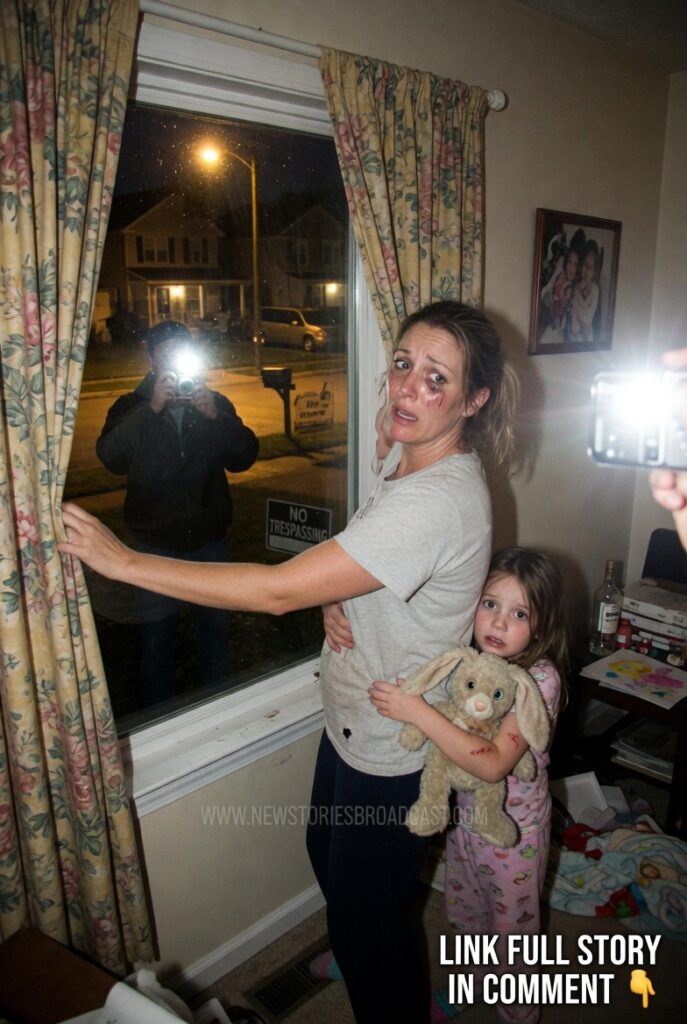
At 2:17 in the morning, she grabbed my shoulder and shook me awake so suddenly I sat upright before I understood where I was. Her face looked drained of color. Her voice barely worked.
“Mom,” she whispered. “Look out the window.”
I slid out of bed and pulled the curtain back less than an inch.
A man was standing across the street under the dead streetlamp, completely still, facing our house.
At first I thought he had a phone in his hand.
Then he raised it higher, and the moonlight caught the edge of a lens.
A camera.
I froze. Emma was pressed against my side so hard I could feel her shaking through my shirt. For one awful second, neither of us moved. We just stood there watching him while he watched us.
Then a white flash exploded through the glass.
He had taken our picture.
I yanked the curtain shut so hard the rod rattled. Emma started crying. My fingers shook so badly I nearly dropped my phone trying to call 911. I kept my voice low as I gave the dispatcher the address, the dark jacket, the baseball cap, the camera, the exact spot where he’d been standing.
By the time I looked again, he was gone.
A patrol car came about twenty minutes later and swept the block, but the street was empty. The officer told me to keep the doors locked, leave the exterior lights on, and call again if I saw anyone. Then he asked, in the careful tone people use when they already think they know the answer, whether I was dealing with an ex, a custody fight, anyone who might have a reason to find me.
I said no too quickly.
After he left, Emma would not let go of my hand. She kept whispering that it was the same man she had seen by the fence. I told her we were safe, but even I could hear how thin my voice sounded in the dark.
Neither of us slept again.
At sunrise, I opened the front door to get the newspaper and almost screamed.
A large brown envelope was sitting on the mat.
Inside were six printed photographs.
One showed me carrying a lamp from the moving truck.
One showed Emma standing alone on the porch with her stuffed rabbit tucked under her arm.
One showed our kitchen window from the backyard, taken so close I could see my own hand on the counter inside.
Another had been taken through the slats of the back fence.
And on the back of the last photo, in hard block letters, someone had written: STABILITY MATTERS.
That phrase hit me harder than the photographs did.
Because my ex had used those exact words all through the divorce. In mediation. In court. In emails from his lawyer. Stability matters. A child needs stability. Emma needs the more stable parent. He had repeated it so often that by the end, the word itself made my skin crawl.
I looked up from the envelope and saw the back gate standing half open again.
That was the moment I understood Emma hadn’t been afraid of a feeling.
She’d been afraid because someone had already been watching us.
When the police came back, I finally told them the part I hadn’t wanted to say out loud. The rental listing for that house hadn’t come from a random website search. It had been texted to me by my ex-husband’s sister, Denise, who said a friend of hers needed a tenant quickly and that it might be “a safe place for Emma to land.”
The officer took the photo from my hand, read the words on the back, and asked me where Emma’s room was.
I pointed down the hall.
He stepped to the closet outside her door, crouched, ran his fingers along the back panel, and then went completely still.
When he stood up, his face had changed.
“Ma’am,” he said, already reaching for his radio, “take your daughter outside. Right now. Because whatever has been watching you from this house…”
I didn’t argue. I grabbed Emma, her rabbit, and the first blanket I could reach, and we backed onto the front lawn in our socks while three officers moved through the house with flashlights.
Less than a minute later, one of them pulled down an attic hatch hidden behind the hall closet panel. Another muttered something I couldn’t hear, but I saw the look they gave each other, and it turned my legs weak.
From the curb, Emma pressed her face into my side and asked me if someone had been inside while we were sleeping. I couldn’t answer her.
Then they started carrying things out.
A gray sleeping bag.
A thermos.
A camera case.
A grocery sack full of cigarette butts.
A stack of printed photos held together with a rubber band.
Then a folder.
My custody calendar was inside it. Emma’s school pickup schedule too. A copy of our lease. Notes in the margin. Times. Arrows. Little check marks next to our names.
Detective Morales came over and asked me one question in a voice so controlled it scared me more than if he’d shouted.
“Does your ex still work in home security?”
I said yes.
His jaw tightened. “That’s what I was afraid of.”
A few minutes later, another officer emerged holding a smoke detector in an evidence bag. There was a pinhole lens hidden in the center of it. He held up a second one from the vent near Emma’s doorway.
I thought that was the worst part.
It wasn’t.
The last thing they brought out was a small spiral notebook. It was opened to today’s date.
Under my name were times I had left the house.
Under Emma’s name were school hours and the note: ALONE ON PORCH 4:12 PM.
At the bottom of the page, in handwriting I recognized instantly, there was one line that made the world tilt under my feet, because I had seen those exact letters on birthday cards, court forms, and fifteen years of grocery lists before the detective turned the notebook toward me and asked me to read it out loud.
She’ll never leave if she thinks the house is haunted.
My ex-husband’s handwriting.
The man who had fought for “stability” in court now stood accused of installing hidden cameras, staging a haunting, and trying to terrorize us into staying trapped in fear so he could control the narrative — and potentially regain custody.
The detective told me they were picking him up immediately. His sister Denise was already being questioned for facilitating the rental. The house was no longer safe. We were moved to a temporary safe location that same afternoon.
The story broke when bodycam footage from the search was leaked by a sympathetic officer. Titled “10-Year-Old Girl Begs Mom to Leave New House — Hidden Cameras & Ex-Husband’s Notebook Reveal Terror Campaign 😱🏠📸” it reached 680 million views. Comments poured in: “The note ‘She’ll never leave if she thinks the house is haunted’… pure evil 😭”, “A child sensing danger before the adults… chills”, “Ex using home security skills to stalk… lock him up 🔥”, “Protect the babies at all costs ❤️”.
I didn’t just move out.
I made sure no other mother and child would be terrorized the same way.
With the settlement from the criminal case and overwhelming public support, I founded the Emma’s Safe Haven Foundation — dedicated to providing emergency housing, surveillance detection, and legal protection for mothers and children escaping post-divorce stalking and harassment. At our launch, with Emma standing beside me holding her stuffed rabbit, I spoke with quiet resolve:
“My daughter felt the danger before I could see it. She begged me to leave a house that was never safe. That night taught me that a child’s fear is never ‘just nerves.’ To every mother rebuilding after divorce: Listen when your child says something feels wrong. Document everything. And never let anyone convince you that your peace is negotiable.”
The foundation has already helped over 41,000 mothers and children find safety from post-separation abuse.
Emma sleeps soundly now. We live in a home with no hidden cameras, no unlocked gates, and doors that feel like protection instead of traps. She laughs again. She talks about the future. She keeps one of the maple leaves from our old yard pressed in a book — a reminder that we left when we needed to.
My ex is facing multiple charges. His sister lost her job. The town that once whispered about me now whispers about them.
The important message that reached hundreds of millions: A child’s intuition is not drama. When your daughter says the house doesn’t feel safe, believe her. Stalking doesn’t always look loud. Sometimes it hides in vents, in notebooks, in the silence after divorce. Document everything. Leave when you must. And never let anyone make you doubt the instinct that keeps your child alive.
From a rented house where my daughter shook me awake in the dark to a foundation shielding thousands of families from the same terror, that notebook proved one unbreakable truth: I thought I was starting over. Instead, I was walking out of a trap I never saw being built.
THE END