That was all the realtor needed.
She stepped through the open sliding doors with the photographer behind her, while the three prospective buyers waited just beyond the porch.
Jenna moved toward them.
“Excuse me. There seems to be a misunderstanding.”
The realtor stopped and looked at her.
Jenna pointed around the room.
“This is our family’s beach house.”
I watched my mother lower her wineglass.
For the first time that afternoon, she looked at the walls instead of at Jenna.
Mark finally put his phone away.
He glanced toward the patio, then toward the driveway, where the black SUV was still parked.
The realtor did not argue with Jenna.
She simply turned the folder so I could see the paperwork inside.
The deed.
My name.
The same name that had paid for every repair, every utility bill, every property tax payment, and every expense Jenna had treated like someone else’s responsibility.
I remembered the locksmith’s call that morning.
Jenna had wanted her own code.
She had wanted the house to function as though possession could be created by changing numbers on a keypad.
I had canceled that request.
Then I made the call that brought these people here.
Now the buyers were standing inside, looking at the rooms Jenna had already divided up.
The guest room.
The patio.
The kitchen.
The same places where she had just told my children they did not belong.
Eli was still outside with the broken sailboat.
Zoe still had her purple backpack on.
I walked to them first.
I crouched beside Eli and took the snapped mast carefully from his hands.
“We’re going home,” I told him.
He looked at the cottage.
“But I thought we were staying here.”
I looked through the open doors at Jenna.
“No,” I said. “We’re not.”
Behind me, the realtor began the showing.
Jenna heard it.
Her face changed, not because anyone had shouted at her, but because the house was continuing without her permission.
That was when she finally understood what I had been saying all along.
She had mistaken being welcomed into my home for owning it.
And now the people she had called “real family” were watching the consequences arrive.
The cottage had started as a promise to my children.
After my divorce, I had not bought it because I needed another property.
I bought it because I wanted them to have one place where they never had to wonder whether they were invited.
Six years of extra surgical shifts had paid for part of it.
So had missed vacations, careful investments, and every bonus I could save.
It was not a casual purchase.
It was something I had worked toward while trying to rebuild a life for two children who had already experienced enough change.
That was why the words Jenna used that afternoon hurt more than the broken boat.
“Your kids can’t stay at our beach house.”
She had said it so naturally.
As though the sentence required no explanation.
As though the furniture, the floors, the guest room, the patio, and the refrigerator full of food had somehow changed ownership because she had spent a few weeks there.
She had originally asked for one weekend.
Work was being done at her house, and she needed somewhere for her family to stay.
I agreed.
That one weekend became three early arrival days.
Then twelve suitcases appeared.
Then the kitchen was stocked with Jenna’s wine.
Then our parents were told they would be spending the summer at the “family beach house.”
The language changed before the ownership did.
I noticed it.
I simply did not expect to have to defend the obvious.
That morning, the locksmith called.
Jenna wanted the keypad changed.
She wanted her own code.
The request sounded small when I first heard it.
But it was not small.
A new code would have changed who could enter the house without asking.
It would have turned temporary permission into something that felt permanent.
I canceled the request.
Then I made another call.
I did not tell Jenna.
I did not tell my parents.
I did not announce what I was planning.
I went to work through the rest of the morning knowing that, by the time everyone was raising glasses that afternoon, the cottage would no longer be theirs to claim.
Still, nothing prepared me for what happened when I walked into the room.
Eli had packed for summer.
His astronomy book was there.
So was his flashlight.
Two superhero figures were tucked into his things.
And on top was his notebook.
Summer at the Beach House.
Inside, he had written three simple plans.
Learn to surf.
Sleep on the porch.
See the stars with Dad.
Then the twins broke his boat.
The crack of the wooden mast was sharp enough that I could still hear it after the room went quiet.
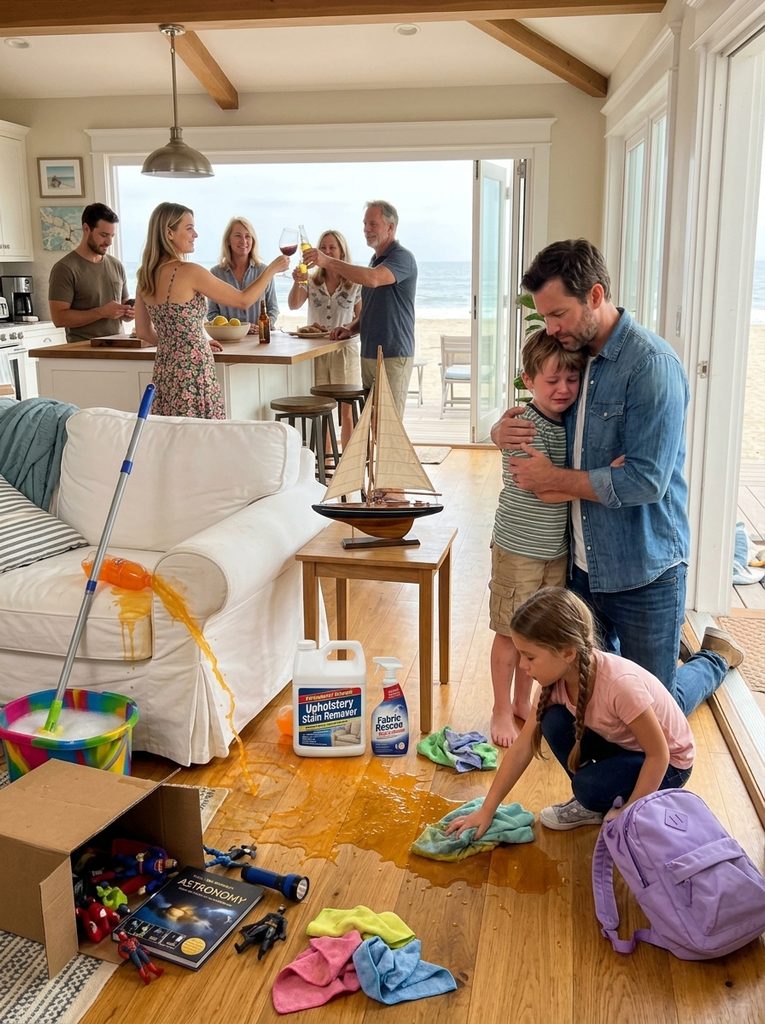
Orange soda spread across the hardwood.
One twin kicked through the cardboard box.
The other tracked sand across the floor.
“Oops,” he said.
Jenna barely reacted.
“Boys, watch where you’re going.”
Then she turned her attention to me.
“The guest room belongs to the twins.”
She told me my children already got enough time with me.
My daughter Zoe stood nearby with both hands wrapped around her purple backpack.
“Where are we sleeping, Daddy?”
That question stayed with me.
Not because I did not know where my children could sleep.
I knew exactly where.
It was because Zoe had heard her aunt claim the house so confidently that she had begun wondering whether her own father had any place left for her inside it.
My mother made it worse.
“Daryl, don’t create a scene.”
She said Jenna’s family needed the place more than I did.
Then she reminded me that I was always at the hospital anyway.
My father looked at the broken boat and dismissed it.
“Kids are kids. It’s just stuff.”
But Eli did not see it as just stuff.
He had built a whole summer around it.
I knelt beside him.
I picked up the chipped blue hull.
Then the snapped mast.
Then the little white sail with his initials written underneath.
“Can it be fixed?” he whispered.
“Yes,” I told him.
I was talking about the boat.
But I was also thinking about something larger.
A child should not have to calculate whether he belongs in his own family’s home.
Jenna did not seem to understand that.
She walked into the guest room and began removing Eli’s folded clothes from the closet.
“These can go in the hall cabinet.”
She said the twins needed the space.
Then she dropped his pajamas on the floor.
Zoe bent to pick them up.
My mother stopped her.
“Leave it, sweetheart. Your aunt is organizing.”
That sentence told me more than an argument would have.
They were not asking anymore.
They were rearranging.
They had already decided that my children were the temporary guests.
Jenna poured herself more wine.
“See? Everyone understands except your father.”
Mark was standing near the kitchen island.
He had never paid a grocery bill for the cottage.
He had never paid a utility bill.
He had never paid a repair invoice.
He had never paid the property tax.
Yet he pointed toward the patio and started talking about a hot tub.
“It’ll increase the value.”
Jenna agreed.
“We were thinking the same thing.”
We.
That was the word that made the situation impossible to misunderstand.
They had begun talking about my property as though it were a shared asset.
Then the orange soda spilled.
Jenna looked at the stain.
“Daryl can hire someone.”
My father laughed.
My mother raised her glass.
“To summer.”
Jenna raised hers higher.
“To real family.”
The glasses touched.
Eli was outside by the open doors with the broken boat pressed against his chest.
Zoe was still holding her backpack.
My parents were drinking.
Jenna was smiling.
Mark was looking at the patio.
And I was standing in the middle of the room realizing that the people who were supposed to know me best had somehow decided that my children were the least important people there.
I did not yell.
I checked my watch.
Nineteen minutes.
Then I sent one message.
Proceed as scheduled.
Jenna noticed me typing.
She smirked.
“Calling a cleaner?”
“No.”
I picked up the spare key beside her wineglass.
Then I slipped it into my pocket.
Her expression tightened.
“What are you doing?”
“Everyone out.”
She stared at me.
“The showing starts in twenty minutes.”
Mark lowered his phone.
My mother looked from him to me.
Jenna laughed once.
But the sound was dry.
“Showing?”
Then she said the sentence that told me she still had not understood.
“You can’t sell our house.”
I did not answer her.
I did not need to.
A black SUV turned into the driveway.
A woman in a navy suit stepped out carrying a thick folder.
A photographer followed her.
Then three prospective buyers.
They crossed the porch and approached the open doors.
Jenna’s wineglass trembled against her fingers.
The realtor opened the folder.
She had the deed.
She had the lock-change authorization.
And she was there because I had asked her to be.
The house had never changed owners.
The family story had.
For weeks, Jenna had been treating access as ownership.
The paperwork said otherwise.
But the deeper problem was no longer the deed.
It was what the afternoon had revealed.
My parents had lifted their glasses with her.
They had watched Eli’s boat break.
They had watched his clothes get pushed aside.
They had watched Zoe wonder where she was supposed to sleep.
And they had called it normal.
The realtor’s presence did not erase that.
It only made the difference impossible to hide.
Jenna had wanted control over the keypad.
She had wanted control over the guest room.
She had wanted control over who counted as “real family.”
Now the only thing she could not control was what the people standing in that room could see for themselves.
The broken sailboat was still in Eli’s hands.
The orange soda was still on the floor.
The guest room was still filled with the evidence of how quickly temporary permission had turned into entitlement.
And the deed was in the realtor’s folder.
Not hers.
Mine.
I went to Eli first.
He looked at the cottage.
“Are we staying here?”
I looked at my son.
Then at Zoe.
Then through the open doors toward the people who had spent the afternoon deciding where my children belonged.
“No,” I told him.
“We’re not.”
The answer was not revenge.
It was a boundary.
Behind me, the realtor began the showing.
Jenna heard the footsteps.
She heard the questions from the prospective buyers.
She saw the photographer moving through the rooms she had already started planning around.
And she finally understood that the house was no longer waiting for her permission.
Neither was I.
The strange part was that selling the cottage did not feel like winning.
It felt like admitting that the place I had bought as a refuge had become tied to a memory I no longer wanted my children carrying.
The house had been supposed to represent belonging.
Instead, for one afternoon, it became the place where my son learned that an adult could break something precious to him and call it “just stuff.”
So I picked up the broken mast again.
I held it carefully.
Eli watched me.
“We can fix this,” I told him.
He nodded.
Maybe the boat would never look exactly the same.
The mast had snapped.
The sail had been pulled loose.
The little hull was chipped.
But it was still his.
And when we walked toward the driveway, Zoe followed beside us with her purple backpack.
The cottage remained behind us.
The realtor continued the showing.
Jenna stood inside the home she had called hers.
And for the first time that summer, my children did not have to ask where they belonged.
They were with me.
The broken boat came too.