The footsteps stopped outside my hospital room.
For several seconds, nobody inside moved toward the door.
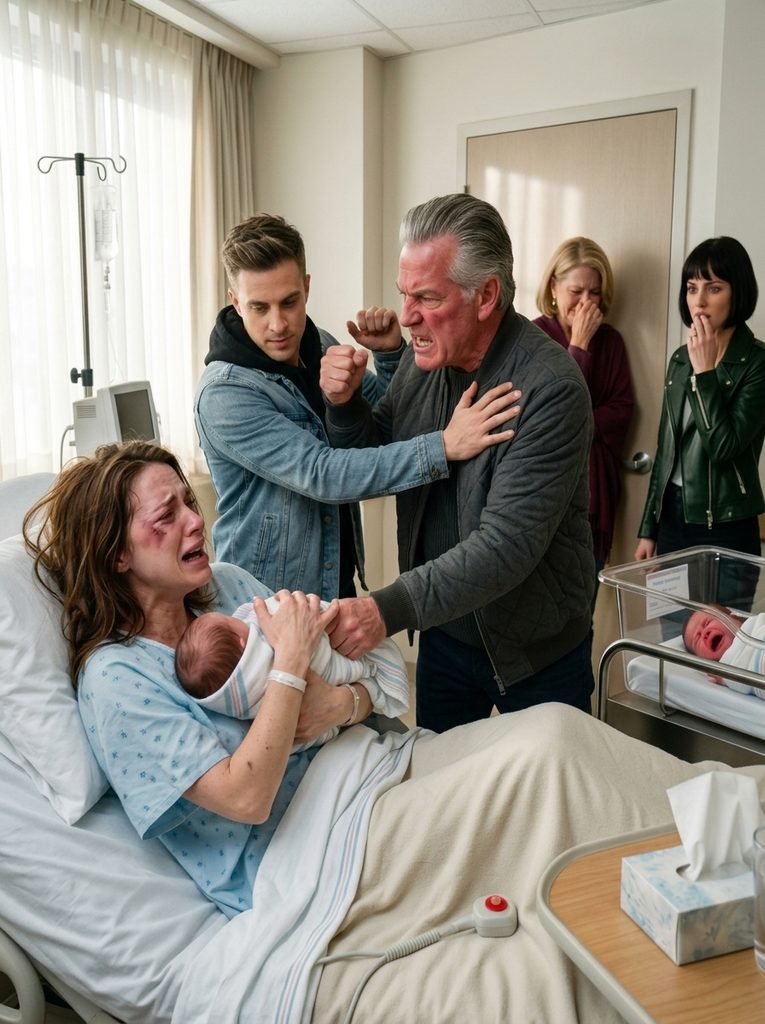
My father stood beside my bed, still carrying the anger he had brought into the room.
My mother remained near the door she had locked.
Carla held the curtain aside.
Mark stood beside the bassinet with Noah in his arms.
And I was still lying there with one hand hidden beneath the blanket.
The tiny panic button was warm against my palm.
I had pressed it twice.
Now I had to trust the plan Ethan had made before he died.
My father looked at the door.
Then he looked back at me.
“You did not just do that,” he said.
I didn’t answer.
My cheek still burned from where he had slapped me.
My abdomen throbbed beneath the hospital sheets.
But the pain was no longer the only thing I could feel.
I could feel the weight of Noah’s cry still hanging in the room.
I could see Lily sleeping in the other bassinet.
And I could hear the footsteps outside.
My father moved toward the door.
The first hospital security officer entered.
A second followed.
Then a police officer stepped into the room and immediately took in the scene.
His eyes went to me.
Then Noah.
Then Mark.
“Put the baby back in the bassinet,” he said.
Mark didn’t move.
My father stepped forward.
“This is a family matter,” he snapped.
The officer kept his voice even.
“Put the baby back.”
Mark finally looked down at Noah.
My son’s tiny face was red from crying.
His little hand had curled against the blanket.
Mark’s arms loosened.
He lowered Noah carefully into the bassinet.
I watched every inch of the movement.
When Noah was safely down, I finally let out the breath I had been holding.
My mother started crying.
“We were only trying to help,” Denise said.
Carla nodded quickly.
“She just lost her husband. She’s not thinking clearly.”
My father pointed toward me.
“She can’t manage anything right now.”
The officer turned toward me.
“Are you the mother?”
I nodded.
“Did you give them permission to take your son?”
“No.”
The word came out weak.
But it was clear.
My father immediately interrupted.
“She doesn’t understand what she’s saying.”
The officer looked at him.
“I asked her.”
That was the first moment my father realized the room was no longer his.
He had walked in believing four adults could surround one grieving woman and make her surrender.
Now there were people standing between him and my bed.
My father tried another approach.
“You don’t know what she’s like,” he said.
“You don’t know what she has been doing.”
The officer asked him what he meant.
Richard began talking about money.
About Ethan’s estate.
About the house.
About insurance.
About how much responsibility had suddenly fallen on me.
He never mentioned the newborn until the officer asked why Mark had been holding him.
That question made my father pause.
It was a small pause.
But I noticed it.
So did the officer.
My mother began explaining again.
She said Mark was only going to keep Noah temporarily.
She said I could visit.
She said I was exhausted and overwhelmed.
Then Mark spoke.
“He’ll be safer with us.”
The words were almost identical to what he had said before the door opened.
But now there were witnesses.
And now his version had to survive questions.
The officer asked him why.
Mark looked at me.
Then at my father.
Neither one answered for him.
“He needs a stable home,” Mark finally said.
I stared at him.
“You mean until I sign the papers.”
Nobody answered.
The silence was no longer something my family controlled.
The officer asked what papers.
My father immediately said there were no papers.
I looked toward the bedside table.
A stack of documents sat where Richard had placed them earlier.
They had been pushed partly beneath a hospital folder.
I could see the corner of one page.
I knew exactly what they had wanted me to sign.
They had come prepared.
They had timed their visit while I was still recovering.
They had waited until Ethan was gone.
And they had decided that grief made me easy to control.
But there was something they had not understood.
Ethan had spent the final weeks of his life preparing for the possibility that my family would try.
Two weeks before he died, my father had threatened to “take what was owed.”
Ethan didn’t respond by fighting with him.
He responded by preparing quietly.
He paid for private security for my delivery.
He made sure there was a way for me to call for help without reaching across the room.
And he gave instructions for what should happen if I ever activated that emergency signal.
At the time, I had thought the button was simply another precaution.
Lying in that hospital bed, I understood why he had insisted on it.
My father had not come to comfort me.
He had come because he believed I had no strength left.
He was wrong about that.
But I was not ready to pretend I wasn’t afraid.
I was afraid.
I was exhausted.
I had just buried the man I loved in my mind while carrying two newborns into a life he would never see.
I wanted Ethan there.
I wanted him to walk through that door.
I wanted him to take one look at my family and know exactly what to do.
Instead, I had his plan.
And I had my children.
The police officer asked my father to step away from the bed.
Richard refused.
He said he was my father.
He said he had rights.
He said he was protecting his grandchildren.
The officer did not debate him.
He simply repeated the instruction.
My father finally stepped back.
That was when Mark spoke again.
“You’re making this worse.”
I looked at him.
“You took my son.”
“You said he would be safer with you.”
Mark’s expression tightened.
“I was trying to help.”
“No,” I said.
“You were trying to get me to sign.”
He looked toward the paperwork.
That was enough.
The officer asked who had prepared the documents.
My father said they were private.
The officer told him they could discuss paperwork separately.
The immediate issue was the newborn.
My mother started crying harder.
She said we were all grieving.
She said the family needed to stay together.
But something had changed.
The argument was no longer about whether I was a grieving widow.
It was about who had the right to decide what happened to my child.
And for the first time, that question was being asked with me in the room.
I pulled my hand from beneath the blanket.
The tiny button was still in my palm.
I looked at it for a second.
Ethan had bought that protection because my father had threatened to take what he believed belonged to him.
My father had thought the answer was money.
But the thing Ethan had protected most carefully was not the estate.
It was my ability to say no.
The officer asked whether I wanted my family removed from the room.
I looked at Lily.
She was still asleep.
Then I looked at Noah.
His eyes were open now.
He was quiet.
I nodded.
“Yes.”
My mother stared at me.
“You would do this to your own family?”
I didn’t answer.
Richard did.
“This is your father’s house you’re talking about.”
“No,” I said.
His face tightened.
“The house is Ethan’s.”
He started to speak again.
Then stopped.
Because the officer had noticed the documents.
He asked my father to leave them on the table.
Richard hesitated.
That hesitation told me more than his shouting had.
He had come prepared.
He had expected me to sign.
And he had expected no one to stop him.
The officer remained beside the table while my family gathered near the door.
Mark looked at Noah one last time.
For the first time since he had taken my son from the bassinet, he did not look certain.
My mother kept trying to explain.
Carla kept insisting there had been a misunderstanding.
Richard said he would not be pushed out of his daughter’s room.
But the room had already changed.
The locked door was open.
The bassinet was beside me.
My son was back where he belonged.
And my father no longer controlled who could hear me say no.
Before they left, Richard turned toward me.
“You’re going to regret this.”
I looked at him.
“I already regret trusting you.”
He stared at me for a moment.
Then the door closed behind him.
I expected relief.
Instead, I felt something heavier.
Because the immediate danger had passed, but the reason they had come was still sitting on my bedside table.
The paperwork.
The estate.
The threats.
And whatever Ethan had arranged beyond the emergency button.
I asked the officer whether the attorney Ethan had named had been notified.
He checked the information connected to the security service.
Then he nodded.
“Yes.”
My heart began pounding.
Not because I was afraid of my family anymore.
Because Ethan had left something behind.
Something he had expected me to need.
The next morning, the attorney came to speak with me.
He did not begin by talking about money.
He asked about Noah.
Then Lily.
Then whether I wanted my parents contacted again.
I said no.
He accepted that answer.
Only after that did he explain what Ethan had put in place.
My husband had not simply paid for security.
He had made sure that nobody could pressure me into making major decisions while I was recovering from childbirth and grieving his death.
The attorney had instructions to keep certain matters from moving forward until I was ready.
That meant my father’s plan could not simply become reality because I was too exhausted to fight it.
But there was another detail.
The papers Richard had brought were not the final documents they had hoped I would sign.
They were an attempt to get me to give up control voluntarily.
My father had been counting on my fear.
He had mistaken exhaustion for surrender.
The attorney placed the papers back into their folder.
“You don’t have to decide anything today,” he told me.
I looked toward the bassinet.
Noah was sleeping beside Lily.
For the first time since Ethan died, I felt like I could breathe without apologizing for it.
My family had wanted me to prove I could handle everything immediately.
Ethan had done the opposite.
He had made room for me to heal.
Weeks passed.
I did not see my parents.
I did not sign anything they sent.
I did not let their threats become my schedule.
The twins grew.
Lily’s dark hair became thicker.
Noah kept making the same little expression Ethan used to make whenever he was pretending not to smile.
Sometimes that expression hurt.
Sometimes it made me laugh.
The house was quieter than it had been when Ethan was alive.
But it was ours.
I kept the two yellow blankets he had chosen.
For a long time, I couldn’t decide where to put them.
They had been meant for the twins to use when Ethan brought them home.
He never got that chance.
So I folded them and placed them in the nursery drawer.
Months later, on a morning when sunlight came through the window, I took them out again.
Lily was sleeping.
Noah was awake.
I wrapped him in one of the blankets and held him against my shoulder.
The same object that once reminded me of everything I had lost now covered the child Ethan had tried so hard to protect.
The panic button was still under the hospital bed where I had left it.
I never wanted to press one like it again.
But I kept the memory of that small vibration.
Not because it saved me by itself.
Because I had used it when I finally understood that saying no was also a form of protecting my children.
My family had walked into that hospital room believing they could decide what happened next.
They left without that power.
And when Noah reached for the edge of his yellow blanket, I tucked it gently around him and whispered his father’s name.
This time, I wasn’t waiting for Ethan to come through the door.
I was carrying what he had left me forward.