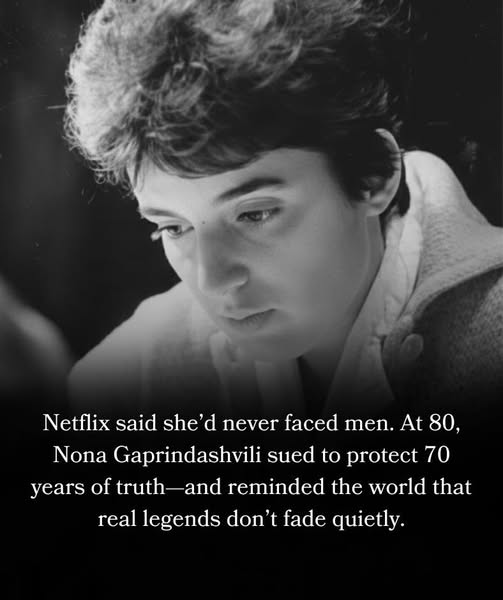
At nearly eighty years old, Nona Gaprindashvili had already beaten the world. She’d beaten champions. She’d beaten grandmasters. She’d beaten a chess culture that told women to stay quiet and stay separate. What she didn’t expect was to be erased by a streaming service. October 2020. The Queen’s Gambit explodes onto Netflix. Millions watch. Chess boards sell out. A fictional girl becomes a symbol of female brilliance. Then a single line appears on screen. “There’s Nona Gaprindashvili,” a character says,
“but she’s the female world champion and has never played against men.”
Nona freezes.
Because by the time that line claims she’d “never faced men,” she’d already beaten many of them.
She wasn’t offended.
She was erased.
Nona was born in 1941 in Zugdidi, Georgia—the only girl among six children. Her brothers taught her chess, expecting her to lose. She didn’t.
By eleven, she beat them all.
By twelve, she replaced her brother at a tournament—and crushed the strongest player there.
At twenty-one, she didn’t just win the Women’s World Championship.
She obliterated it.
For sixteen years, no woman came close. But Nona wasn’t satisfied. A women’s title felt like a fence, not a crown.
So she walked through the gate no woman was supposed to cross.
She entered men’s tournaments.
Not exhibitions. Not charity matches. Real competitions. Real stakes.
She beat grandmasters. She drew legends. She won tournaments where no woman had ever finished near the top.
In 1977, she entered an elite open tournament in California—no women’s section, no protection.
She tied for first place.
History blinked.
The following year, chess had no choice.
They gave her the Grandmaster title—the real one. Same title as Fischer. Same title as Kasparov. No prefixes.
First woman. Ever.
Decades later, Netflix told the world she’d “never faced men.”
So Nona did what she’d always done when people underestimated her.
She made a move.
At eighty years old, she sued Netflix for $5 million—not to get rich, but to set the record straight.
Netflix argued fiction gave them freedom to lie.
A federal judge disagreed.
You can’t use a real person’s name, place them in history, and rewrite their achievements as fact.
Netflix settled.
Quietly.
And Nona went back to the board.
At eighty-one, she won another world championship.
Because she never stopped proving people wrong.
Beth Harmon inspired millions.
But Nona Gaprindashvili made that inspiration possible.
She didn’t imagine equality.
She enforced it.
Across sixty years. Across continents. Across courtrooms.
And when Hollywood tried to rewrite her legacy, she reminded them of something chess teaches better than anything else:
Every move matters.
And the truth always finds its way to checkmate.