When the sky turned black at noon, a 19-year-old teacher had minutes to decide: stay and freeze, or walk into a storm that was killing everyone it touched.
January 12, 1888. The morning arrived gentle across the Nebraska plains, almost deceptively so. Children walked to school without heavy coats, laughing in air mild enough to feel like spring. Minnie Freeman felt it too as she unlocked the door of her one-room sod schoolhouse near Mira Valley. At nineteen, she was barely older than some of her students, yet she carried the full weight of their safety on narrow shoulders.
The lessons began ordinarily. Arithmetic. Reading. The small coal stove kept the chill at bay. Then the light changed.
What had been pale winter sun dimmed into something Minnie had never seen before. By noon, darkness fell like a curtain dropping. The wind began to howl, not with the playful voice of weather passing through, but with rage that shook the walls. Minnie stopped mid-lesson. She had grown up on these plains. She knew storms. But this felt different. This felt alive.
Then it struck.
The temperature collapsed with terrifying speed. Within minutes, the mild air became deadly, plunging toward forty below zero. Wind tore across the land at impossible speeds, screaming and relentless. Snow didn’t fall — it attacked, slamming into the schoolhouse like thrown stones. The building groaned. The walls shuddered. Then the door exploded inward, ripped from its hinges by the force of ice and wind.
Thirteen children turned to look at Minnie.
Some were crying. Others sat frozen in shock. Their cheeks were already turning red. Their small hands were shaking. Fear climbed into Minnie’s throat, sharp and metallic. She felt it rise, demanding attention. But she refused to let it settle there.
In that moment, Minnie understood something with absolute clarity: No one was coming. The storm was too sudden, too violent. If they stayed in this schoolhouse, the cold would claim them one by one, quietly and without mercy. Waiting would be the same as surrender.
So she chose to move.
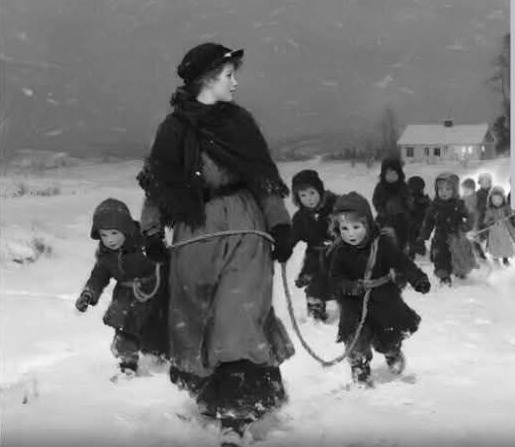
Minnie worked quickly, her hands steady even as her heart hammered. She remembered a ball of twine she’d confiscated from a student days earlier. She found it and began tying the children’s hands together so no one could be lost in the white void outside. She wrapped them in every scarf, coat, and blanket the schoolhouse held, even pulling off her own cloak. Then she lifted the smallest child into her arms, looked at the others, and said what she hoped was true: “Stay together. Follow me.”
She opened the door and stepped into the storm first.
The blizzard swallowed them whole.
Visibility vanished. They could see nothing but white chaos in every direction. The wind tore at their faces with fingers of ice, pulling at their clothes, trying to rip the children from her grasp. Each step forward felt like walking through water. Snow burned their exposed skin. Cold numbed their fingers and toes within seconds. The children stumbled. Some cried. Others went silent with exhaustion and fear. But they held on to that twine, trusting Minnie with everything they had because there was no other choice.
Minnie pushed forward anyway.
She shouted words of encouragement that the wind devoured instantly. She counted the children over and over, terrified of losing even one. She knew the direction — she walked this path every day between school and the farmhouse where she boarded. But in the storm, certainty became hope. Hope became prayer. Time stretched and warped. Minutes felt like hours. Her legs burned. Her lungs ached from breathing frozen air. The child in her arms grew heavier with each step. Doubt whispered that they were lost, that she had led them into death instead of away from it.
Still, she refused to stop.
Then, through the endless white, a shape emerged.
The farmhouse.
It was barely visible, a dark blur against the storm, but it was enough. Minnie summoned the last of her strength and pushed forward those final impossible steps. When she reached the door and it opened, warm air rushed out like an embrace. Hands reached for them. The children stumbled inside, one after another, all thirteen of them.
Alive.
Across the Great Plains that day, the Schoolhouse Blizzard would claim 235 lives. Families froze within sight of their own homes. Children never made it back from school. Teachers tried to save their students and failed. Entire communities carried scars from January 12, 1888, for generations.
But in one small place near Mira Valley, tragedy was held back by the will of a teenage girl who refused to accept it.
News of Minnie Freeman spread like wildfire. Newspapers across the nation told her story. She became known as “Nebraska’s Fearless Maid.” A wax likeness of her toured the country. Strangers sent her more than eighty marriage proposals. A song was written in her honor: “Thirteen Were Saved.” Awards arrived. Recognition poured in. Yet Minnie never sought the spotlight. She never claimed to be extraordinary.
She had simply done what needed to be done.
Years later, Minnie married and moved to Chicago, where she became an advocate for women’s rights. She lived a long life and passed away in 1943. A mural of her leading those children through the storm now graces the Nebraska State Capitol. An episode of “Little House on the Prairie” was based on her story. Books have been written. Her legend endures.
But perhaps the most powerful truth about Minnie Freeman is this: She was just nineteen years old when she made the choice that mattered most. When the storm came and darkness fell and fear demanded surrender, she chose courage instead. When waiting felt safer than moving, she chose action. When the odds seemed impossible, she chose to try anyway.
And because of that choice, thirteen children who might have been forgotten to history grew up, had families of their own, and told the story of the teacher who walked into a killer storm and brought them home alive.