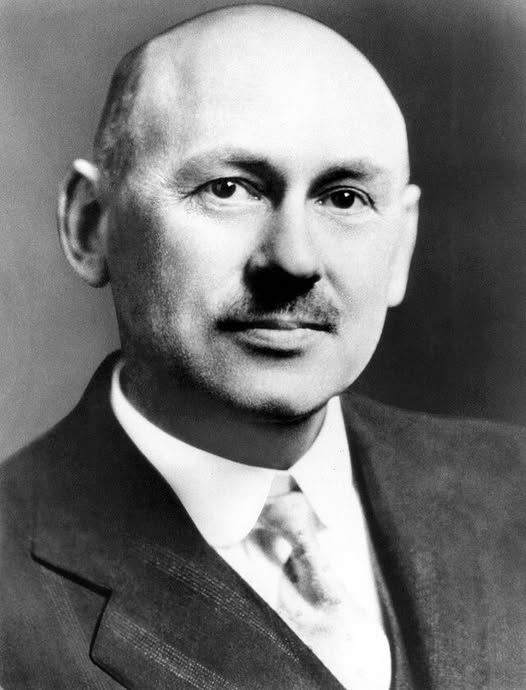
Worcester, Massachusetts. 1920. Robert Goddard stood in his physics lab at Clark University and made a prediction that would make him a laughingstock. He told the world that rockets could one day reach the moon.
The response was brutal.
The New York Times published an editorial mocking him, claiming he lacked “the knowledge ladled out daily in high schools” because everyone knew rockets couldn’t work in the vacuum of space. Colleagues whispered. Students snickered. The press dubbed him “The Moon Man,” and not as a compliment.
Goddard didn’t argue. He just kept working.
On March 16, 1926, in a cabbage patch on his Aunt Effie’s farm in Auburn, Massachusetts, he wheeled out something that looked like plumbing gone wrong. A contraption of metal tubes, tanks, and wires standing awkwardly in the snow. His wife Esther stood ready with a camera. A colleague watched skeptically.
Goddard lit the ignition.
The rocket roared to life, lifted off, and flew for exactly 2.5 seconds before crashing into the frozen ground 184 feet away. It reached an altitude of 41 feet.
By any measure, it was crude. Ungainly. Almost comical.
But it was the first liquid-fueled rocket in history. The moment that changed everything.
Within hours, concerned neighbors had called the fire department. The local marshal showed up and told Goddard in no uncertain terms: no more rocket experiments in Massachusetts. Too dangerous. Too disruptive. Too insane.
So Goddard made a decision that would define his life. If his own state wouldn’t let him build the future, he’d go somewhere nobody cared what he did.
He moved to Roswell, New Mexico, to the middle of nowhere.
He set up shop in a literal shack in the desert, funded by a modest grant from the Guggenheim Foundation that barely covered expenses. His lab was crude. His equipment was cobbled together. He worked with a tiny team while dust storms buried his equipment and rattlesnakes slithered through his workspace.
But out there, away from ridicule and regulations, Goddard was free to solve impossible problems.
How do you keep a rocket engine from melting under its own heat? Goddard invented regenerative cooling, circulating fuel around the combustion chamber.
How do you steer something moving at supersonic speeds? Goddard developed gyroscopic guidance systems and movable vanes that directed exhaust.
How do you prevent catastrophic fuel explosions? Goddard pioneered safe pumping systems and combustion chamber designs.
Every single problem that would later stump rocket programs around the world, Goddard encountered first. And solved. Alone. In a desert shack. With almost no money and even less recognition.
He filed over 200 patents. He built rockets that flew faster, higher, and more reliably with each iteration. By 1935, his rockets were reaching altitudes over 7,500 feet and traveling at supersonic speeds.
The world barely noticed.
Meanwhile, in Germany, a team of scientists was paying very close attention. They studied Goddard’s published papers. They replicated his designs. They scaled them up into weapons, the V-2 rockets that would terrorize London during World War II.
Goddard died in August 1945, just weeks after the war ended. He never saw a satellite orbit Earth. He never saw humans walk on the moon. He died believing his life’s work had been largely ignored by his own country.
Then came the reckoning.
When American forces captured German rocket scientists after the war, military officials asked them how they’d built such advanced rockets. Wernher von Braun, the lead engineer who would later direct NASA’s Apollo program, gave a simple answer:
“We learned it from your man, Goddard.”
American officials were stunned. They’d had the father of modern rocketry in their own backyard, working in obscurity while they ignored him. The patents Goddard held turned out to be so fundamental that the U.S. government eventually paid his estate $1 million for the rights, acknowledging that every American rocket program was built on his work.
In 1969, when Apollo 11 landed on the moon, The New York Times finally printed a retraction of their 1920 editorial mocking Goddard. It took them 49 years to admit: he was right.
Today, every rocket that launches carries Goddard’s DNA. The SpaceX Falcon. The Atlas V. The rockets that sent rovers to Mars and telescopes beyond our solar system. All of them use liquid fuel propulsion, gyroscopic guidance, and cooling systems that trace directly back to a man working alone in a New Mexico desert.
NASA’s Goddard Space Flight Center bears his name. His Aunt Effie’s cabbage patch, where that first primitive rocket flew 41 feet, is now a National Historic Landmark.
Robert Goddard spent his life being called a fool for believing something impossible. He died never knowing he’d been proven right.
But every time a rocket lights up the sky and climbs toward space, his vindication burns brighter than any mockery ever could.
The neighbors called the police on him. History calls him the father of space flight.