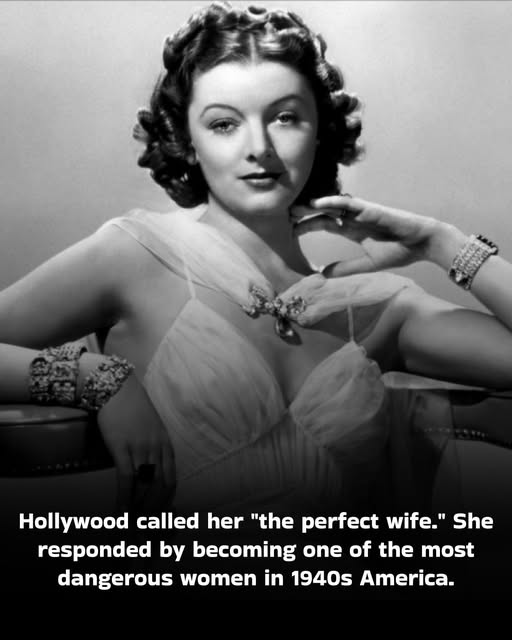
Myrna Loy was box office gold in the 1930s and 1940s. Audiences adored her as Nora Charles in The Thin Man films—witty, sophisticated, the ideal partner who could match her husband martini for martini and quip for quip. MGM literally marketed her as “The Perfect Wife,” pairing her with every leading man in Hollywood: Clark Gable, Cary Grant, Spencer Tracy. America loved her. The studio loved her. Everyone thought they knew exactly who Myrna Loy was.
They had no idea.
Behind the glamorous image, Myrna Loy was quietly becoming one of Hollywood’s most radical voices. And she didn’t care what it cost her.
In the early 1940s, while filming one of her charming comedies, Loy walked onto a segregated set. She saw Black actors forced to use separate facilities, eat separately, be treated as inferior.
She stopped production.
“I won’t work under these conditions,” she told the studio executives. Not as a publicity stunt. Not with fanfare. She simply refused to continue until Black cast and crew were treated equally.
The studio could have fired her. She was replaceable—Hollywood always had another pretty face waiting. But Loy had leverage: she was too popular, too profitable. They changed the policy.
She did this repeatedly. Different studios. Different films. Always the same quiet ultimatum: integrate or I walk.
Most of her white co-stars said nothing about segregation. Myrna Loy risked her career over it.
Then came World War II.
At the height of her fame, earning top dollar, Myrna Loy did something unprecedented: she stopped acting entirely. She suspended her career to work for the Red Cross, then the War Department. She wasn’t selling war bonds at glamorous rallies—she was doing the actual administrative work, coordinating relief efforts, helping refugees.
Her studio was furious. She was walking away from millions. She didn’t care.
“There are more important things than movies,” she said.
When the war ended, Hollywood had changed. The House Un-American Activities Committee began hunting for “communists” in the film industry. Careers were destroyed on rumor and accusation. The blacklist grew longer every week. Most stars stayed silent, terrified of being associated with anyone controversial.
Myrna Loy spoke up.
She publicly condemned the committee. She called the hearings “witch hunts.” She defended colleagues who’d been blacklisted. She aligned herself with civil liberties organizations that the government considered suspicious.
Her agents begged her to stop. Studios warned her. Conservative columnists attacked her. The FBI opened a file on her.
She kept talking.
“I’m not going to be frightened into silence,” she said. “That’s exactly what they want.”
This wasn’t theoretical courage—it had consequences. Her film offers decreased. Studios became nervous about hiring her. She was still famous, still talented, but suddenly “difficult” to work with.
The perfect wife was becoming inconvenient.
Here’s what makes this remarkable: Myrna Loy was never a Communist. She had nothing to hide. She could have stayed quiet, kept working, protected her career. She opposed McCarthyism purely on principle—because she believed in freedom of speech and thought, even for people she disagreed with.
In the 1960s and 1970s, when the women’s movement emerged, Myrna Loy was already in her sixties and seventies. She joined anyway. She marched. She spoke at rallies. She famously said, “You don’t have to be anti-man to be pro-woman,” articulating a version of feminism that many found threatening.
She never stopped.
Through all of this—the activism, the political stands, the career risks—here’s the most baffling thing: The Academy never nominated her for an Oscar. Not once.
She appeared in over 120 films. She was ranked among the top box office stars for years. Critics praised her performances. But the Academy ignored her.
Some say it was because she did comedy, and the Oscars have always undervalued comedy. Others suggest her political activism made her unpopular with Academy voters. Whatever the reason, one of Hollywood’s biggest stars was systematically overlooked.
In 1991, two years before her death, the Academy finally gave Myrna Loy an honorary Oscar, acknowledging her “extraordinary contribution to the art of film.”
She was 85 years old. She’d been fighting for civil rights, women’s rights, and human decency for fifty years.
Better late than never, perhaps. But also: too late to undo decades of deliberate oversight.
Myrna Loy died in 1993 at age 88. By then, many had forgotten her films. Few remembered her activism. Hollywood had moved on to new perfect wives, new idealized women.
But here’s what they couldn’t erase: Myrna Loy proved you could be glamorous and radical. Commercial and principled. America’s sweetheart and a dangerous woman.
She played the perfect wife on screen. In real life, she refused to be perfect, refused to be quiet, refused to let injustice pass without challenge.
The studio heads who marketed her as “The Perfect Wife” never understood the irony.
She was perfect—just not in the way they intended.
She was perfectly willing to risk everything for what was right. Perfectly unafraid of powerful men. Perfectly committed to justice, even when it cost her.
Hollywood wanted a perfect wife. They got a revolutionary.
And she smiled her famous smile and kept fighting anyway.