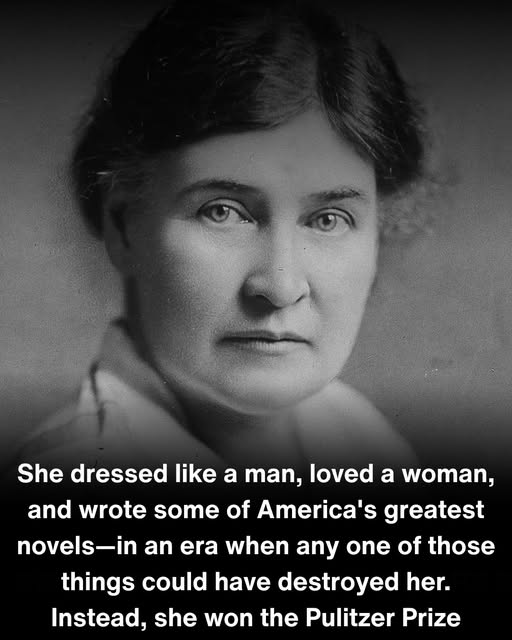
Born in 1873 in Virginia, Willa moved to the Nebraska prairie at age nine. While other girls played with dolls, she roamed the grasslands, befriended immigrant families—Bohemian, Swedish, German—and listened to their stories of survival, loss, and stubborn hope.
The prairie wasn’t pretty or gentle. It was brutal, unforgiving, and magnificent.
And Willa fell in love with it.
But the world had very specific ideas about what young women should do. They should marry. They should have children. They should stay quiet, stay home, stay small.
Willa Cather looked at those expectations and said no.
At the University of Nebraska, she showed up in men’s clothing and a severe haircut, signing her work “William Cather, Jr.” Classmates whispered. Professors disapproved. Society was scandalized.
But Willa didn’t care.
She wasn’t performing masculinity—she was claiming the freedom men took for granted. The freedom to write. The freedom to think. The freedom to live on her own terms.
After college, she moved to Pittsburgh, then New York City, working as a magazine editor while writing fiction on the side.
In 1908, she met Edith Lewis—a young editor with dark eyes and a quiet intelligence that matched Willa’s own.
They moved in together. And for the next forty years, they were partners.
Not roommates. Not friends. Partners—in the fullest sense of the word.
In an era when women could be institutionalized for “deviant behavior,” when loving another woman could cost you your job, your reputation, your freedom, Willa and Edith built a life together in Greenwich Village.
They shared apartments. They traveled together. They grew old together.
And everyone who knew them understood exactly what they were to each other, even if polite society pretended not to notice.
All the while, Willa wrote.
In 1913, she published O Pioneers!, a novel about Alexandra Bergson—a Swedish immigrant woman who inherits her father’s failing Nebraska farm. While her brothers want to sell and escape the brutal prairie, Alexandra sees something they don’t: potential. She experiments with crops, studies the land, and transforms the farm into something thriving.
Alexandra Bergson was strong, independent, and unconventional—a woman who chose land and purpose over marriage and conformity.
Sound familiar?
Then came The Song of the Lark (1915), about Thea Kronborg, a talented girl from a small Colorado town who refuses to let poverty or gender limit her ambitions. She becomes an opera singer, sacrificing conventional happiness for artistic greatness.
And in 1918, Willa published My Ántonia—perhaps her masterpiece.
The novel tells the story of Ántonia Shimerda, a Bohemian immigrant girl whose family nearly starves on the Nebraska prairie. Her father commits suicide in their first terrible winter. Her family is broken by poverty and grief.
But Ántonia survives. She works in the fields like a man. She endures heartbreak. She builds a life through sheer resilience.
The narrator, Jim Burden, loves Ántonia from childhood—not romantically, but with deep, abiding respect. He sees in her something noble: the strength of women who built America with their bare hands while history credited only men.
These novels weren’t just stories. They were radical acts.
Willa Cather took the American frontier—that mythical masculine space of cowboys and heroes—and said: “You’re telling it wrong. Women built this. Immigrant women. Women who worked themselves to exhaustion. Women you ignore.”
She wrote poor immigrant women as heroes. She wrote about the emotional lives of people history considered insignificant. She wrote the prairie not as a backdrop for men’s adventures, but as a living force that shaped everyone who encountered it.
And she did all of this while living openly with Edith Lewis.
The literary establishment noticed.
In 1923, Willa Cather won the Pulitzer Prize for One of Ours, a novel about World War I. She was one of the first women to receive such recognition. Universities gave her honorary degrees. Critics called her one of America’s greatest writers.
But success came with scrutiny.
As her fame grew, so did whispers about her “unconventional” life. Journalists asked invasive questions about her relationship with Edith. She refused to answer. She gave few interviews. She was intensely private—not out of shame, but because she refused to let her personal life become public spectacle.
In her will, Willa forbade the publication of her letters. She knew what people would look for. She knew they’d dissect her life, searching for confirmation of what they already suspected.
She denied them that satisfaction.
Willa Cather died in 1947 at age 73, with Edith by her side.
For decades afterward, literary scholars performed elaborate gymnastics to avoid discussing her sexuality. They called Edith her “companion” or “friend.” They analyzed her novels while carefully ignoring what those novels revealed about their author.
But her books told the truth anyway.
She wrote strong women who rejected conventional marriages. She wrote deep, intense friendships between women that felt like love because they were love. She wrote characters who didn’t fit society’s boxes and survived anyway.
Willa Cather understood something profound: the American West wasn’t tamed by rugged individualist men. It was settled by communities—by immigrant families, by women who did backbreaking labor, by people who didn’t fit the mythology but built the reality anyway.
And she understood this because she was one of them.
A woman who loved women. A writer who dressed like a man. An artist who refused to perform femininity or hide who she loved or write the stories she was “supposed” to write.
The prairie taught her that survival requires stubbornness. That beauty and brutality coexist. That the people history overlooks are often the ones who matter most.
Willa Cather gave America some of its greatest literature—novels that capture the immigrant experience, the pioneer spirit, and the reality of building a nation from nothing.
She did it while living a life that could have destroyed her in a less courageous person’s hands.
She dressed like a man when women couldn’t wear pants.
She loved a woman when loving women was criminal.
She wrote novels about strong, unconventional women when literature was supposed to center men.
And she became one of the greatest American writers of the 20th century.
Not despite who she was—because of who she was.
The same courage that made her cut her hair and call herself William at age sixteen made her write Alexandra Bergson and Ántonia Shimerda: women who refused to be small, who claimed space in a world that wanted them invisible.
Willa Cather proved that the most American story of all is the story of refusing to fit in.
She was told to be quiet, conventional, acceptable.
She chose to be loud, unconventional, and unforgettable instead.
And she won.