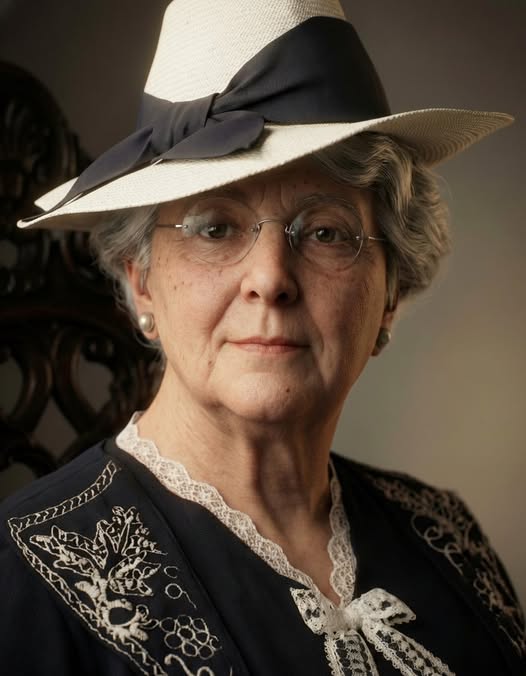
She would never remember her mother.
Before Maud turned two, tuberculosis took Clara Montgomery’s life. Her father, crushed by grief, could not bear the daily reminder of his loss. The child had her mother’s eyes. He left her with his elderly parents in Cavendish, boarded a train west to Saskatchewan, remarried, and built a new family.
The little girl he left behind would see him only rarely again.
Picture that childhood.
No siblings. No soft voices. No sense of being chosen. Only a remote farmhouse, two stern Scottish Presbyterian grandparents, and a silence that seemed to stretch forever. Maud’s grandmother ruled the house with rigid discipline. Her grandfather believed affection weakened character. Praise was rare. Comfort rarer still.
Maud’s imagination had nowhere safe to land.
So she did what lonely children have always done.
She created worlds of her own.
She invented imaginary friends who listened and never judged. She named the trees in the orchard and spoke to them as if they were kind companions. She transformed the rolling green fields and red clay roads of Prince Edward Island into places where wonder lived and girls like her were cherished. By the age of nine, she was filling journals with poetry and private thoughts, giving language to feelings she was never allowed to speak aloud.
Books became her refuge. Writing became her secret promise to herself. One day, she would be a writer. One day, her voice would matter.
The road there was unforgiving.
As a teenager, she was sent west to live with her father and his new wife. The house was crowded. The welcome was cold. Her stepmother resented her presence. Maud felt like an intruder in a life that should have been hers. She lasted only a short time before returning to Prince Edward Island, wounded but resolved.
She earned her teaching certificate. She studied literature at university. She accepted teaching posts she disliked because they paid just enough and left her evenings free. She wrote constantly. Stories. Poems. Anything that would take her out of herself for a few hours.
By her early thirties, she had published more than one hundred short stories. Her name was appearing in magazines. Yet she wanted more than fragments. She wanted to build a world.
In 1905, inspiration arrived from an old notebook entry she had once scribbled and forgotten.
“Elderly couple apply to orphan asylum for a boy. By mistake a girl is sent them.”
That single sentence unlocked everything.
She poured her own loneliness into a red haired, freckle faced orphan named Anne Shirley. She gave Anne the imagination that had saved her as a child. She set the story on the island she loved and resented in equal measure. And she gave Anne what Maud herself had longed for but rarely received. Unconditional love.
When the manuscript was finished, she called it Anne of Green Gables.
Publishers turned it down one after another.
Too long. Too domestic. Too focused on a girl. Not marketable.
Crushed, Montgomery shoved the manuscript into a hatbox and tried to forget it existed. For nearly two years, Anne Shirley sat in that box while Montgomery forced herself to move on, writing other stories and poems, telling herself that this dream was finished.
But Anne refused to disappear.
In 1907, Montgomery opened the hatbox. She revised the manuscript one final time. She sent it to the L.C. Page Company in Boston.
This time, someone understood.
In June 1908, Anne of Green Gables was published. Lucy Maud Montgomery was thirty three years old.
The response was immediate and overwhelming.
The first printing sold out almost at once. Then another. Then another. Within a year, the book had gone through six printings. Readers fell in love with Anne’s chatter, her fierce loyalty, her stubborn hope, her determination to find beauty even in disappointment.
Mark Twain called Anne “the dearest and most lovable child in fiction since Alice.”
Letters arrived from around the world.
The lonely child from Cavendish, the one who had been passed along and overlooked, had found her audience.
Montgomery went on to write eight Anne books, twenty novels in total, more than five hundred short stories, and hundreds of poems. She married a Presbyterian minister. She gave birth to two sons after losing one as an infant. She spent years caring for a husband battling severe depression. She endured the Spanish flu, the devastation of the First World War, and relentless struggles with publishers who exploited her success.
She kept writing anyway.
When Lucy Maud Montgomery died on April 24, 1942, she was laid to rest on Prince Edward Island. The same land that had once felt like a cage had become inseparable from her legacy.
More than a century later, Anne of Green Gables has never gone out of print. It has been translated into dozens of languages and sold tens of millions of copies. Prince Edward Island is now known around the world as Anne’s home, drawing readers who want to walk the paths that once existed only on the page.
But Montgomery’s true legacy cannot be counted in sales or visitors.
It lives in the quiet recognition felt by readers who saw themselves in Anne Shirley. Children who were too loud, too sensitive, too imaginative. Girls who felt unwanted, misplaced, or unseen. Readers who learned that difference was not a flaw, but a strength.
Lucy Maud Montgomery took a childhood shaped by loss and restraint and transformed it into stories that offered belonging to millions.
She showed that imagination is not escape. It is survival.
She proved that the child who talks to trees and dreams of being loved can grow into someone who gives that love to the world.
From a hatbox to a global phenomenon.
From an abandoned toddler to a literary legend.
From private heartbreak to shared healing.
Thank you, Lucy Maud Montgomery.
Thank you for Anne.
And thank you for showing that the girl nobody chose became the writer the world could not do without. “