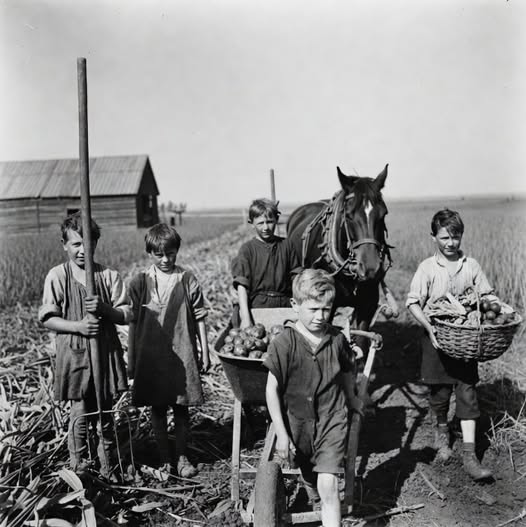
April 1922. Rural Kansas. Both parents dead within one week—mother from a burst appendix, father from a sudden heart attack in the barn. Five children left behind. No relatives nearby. No neighbors close enough to notice. Just Eleanor, fourteen years old, staring at an impossible choice: keep going or let her family starve.
She chose to keep going.
Eleanor became everything overnight. She planted the spring crops exactly as her father had taught her, directing her younger siblings like a general commanding troops. Twelve-year-old Thomas fed the animals twice daily without fail. Ten-year-old Margaret cooked every meal and kept the house running. Eight-year-old Clara worked the fields beside Eleanor from sunup to sundown. Six-year-old James did whatever needed doing—carrying water, collecting eggs, picking rocks from the soil.
They worked harder than children should ever have to work. They survived on determination and muscle memory, following routines their parents had drilled into them over years of farm life. They planted. They weeded. They harvested. They kept the animals alive and the machinery working and the house standing.
But the nights were unbearable.
All five children slept together in their parents’ bed, pressed against each other in the darkness, terrified of being alone. James cried every single night for weeks, sobbing for parents who would never comfort him again. Eleanor held him close and made promises she wasn’t sure she could keep: “It’s going to be okay. We’re going to be fine. I’ll take care of everyone.” She never let the younger ones see her cry. She had decided she was the adult now, and adults had to be strong.
Spring turned to summer. Summer turned to fall. The crops grew. The harvest came. Eleanor loaded grain into wagons and drove them into town to sell—a teenage girl doing a man’s work, and doing it well.
That’s when someone finally noticed.
October 1922. A shopkeeper saw a fourteen-year-old driving a harvest wagon and asked the obvious question: “Where are your parents?”
“They’re dead,” Eleanor said simply. “They died in April. We’ve been running the farm ourselves.”
The sheriff arrived that afternoon. He found five children living alone in perfect order—farm maintained, animals healthy, crops harvested, house clean. They had survived eight months without a single adult knowing they existed.
Within a week, county authorities scattered them to different relatives across Kansas. The farm was sold. The life they had built together—the impossible, heartbreaking, triumphant life—was dismantled overnight.
Eleanor never forgave them for it.
She spent the next sixty-seven years trying to undo what the county did in seven days. She tracked down her scattered siblings. She visited them. She kept them connected. She refused to let bureaucracy have the final word on her family.
At her funeral in 1989, eighty-year-old Thomas spoke: “My sister was fourteen when our world ended. She kept us alive. She kept us together. She planted crops and harvested them. She held our baby brother when he cried every night. She did everything. And when the county finally noticed us and tore us apart, she spent her whole life putting us back together. She was fourteen years old when everything disappeared. She didn’t disappear with it. That’s Eleanor. That’s who she was.”
Sometimes the most extraordinary acts of love happen in complete silence. Sometimes a child becomes a hero simply because giving up isn’t an option. And sometimes, the greatest tragedy isn’t what we lose—but what we’re forced to leave behind when someone finally comes to save us.