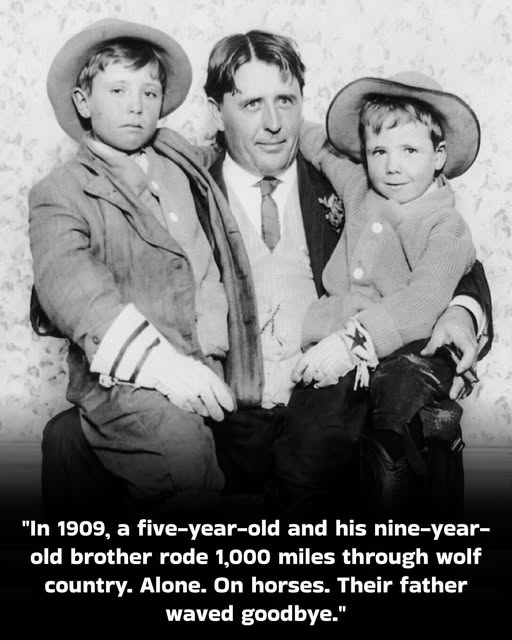
Bud, age nine, checked the saddle straps one final time.
Temple, barely five years old, climbed onto his pony Geronimo from a tree stump because he was too small to mount any other way.
They were about to ride over 1,000 miles to Santa Fe and back—through territory where armed men still feared to travel alone.
Jack didn’t stop them.
He opened a checking account for each boy. He handed Bud a copy of the New Testament. He gave them some rules: no more than 50 miles a day, no crossing water unless they could see the bottom, say your prayers at night.
Then he watched his children disappear into the wilderness.
What happened next sounds impossible.
Temple contracted dysentery from drinking gypsum water. He sprained both ankles trying to dismount.
One night, Bud stayed awake firing his shotgun into the darkness as a pack of wolves circled their camp while his five-year-old brother slept.
They ran out of food and water between towns. They forded rivers that had drowned grown men. A threatening note arrived at their home, addressed to “The Marshal of Oklahoma”—their father.
Fifty-four days later, they rode into Santa Fe.
Crowds lined both sides of the street. The governor welcomed them at the state capitol.
Then they turned around and rode home.
That was just the beginning.
The following year, 1910, Bud and Temple—now ten and six—decided to ride to New York City to meet President Theodore Roosevelt.
Two thousand miles. On horseback. Alone.
Their pony Geronimo foundered in Hominy, Oklahoma. Temple had to buy a new horse—a red-and-white paint he named Wylie Haynes.
They nearly drowned crossing swollen rivers. Temple developed a 103-degree fever in New Jersey. Doctors ordered him to rest. He got back on his horse the next morning.
Along the way, they became the most famous children in America.
Newspapers tracked their every mile. Crowds ripped at their clothes trying to get souvenirs. An Ohio paper noted: “The Abernathy boys are beating all records for juvenile fame. They couldn’t have become better known if they had got themselves kidnapped and ransomed.”
They met President Taft in Washington. The House of Representatives stopped its proceedings to hear their story.
In New York, Theodore Roosevelt refused to begin his ticker-tape parade until the Abernathy boys took their place right behind him—ahead of his Rough Riders.
A six-year-old and a ten-year-old, on horseback, leading a parade through Manhattan with a million people cheering.
Orville Wright offered to take them up in his airplane.
After the parade, their father suggested shipping the horses home and taking the train back to Oklahoma.
The boys had a different idea.
They wanted to buy an automobile and drive themselves home.
Jack agreed. At the time, there were no driver’s license laws.
Temple’s legs were too short to reach the pedals. So Bud drove while Temple cranked the engine to start it.
They drove 2,000 miles home in 23 days.
In 1911, the brothers accepted the ultimate challenge: ride horseback from the Atlantic Ocean to the Pacific in 60 days or less, never eating or sleeping indoors.
The prize was $10,000.
Temple was seven. Bud was eleven.
They started at midnight on Coney Island, carrying a flask of Atlantic saltwater to pour into the Pacific.
Their horses ran away in the Utah salt flats. The boys spent three days chasing them on foot.
They arrived in San Francisco in 62 days—two days too late for the prize, but they had just set a cross-country horseback record that has never been broken.
In 1913, the Indian Motocycle company offered them a custom-built two-seater motorcycle. Temple was nine. Bud was thirteen.
They rode from Oklahoma to New York City.
That was their final adventure.
Over four years, two children had traveled more than 10,000 miles across America—by horse, by automobile, by motorcycle.
They’d met two presidents. Ridden in a ticker-tape parade. Starred in a silent film. Set a record that still stands over a century later.
Then they grew up.
Bud became a lawyer in Wichita Falls, Texas. He died in 1979.
Temple worked in the oil and gas business. He died in 1986.
Their story has almost disappeared from history.
But once upon a time in America, a five-year-old boy climbed onto a pony from a tree stump because his legs were too short to mount, and his father said: “Say your prayers at night.”
And then watched him ride into wolf country.
That’s not reckless parenting by today’s standards.
That’s a different world entirely.
One where childhood meant something we can barely imagine now.