On the morning of April 16, 2007, Norris Hall at Virginia Tech filled the way it always did. Students arrived carrying backpacks and notebooks, thinking about assignments, exams, and what came next in an ordinary Monday. No one expected history to enter the building with them.
In Room 204, Professor Liviu Librescu prepared to teach his aerospace engineering class. He was seventy-six years old, soft-spoken, disciplined, and demanding in the way professors are when they believe deeply in their students. Few of them knew the full story of his life. Fewer still knew how it would end.
At 9:05 a.m., the fire alarm sounded. Students glanced at one another, assuming it was a drill. Then came the sounds that shattered that assumption. Gunshots echoed through the hallway, sharp and unmistakable, growing closer with each second.
Doors slammed. Classrooms turned into locked spaces with nowhere to go.
Librescu did not hesitate. He had heard violence before. He had lived through it.
Born in 1930 in Ploiești, Romania, he was five years old when fascist persecution reached his family. As a Jewish child, he was forced into labor camps. His father died there. Librescu survived the Holocaust carrying memories that never fully faded. He knew what gunfire meant, and he knew how quickly lives could be erased.
He shouted to his students to move. He ordered them to the windows. The classroom was on the second floor, and fear froze them for a moment. Jumping meant broken bones, pain, uncertainty. Staying meant something far worse.
“Go. Now,” he told them.
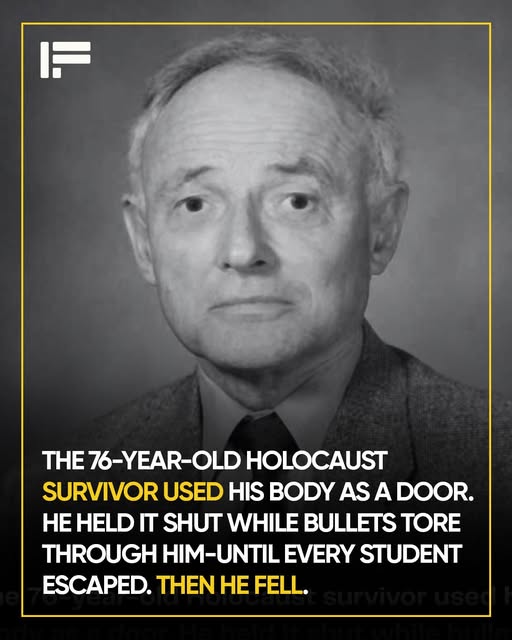
As students climbed out and dropped to the ground below, Librescu moved to the door. He braced himself against it, using his body to keep it shut as the shooter reached the room and fired through the wood. He did not step away. He did not retreat. He stayed where he was, holding the barrier as long as there were students still escaping.
One by one, they cleared the windows. Some landed hard. Some were injured. All of them lived.
Only after the room was empty did the door give way. Liviu Librescu was killed where he stood.
That day, thirty-two people were murdered at Virginia Tech before the gunman took his own life. It became one of the deadliest school shootings in American history. Yet inside Room 204, nearly every student survived because one man chose to stand instead of run.
Librescu’s life before that morning was marked by resilience. After the war, he became a leading aerospace engineer in Romania, publishing influential research despite discrimination under the communist regime. His Jewish identity limited his career and his freedom. For years, he applied to emigrate and was denied. Only in 1978, after intervention by Israeli Prime Minister Menachem Begin, was he allowed to leave.
He rebuilt his life in Israel and later in the United States, joining Virginia Tech in 1985. He published hundreds of papers, mentored generations of engineers, and earned international respect. He had escaped persecution, rebuilt his future, and found peace.
On April 16, 2007, he gave all of that away to protect students who trusted him.
Those students never forgot. They spoke of his voice urging them to jump, of knowing he was holding the door while shots rang out behind them, of surviving because he refused to move. His funeral in Israel drew thousands. Romania posthumously honored the man it once marginalized. Virginia Tech established scholarships in his name.
Liviu Librescu survived humanity’s darkest chapter as a child. When violence returned decades later in a different form, he chose not to survive again at someone else’s expense.
He became the barrier.
He became the door.
And because of that choice, his students carried on living.