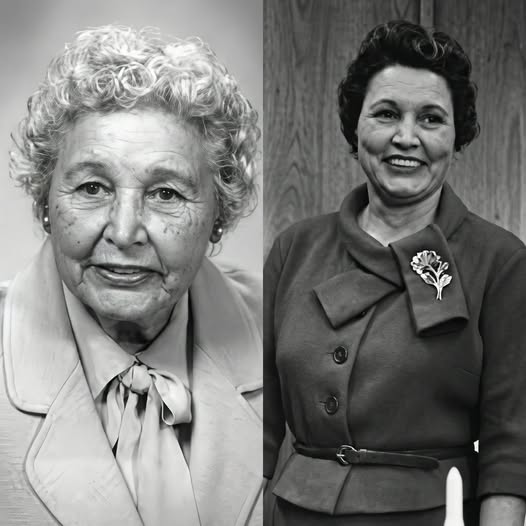
She did not touch the stars.
She calculated the paths that made touching them inevitable.
Mary Golda Ross was born in 1908 in Oklahoma, into the Cherokee Nation, in a family where education was not aspiration but obligation. Knowledge had always been a form of survival for her people. Treaties were broken with words. Land was taken with paper. To understand systems was to endure them. Mary learned early that numbers could be shields as much as tools.
She loved mathematics not for abstraction but for its clarity. Equations did not lie. They did not shift standards depending on who was speaking. They either worked or they did not. In a world that treated Native Americans as historical artifacts and women as technical assistants, math offered something rare. Authority without permission.
She became a teacher first because teaching was one of the few professions available to women who excelled. But her aptitude reached beyond classrooms. When World War II reshaped American industry and engineering talent was suddenly scarce, doors that had been sealed cracked open just enough.
Mary Golda Ross stepped through one of them.
She was hired by Lockheed Aircraft Corporation and assigned to its most secretive division. Skunk Works. A place where projects were not announced, failures were buried, and success was often invisible until it changed the world. It was a room full of men designing futures faster than the public could imagine.
She was the only Native American.
One of very few women.
And one of the sharpest minds in the room.
Her work was not about building engines or fuselages. She worked at a more foundational level. Trajectories. Orbits. Re entry paths. The mathematics of leaving Earth and not dying in the attempt. She helped develop the equations that determined how a spacecraft could move from one gravitational body to another. How it could slingshot. How it could return.
This was not science fiction.
This was survival math.
If a calculation was wrong, astronauts would not miss a target. They would miss existence. Mary’s work required precision that bordered on unforgiving. She had to account for forces no human had yet experienced firsthand. Heat. Velocity. Curvature. Time. She worked in abstraction because reality had not caught up yet.
She helped write NASA’s Planetary Flight Handbook, a document that would become foundational for space exploration. It laid out the mathematical principles for interplanetary travel. Not one mission. Not one launch. The entire logic of how humans would move beyond Earth.
The Apollo program rested on this groundwork.
Astronauts whose names became legends followed paths calculated by people whose names were never spoken aloud. Mary Golda Ross was one of them.
Because her work was classified, she could not talk about it. Because she was a woman and Native American, the institutions that benefited from her brilliance had no interest in elevating her publicly. Because she did not seek attention, history learned how to overlook her easily.
She let the math speak.
She remained at Skunk Works for decades, contributing to projects that pushed the boundaries of aviation and spaceflight. When she retired, she did something just as radical. She turned back toward education. Toward access. Toward ensuring that Native American students especially young women could see futures that had never been presented to them.
She became an advocate for STEM education long before the acronym became fashionable. She understood that representation was not symbolic. It was structural. If students never see someone like themselves inside the systems that shape the future, they learn to exclude themselves before anyone else has to.
Mary Golda Ross never framed her career as exceptional.
She framed it as necessary.
She knew that Indigenous people had always understood complex systems. Seasonal cycles. Navigation. Astronomy. Mathematics embedded in land and ceremony. Western science did not invent precision. It formalized it. She moved between these worlds without apology.
Her Cherokee identity was not separate from her work.
It informed it.
It grounded her in long term thinking. In responsibility beyond a single lifetime. In the understanding that progress without ethics collapses. That exploration without accountability becomes conquest.
When she died in 2008 at the age of 99, much of the public still did not know her name. But the institutions did. NASA honored her. Engineering societies recognized her. Slowly the record corrected itself.
Today she is remembered as the first known Native American female engineer.
That title matters. But it is not the whole truth.
Mary Golda Ross was a pathfinder.
She helped humanity leave Earth using mathematics precise enough to cross silence and return. She did it while carrying the weight of histories that tried to confine her to the margins. She did it without spectacle. Without permission. Without erasure of who she was.
She proved that space exploration was not just a national project.
It was a human one.
And that the future is not built only by those who plant flags, but by those who calculate trajectories so carefully that everyone else gets to come home.
She did not chase the stars.
She made them reachable.
And the sky has been wider ever since.