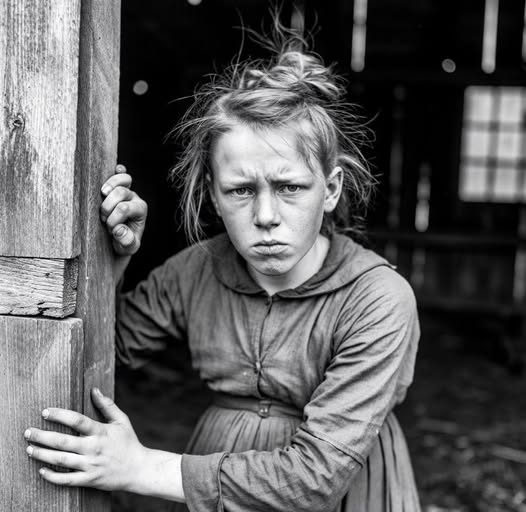
On a frozen January morning in 1916, eleven-year-old Lily Mae crawled across dirt toward a barn. Not because she wanted to. Because her sixty-two-year-old husband told her to stop screaming.
She’d been in labor for eighteen hours.
He sat inside the house, fifty yards away, irritated by the noise. Childbirth was women’s business, he said. He wasn’t interested in watching.
So Lily went to the barn. Alone.
Eleven years old.
The floor was hard and cold. There were no blankets. No water. No mother to tell her everything would be okay. Her own mother had died years before.
She delivered her baby by herself on that dirt floor. When the child slipped into her trembling hands, Lily wasn’t even sure if she’d done it right. She cut the cord with a piece of broken glass. Wrapped the baby in her own dress because there was nothing else.
Then she lay there, bleeding into the hay, holding her newborn daughter, crying quietly.
She was eleven years old.
And she was somebody’s mother.
She named her Ruth.
As the baby breathed against her skin, something fierce awoke inside Lily—something stronger than fear. Stronger than pain. Stronger than everything she’d endured.
Love.
And with it, a promise: No one will ever sell you the way they sold me.
Lily had been sold at ten. Her father traded her for fifty dollars and a cow. Seven months later, she was pregnant. By eleven, giving birth in a barn while a grown man ignored her screams.
For eight years, she survived that house.
Elias was cruel. He beat her. Used her. Treated her like property.
But Lily endured. Because of Ruth.
She kept her daughter close. Taught her to read from an old Bible. Whispered stories about a world where girls weren’t bought and sold like livestock. Ruth grew up believing her mother was the strongest person alive.
She was right.
At nineteen, Lily had already lived more pain than most people experience in a lifetime—and she’d kept her child safe through all of it.
Then one evening in 1924, Elias made an announcement at supper. Casual. Like he was discussing the weather.
He’d arranged Ruth’s marriage. Man named Silas Combs. Fifty-seven years old. Seventy-five dollars. Wedding next month.
Lily stopped breathing. The room went silent except for the pounding in her ears.
He was going to do it again. To her baby.
Every bruise. Every night. Every humiliation she’d survived—he was about to hand it all to Ruth like it was tradition. Like it was normal.
Something inside Lily broke. Not fear. Something harder. Resolve.
That night, after Elias fell asleep, Lily shook Ruth awake. “We’re leaving,” she whispered.
They packed almost nothing. A few clothes. A little food. Hope.
They climbed out the window and walked. Fifteen miles through darkness to a cousin Lily hadn’t seen in eight years. Fifteen miles of cold and terror.
But every step meant Ruth was still free. So Lily kept walking.
At dawn, Elias found them.
He rode up fast, shouting, and grabbed Ruth first.
Lily fought like an animal. Scratching. Biting. Throwing herself at him with everything she had. She wasn’t strong—but she was desperate.
He struck her with the butt of his rifle.
The sound was sickening. Lily fell. Didn’t get up.
Ruth screamed—but then bit his hand and ran. Ran toward the cousin’s house. Ran without looking back, even though her mother lay bleeding in the road.
They carried Lily inside. Sent for a doctor. But he only shook his head. Fractured skull. Nothing to be done.
She woke once. Just once.
Her first words weren’t about herself. They were: “Is Ruth safe?”
Yes, they told her. Ruth is safe. Elias is gone. No one will ever sell that little girl.
Lily smiled. A small, tired, peaceful smile. “Good,” she whispered. “That’s all that matters.”
Thirty minutes later, at nineteen years old, Lily Mae died.
She’d spent eight years protecting her daughter. And she died doing exactly that.
Ruth lived to eighty-two. Never married—she said she couldn’t. But she became a teacher. Helped women escape violent homes. Fought for laws against child marriage. Adopted a child of her own.
She spent her entire life making sure no little girl would be sold the way her mother had been.
At Ruth’s funeral in 1998, her daughter said: “My grandmother was eleven when she gave birth alone in a barn. Married to a sixty-two-year-old man. She survived eight years of abuse to protect her daughter. And when he tried to sell my mother the same way, she ran. She died saving her child. She was a child who saved her child. That is the bravest thing I have ever heard.”
Some people become mothers when they’re ready. Lily became a mother when she was still a child herself.
But love doesn’t wait for age. And sometimes the smallest, youngest, most forgotten girls carry the fiercest hearts of all.