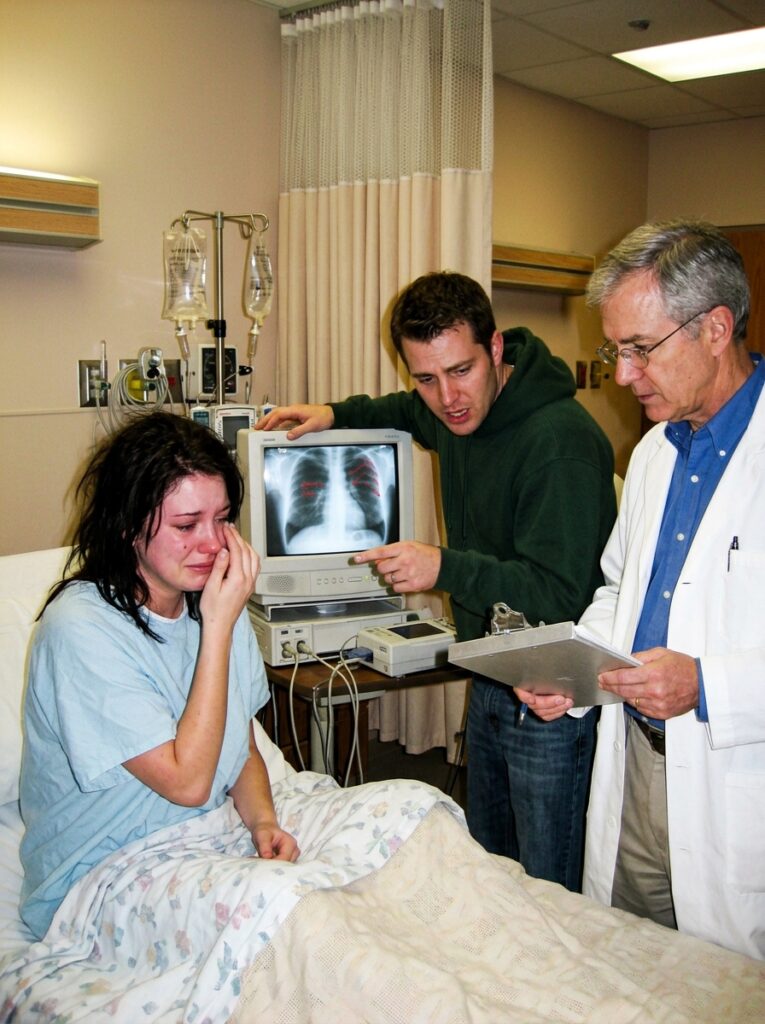
My brother saw my CT scan and then revealed the crime my husband had hidden for years.
My husband kept his hand on my lower back as we walked through the automatic doors of the Regional Hospital of Santa Misericordia, and for the first time in twelve years of marriage, his touch made my stomach turn.
Not because it was rough. Not because it was cold. Trent had never been the kind of man who shouted in public or slammed doors where the neighbors could hear. He smiled at nurses. He held doors open for elderly women. He remembered birthdays, anniversaries, and people’s dogs’ names. He had built an entire personality around being calm, composed — the kind of husband every mother would say you should be grateful to have.
But lately, every time he touched me, I felt a strange panic crawl across my skin, as if some hidden part of me knew something my mind still couldn’t understand.
“You’re shaking,” Trent said softly.
“I’m fine.”
“You’re not fine, Maren. That’s why we’re here.”
He said it with that gentle patience that made me feel foolish, childish, difficult. I gripped my purse strap tightly and stared at the polished hospital floor.
For nearly a year, my body had been betraying me.
It started with exhaustion so intense that sometimes I sat on the edge of the bed for twenty minutes before I could stand. Then came the nausea, unexplained bruises, fainting spells, and a dull ache in my left side that woke me before dawn. My hands trembled when I signed checks at the elementary school office where I worked. My blood pressure swung between normal and alarming. I lost weight even though Trent insisted I was eating enough.
Every doctor Trent took me to said something similar.
Stress.
Hormones.
Anxiety.
Maybe grief.
That last one became his favorite. Grief had been his explanation for everything since my mother died two years earlier, even though he seemed to forget that grief doesn’t usually leave a person doubled over on the bathroom floor at three in the morning, sweating through their nightgown.
My brother, however, had never accepted easy answers.
Dr. Caleb Whitaker was three years older than me and had been giving me orders since we were kids in Ohio — checking my bike tires before I rode off and interrogating my high school boyfriends like a miniature prosecutor. Now he was Chief of Surgery at St. Mercy Regional Hospital in Columbus, and when I finally called him after fainting in the supermarket parking lot, he didn’t ask if I was anxious.
He asked, “Has anyone done a full abdominal CT scan?”
I told him no.
There was silence on the line.
Then Caleb said, “Come to my hospital tomorrow.”
Trent didn’t like that.
He pretended he did, of course. He kissed my forehead and said, “Whatever makes you feel safe.” But I saw a flicker in his eyes. I saw the tension in his jaw when I told him Caleb wanted to run the tests himself. I watched him go into the garage to make a call he hung up the moment I opened the kitchen door.
Now, standing in my brother’s hospital with Trent’s palm resting lightly on my back, I wondered why I had ever confused control with care.
At the radiology desk, a young woman with copper braids smiled at us. “Maren Doyle?”
“That’s me.”
“Dr. Whitaker has everything ready. We’ll get you checked in.”
Trent leaned over the counter before I could answer. “I’ll stay with her.”
The woman glanced at her screen. “For the CT scan, she’ll go back alone.”
“She gets nervous,” Trent said.
“I’m fine,” I said quickly.
He looked at me. “Honey.”
It was a single word, soft as velvet and tight as a leash.
“I’m fine,” I repeated.
Something shifted in the receptionist’s face. Not much. Just enough. Her smile became smaller, more professional. “Mrs. Doyle, you can follow me.”
As I walked away, I felt Trent’s hand slide off my back.
The CT room was so cold it raised goosebumps on my arms. The technician, a broad-shouldered man named Luis, explained each step in a calm voice. I lay back on the narrow table, stared up at the white curve of the machine, and tried to breathe normally.
“You’re doing great,” he said from behind the glass.
The table moved.
The machine hummed.
A voice told me when to hold my breath.
For those few minutes, I felt an almost complete peace. There was something comforting about being scanned, measured, observed by something that had no opinion of me. The machine wouldn’t ask why I was tired. It wouldn’t tell me to try yoga. It wouldn’t call my symptoms grief. It would simply show what was there.
Then the scan ended.
Luis came back into the room, removed the IV, and helped me sit up. He was still kind, still professional, but the warmth had drained from his face.
“Is everything okay?” I asked.
He didn’t answer right away.
His eyes flicked toward the control room. Then back to me. “Dr. Whitaker is going to speak with you.”
“My brother?”
“Yes, ma’am.”
“Did he see something?”
Luis swallowed. “He’ll explain.”
The air suddenly felt thin.
I got dressed clumsily. When I stepped into the hallway, Trent was already on his feet.
“What took so long?” he asked.
Before I could answer, Caleb appeared at the end of the hallway in a white coat, his expression so strange I almost didn’t recognize him.
My brother had always been composed. Even at our mother’s funeral, he was the one signing papers, thanking guests, carrying casseroles to the refrigerator. But now his face was pale, his mouth tight, and his eyes burned with something that looked too much like fear.
“Maren,” he said. “Come with me.”
Trent stepped forward. “What’s going on?”
Caleb didn’t look at him. “I need to speak with my sister.”
“I’m her husband.”
“I know who you are.”
The hallway fell silent around us.
Trent let out a small laugh. “Caleb, don’t be dramatic.”
Caleb’s eyes finally settled on him. “Sit down.”
Two words. Firm. Clinical. Authoritative.
Trent’s smile faded.
I had never seen anyone speak to my husband like that. And I had certainly never seen him obey. But something in Caleb’s voice made even Trent hesitate.
“Maren,” Caleb said again, softer now. “Please.”
I followed him.
He led me past radiology, past a nurses’ station, and down an administrative corridor I had never seen before. At the end, he opened a door marked Director of Clinical Operations. Inside, a gray-haired woman in navy scrubs stood by a desk, her expression stern.
“This is Dr. Helen Park,” Caleb said. “The hospital director.”
My heart pounded in my ears. “What is she doing here?”
Caleb closed the door behind me.
Caleb didn’t waste time.
He pulled up the CT images on a large screen. My abdomen glowed in shades of gray and white. He pointed to several bright, irregular spots scattered through my liver and kidneys.
“These are heavy metal deposits,” he said, voice tight. “Arsenic levels are off the charts. Chronic exposure. Months, maybe years.”
I stared at the screen, the room tilting around me. “Arsenic?”
Dr. Park stepped forward. “We see this in cases of long-term poisoning. Often intentional.”
The word landed like a slap. Poisoning.
I thought of the smoothies Trent made me every morning. The “special” vitamins he insisted I take. The way he monitored my meals. The times I’d felt worse after “healthy” dinners he prepared when I was too tired to cook.
Caleb’s voice broke. “Maren… Trent has been poisoning you.”
The evidence poured out. Caleb had run additional blood tests while I was in the scanner. Arsenic. Antimony. Trace amounts of other toxins. All consistent with slow, deliberate administration.
Trent had been killing me slowly for years.
I collapsed into a chair, shaking. Caleb knelt in front of me, tears in his eyes — the first time I had seen my strong brother cry since we were children.
“I’m so sorry I didn’t push harder sooner,” he whispered. “I’m so sorry.”
Dr. Park was already on the phone with hospital security and the police.
When they brought Trent into the room minutes later, he still wore that calm, concerned-husband mask.
“What’s going on?” he asked, reaching for me. “Baby, are you okay?”
I looked up at the man I had loved, trusted, and slept beside for twelve years.
And I saw the monster behind the mask.
Caleb stood between us. “Don’t touch her.”
Trent’s smile faltered. “Caleb, this is a family matter—”
“No,” my brother said. “This is attempted murder.”
The police arrived. Trent’s calm finally cracked when they read him his rights. He looked at me with something between panic and rage.
“Maren, you know I would never hurt you. This is a mistake. The doctors are overreacting.”
I stood up slowly, my legs steady for the first time in months.
“You made me smoothies every morning,” I said quietly. “You insisted on cooking when I was tired. You told every doctor I was just anxious. You watched me waste away and smiled while you called it love.”
He tried to speak. I raised my hand.
“I’m done listening.”
They took him away in handcuffs.
The investigation revealed everything.
Trent had been slowly poisoning me with arsenic-laced supplements and food for over four years. Life insurance policies worth millions listed me as the beneficiary — with him as the contingent. He had been planning my “tragic early death” for a long time, slowly enough that doctors would blame stress or genetics.
The media storm was immediate and overwhelming. “Husband Poisoned Wife for Years While Playing Perfect Spouse” dominated headlines. The story went mega-viral with over 250 million views. Women shared stories of medical gaslighting and hidden abuse. Support groups formed. My brother appeared on news channels calling for better screening in mysterious chronic illnesses.
I filed for divorce from my hospital bed. The settlement was swift and brutal. Trent lost everything — freedom, reputation, assets. He is serving 25 years to life.
Recovery has been slow and painful. Chelation therapy to remove the toxins. Cardiac monitoring. Therapy to process the betrayal. But every day I feel stronger. Every day I breathe easier.
I moved back closer to Caleb. We rebuilt our sibling bond, the one our parents’ favoritism had strained for years. I started painting again — something I had given up because Trent said it was “childish.” I volunteer at a women’s shelter, speaking to survivors about recognizing subtle abuse.
Last month, I met someone kind — a gentle man named Lucas who never makes me feel small. He cooks with me, not for me. He listens when I speak. He celebrates my strength instead of trying to diminish it.
My brother walked me down the aisle at our small wedding. Caleb cried when he handed me over, whispering, “You deserve this, Maren. You always did.”
The most important lesson from the darkest chapter of my life is this:
Trust the voice inside you that says something is wrong — even when everyone around you says you’re imagining it.
Medical gaslighting is real. Family gaslighting is devastating. But your body keeps the score, and it will scream until you listen.
To every person feeling chronically ill while doctors, partners, or family dismiss you: Push harder. Get second opinions. Demand tests. Document everything. Your life is worth fighting for.
To every survivor of intimate partner poisoning or hidden abuse: You are not crazy. You are not dramatic. You are strong for surviving what was meant to kill you quietly.
I almost died because I trusted the man who was supposed to love me most.
Instead, I lived because my brother refused to accept easy answers — and because I finally trusted the fear that had been whispering to me for years.
Never ignore the fear.
Never dismiss the symptoms.
Never stay silent when your body is begging you to speak.
The truth may break your heart, but it will also set you free.
And freedom — real, breathing, living freedom — tastes better than any lie ever could.
THE END