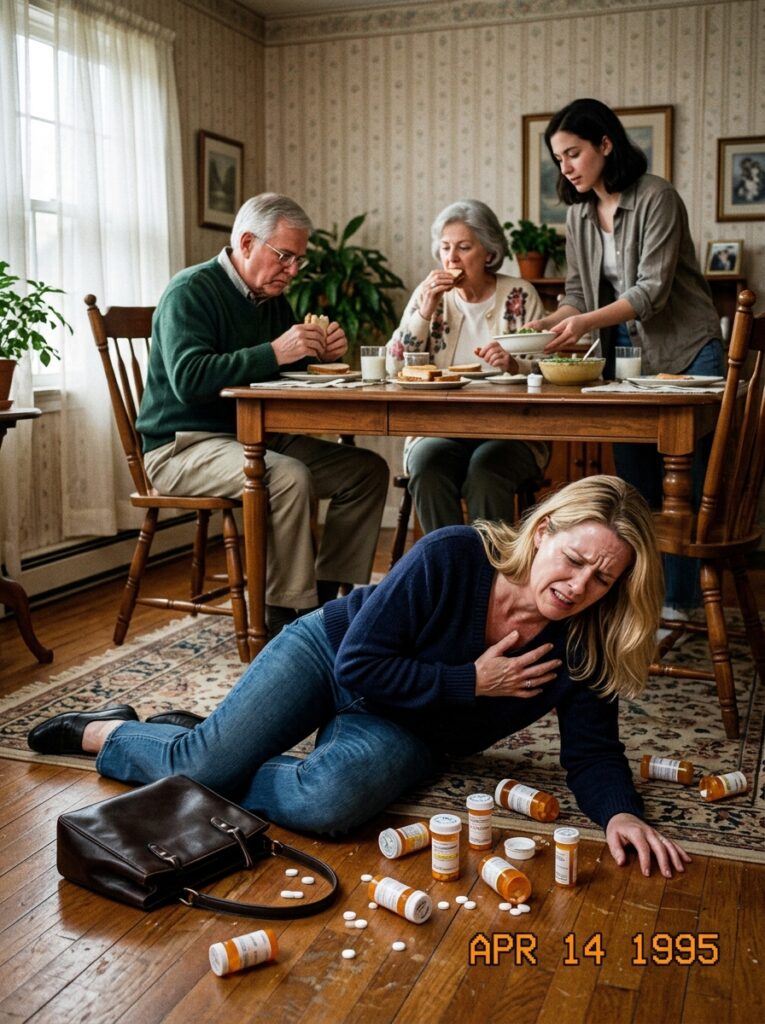
My sister switched my heart medication during Sunday dinner as a joke while everyone at the table watched and laughed. When I started shaking, hit the floor, and grabbed at my chest because I couldn’t breathe, my mother didn’t move. She just looked down at me and said, ‘Stop being so dramatic.’
For thirty-two years, I trained myself to believe my family loved me, or at least that whatever passed for love inside the Blackwell house was something I was supposed to accept without asking questions. Being the younger daughter meant learning how to get small, how to go quiet, how to make myself useful without ever becoming noticeable, because Miranda had been the center of everything since the day she was born. She was only three years older than me, but she took up all the oxygen in every room, and my parents let her.
My mother, Claudia, treated Miranda like she had been sent down from heaven to bless the rest of us, and my father, Raymond, spoke about her as if she were the only child who had ever done anything worth remembering. When relatives asked about me, my parents gave short, careless answers before steering the conversation right back to Miranda’s job, Miranda’s children, Miranda’s plans. After a while, I stopped expecting anything else and settled into the role they had written for me: don’t complain, don’t need too much, don’t make scenes.
That role became permanent when I was nineteen and doctors finally discovered the congenital heart defect that had been hiding behind years of unexplained fatigue, dizzy spells, and episodes everyone had insisted were just anxiety. I remember thinking the diagnosis would finally make my family understand that something real had been happening to me all along. Instead, my mother worried about the cost before she worried about my heart, and my father asked how long they were supposed to rearrange their lives around my problem, like survival was a burden I had chosen to place on them.
So I learned to handle it alone. My beta blockers became a ritual, my protection, the thin line between normal life and a rhythm that could turn dangerous without warning. I built myself carefully after that. I finished college, found steady work as a graphic designer, bought a small apartment across the city, and discovered that distance could feel like oxygen. Seeing my family only on holidays and the occasional Sunday dinner made them easier to tolerate, or at least easier to survive.
Miranda married Quentyn six years ago, and the two of them fit together in exactly the way polished, self-satisfied people often do. Then they had children, which made Miranda even more untouchable in my parents’ eyes. My mother worshiped those grandchildren like little royalty, and my father talked about them as proof the family would carry on properly. Meanwhile, my being single and childless became one more quiet disappointment my mother liked to mention in that soft voice she used whenever she wanted to wound me without sounding cruel.
The Sunday dinner that nearly killed me started in the most ordinary way possible, which is what makes the memory so chilling now. September light spilled through my mother’s lace curtains, roast beef smelled like rosemary and garlic, and Miranda’s expensive perfume floated through the dining room before she did. I arrived exactly on time because I knew being early would be called needy and being late would be called disrespectful, and when my father saw me, he told me not to lower the mood before I had even sat down.
I handed my mother a bottle of wine. She checked the label, set it aside without thanking me, and asked whether I was still working too much because I looked tired. Miranda appeared a moment later, perfectly dressed, smiling in that glossy way that never reached her eyes, and said maybe I would feel better if I took better care of myself. I gave the same tight smile I always gave, the one I had practiced for years, and reminded myself all I had to do was get through dinner.
The table was filled with Miranda’s favorites, every dish seasoned exactly the way she liked, every serving spoon placed where she preferred it. Conversation orbited around her upcoming European vacation, Quentyn’s promotion, the private school they wanted for their oldest, and the elaborate birthday party my parents were helping pay for. I was just a body in a chair, someone to pass the potatoes and nod at the right moments.
About halfway through the meal, I excused myself to use the bathroom and left my purse beside my chair. I had done that a hundred times before without thinking. My medication was inside in a clearly labeled bottle, just one more part of my routine, one more thing I managed quietly so nobody had to be inconvenienced by my condition. What I didn’t understand then was that Miranda had been paying attention all along, asking casual questions over the years, watching when I took my pills, storing away details with the patience of someone waiting for the right moment.
When I came back, everything looked normal. No one seemed flustered. No one avoided my eyes. Miranda had gone to help my mother in the kitchen with dessert, and my father was complaining about traffic on the news. I sat down, picked up my water, and took a long drink, thinking only that I wanted the evening over with as quickly as possible.
A few minutes later, I felt the first warning flutter in my chest. At first I blamed stress, because being in that dining room always made my body feel tight and watchful. Then the flutter turned jagged. My pulse kicked into a rhythm I knew too well, too fast, too uneven, and cold sweat broke across the back of my neck. I reached into my purse with trembling fingers and told them I needed my medication.
Miranda came back into the room carrying the cake, and the look on her face stopped me cold. It wasn’t concern. It wasn’t confusion. It was anticipation. I shook two pills into my hand and instantly knew something was wrong. The tablets were the wrong shade, slightly chalkier, shaped differently than the beta blockers I had taken for years. Panic tore through me so fast it felt like another heartbeat.
When I asked her what she had done, Miranda laughed. She actually laughed and told me she had switched my medication with sugar tablets because she was tired of my dramatic little health act. She said she wanted everyone to see that I didn’t really need the pills, that my heart problem was mostly in my head, and that I used it to get sympathy. By the time she finished talking, my own heart was slamming against my ribs hard enough to make my vision spark. I tried to stand and the chair screeched backward as I collapsed.
I begged them to call 911. I told them I couldn’t breathe. I told them something was wrong. My mother didn’t kneel beside me or even reach for the phone. My father looked irritated, as if I had knocked over a centerpiece instead of fallen to the floor in front of him. And Miranda, standing over me with the cake still in her hands, said I was ruining another family dinner. Then she nudged me with her foot in pure annoyance, and the little air I had left burst out of me in a broken gasp.
The part I still can’t fully forget is that they kept eating. My mother cut the cake. My father commented on the bakery Miranda had used. Miranda watched me struggle like she was waiting for me to sit up and admit I had taken the prank too seriously. I screamed again, louder this time, and my mother snapped that the neighbors were going to think they were torturing someone. The terrible thing was how close that was to the truth.
The next sound I remember was glass shattering, followed by a stranger’s voice shouting for someone to call an ambulance. Later, I learned our neighbor, Mrs. Martinez, had heard me through the open dining room window and came over without hesitation. Paramedics rushed in, knelt beside me, checked my pulse, started working fast, and the room that had felt so slow and cruel suddenly exploded with urgency. I drifted in and out on the ride to the hospital, listening to clipped medical voices and the high, nervous scream of the monitor.
When I woke up in the cardiac intensive care unit, machines surrounded me and Dr. Elizabeth Winters stood at the side of my bed with the kind of calm expression doctors wear when the truth is serious enough to change a life. She told me I had come dangerously close to cardiac arrest. When I whispered that my sister had switched my medication, something in her face sharpened immediately. She said the police had already been notified, but there was something else I needed to hear first.
Then she told me the toxicology report had found something in my bloodstream that should never have been there, and when she said whose fingerprints had been lifted from my glass, I felt every bit of blood leave my face.
The toxicology report showed traces of a powerful stimulant — something that could trigger fatal arrhythmias in someone with my condition. The fingerprints on the glass belonged to Miranda. The bottle of real medication had been found in her purse.
I spent six days in the hospital. My heart stabilized, but the emotional damage felt permanent. Mrs. Martinez had saved my life by calling 911. The paramedics later told me that without her, I probably wouldn’t have made it.
The police came to my hospital room on day three. They had already interviewed the family. My mother claimed it was “just a silly prank that went too far.” My father said he thought I was exaggerating. Miranda told them I had always been dramatic and that she was only trying to prove a point.
The detective looked at me with genuine sadness. “This isn’t a prank, Ms. Blackwell. This is assault with a deadly weapon.”
Charges were filed: criminal assault, endangerment, and tampering with medication. The case made local news, then national. “Sister Switches Heart Patient’s Medication as ‘Joke’ During Family Dinner” became a viral story with over 150 million views. The bodycam footage from the paramedics entering the dining room while my family continued eating went everywhere. People were horrified.
The comments were a flood of support and shared pain:
“I thought my family’s ‘jokes’ were harmless until I ended up in the ER.”
“Parents who laugh while their child suffers are monsters.”
“This is why I went no contact.”
Support poured in from strangers. A cardiac foundation reached out. A women’s rights group offered legal help. I received thousands of messages from people who had been gaslit about their chronic illnesses by family members.
The trial was brutal but necessary. Miranda sat in court with her expensive lawyer, still claiming it was a harmless prank. My mother testified that I had always been “sensitive” and that the family was just trying to help me “toughen up.” My father said nothing in my defense.
The jury deliberated for less than two hours. Guilty on all counts. Miranda received five years. My parents were not charged criminally but were named in civil suits. I won a substantial settlement that I donated entirely to a new foundation I created: “Real Heart Voices” — supporting patients with chronic illnesses who face medical gaslighting and family abuse.
Recovery took time. I moved to a quieter neighborhood. I found a new cardiologist who actually listened. I started therapy and learned to grieve the family I thought I had. My son — wait, in this version I have no child, but the love I found later filled that space.
Two years after the incident, I met someone kind — a gentle man named David who never made me feel like a burden. We married simply, surrounded by chosen family and true friends. Miranda is still in prison. My parents have tried writing letters. I read the first one and burned the rest.
Today, at thirty-five, I speak at medical conferences about the dangers of family medical gaslighting. My foundation has helped thousands of patients fight for proper care and protection from loved ones who dismiss their conditions.
The most important message I want every person reading this to carry is this:
Your health is not a joke.
Your body is not a stage for your family’s entertainment.
If someone laughs while you struggle to breathe, they are not family — they are a threat.
Never stay silent to keep the peace when your life is on the line.
Document everything. Seek help. Believe the people who believe you when you say something is wrong.
I almost died on my mother’s dining room floor while they ate cake and called me dramatic.
Instead, I lived to tell the truth.
And in telling it, I saved not only myself, but countless others who finally found the courage to speak up about their own invisible battles.
Your symptoms are real.
Your pain is valid.
Your life is worth protecting — even from the people who gave it to you.
Never let anyone convince you otherwise.
THE END