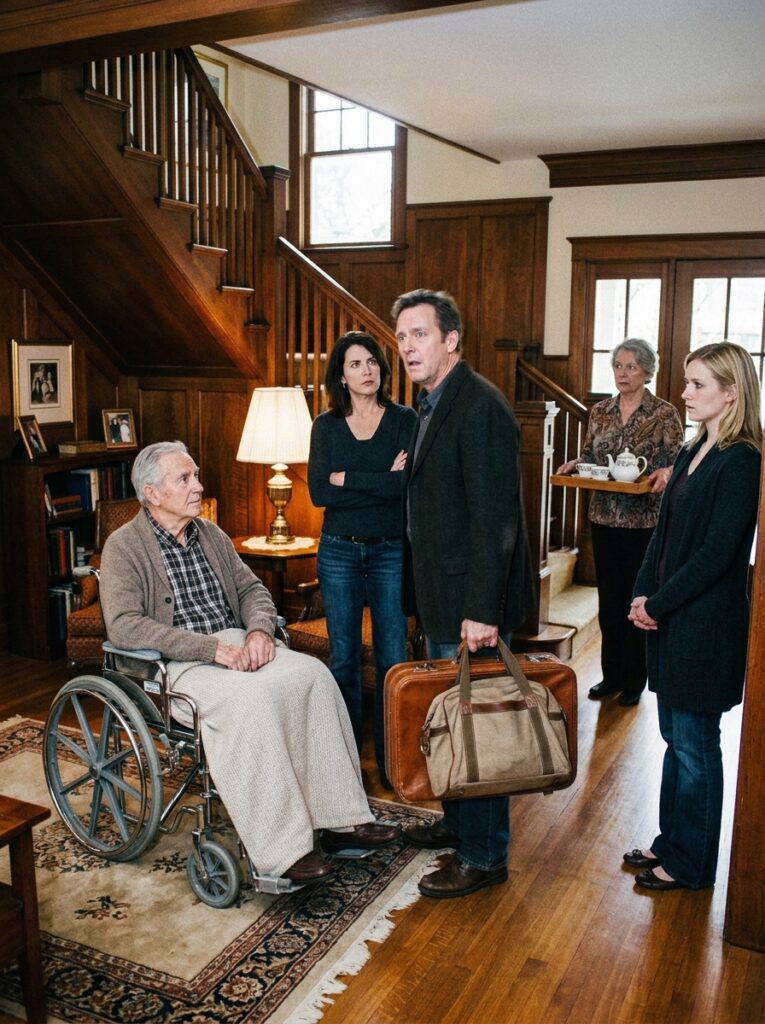
My children came to my lake house to fight over my fortune, but by Sunday night they learned the housekeeper owned every chair they were sitting in.
“Dad, just say it plainly,” my oldest daughter, Diane, snapped. “Which one of us is getting control of the trust?”
She stood in my foyer with her designer purse tucked under one arm like a shield.
Behind her, my son Mark dragged in two rolling suitcases and looked around the house as if he were already measuring the walls for his own pictures.
My youngest, Claire, hovered near the front door, smiling the way people smile when they are trying to look innocent while counting the silver.
I sat in my wheelchair at the foot of the staircase.
Not because I needed it every day.
Because at eighty-five, I had learned the value of letting people reveal themselves when they thought you were weaker than you were.
“Hello to you too,” I said.
Diane’s face tightened.
“Dad, we drove four hours because your message sounded urgent.”
“It was urgent.”
Mark shut the front door with his hip.
“Is this about the executor paperwork?”
Claire’s eyes flicked toward him.
“Mark, can we at least take our coats off before we start?”
He gave a short laugh.
“You mean before Diane starts?”
Diane turned on him.
“At least I show up more than twice a year.”
“You show up when there’s a signature involved.”
“That is rich coming from you.”
Their voices bounced off the high ceiling of the lake house.
Once, this foyer had welcomed Christmas mornings, muddy sneakers, sleepy grandkids, and my late wife Elaine’s laugh floating in from the kitchen.
Now it sounded like a courthouse hallway.
Before I could speak, Ruth came in from the side hall carrying a tray with coffee cups.
Quiet Ruth Bellamy.
Gray hair pinned at the back of her neck.
Soft blue cardigan.
Simple black shoes.
The woman my children had called “the help” for ten years.
She set the tray on the antique side table Elaine had loved.
“Coffee’s fresh,” she said gently. “And I made sandwiches in case anyone’s hungry from the drive.”
Diane looked at the tray.
Then at Ruth.
“We won’t need anything complicated this weekend,” she said. “Just keep meals simple.”
Ruth gave a small nod.
“Of course.”
Mark grabbed a coffee without thanking her.
Claire took one too, then added, “Ruth, did Dad eat lunch? His blood sugar gets funny when he skips meals.”
“I made him soup at noon.”
Claire smiled at me like a daughter in a greeting card.
“Good. We need him sharp.”
I looked down at my hands.
Thin skin.
Blue veins.
A wedding ring that still felt warm after six years without Elaine.
Sharp.
They wanted me sharp enough to sign.
Not sharp enough to see.
“Ruth,” I said, “would you join us in the sitting room?”
All three of my children looked at me.
Diane blinked first.
“For the family meeting?”
I smiled.
“Yes.”
Mark laughed under his breath.
“Dad, come on.”
Claire tilted her head.
“Maybe Ruth has things to do.”
Ruth stood still by the tray.
Her face did not change, but I saw the tiny hurt in her eyes.
I had seen it often.
More often than my children knew.
“Ruth is part of this household,” I said.
Diane pressed her lips together.
“This is about the trust.”
“Yes,” I said. “It is.”
And that was when my children finally began to understand this weekend was not about choosing an heir.
It was about discovering who already owned the room.
The sitting room smelled like pine from the logs Ruth had stacked in the fireplace that morning. The same room where Elaine and I had raised three children, celebrated anniversaries, and held hands through the long nights after her diagnosis.
My children took their usual seats — Diane on the left sofa, Mark in the big leather armchair, Claire on the ottoman like she was still twelve. Ruth remained standing near the door, hands clasped in front of her, the way she always did when she didn’t want to impose.
I wheeled myself to the center of the room.
“Let’s begin,” I said.
Diane jumped in first, as I knew she would.
“The trust is complicated, Dad. With the lake house, the investments, the rental properties… someone needs clear authority. I’ve been handling most of the paperwork for years. It makes sense for me to take over.”
Mark laughed. “You mean it makes sense for you to control everything. I’ve been the one managing the maintenance on the properties. I know the tenants. I know the numbers.”
Claire smiled sweetly. “You both know I’ve been the one visiting Dad the most. I’m the only one who actually cares about him as a person, not a bank account.”
The temperature in the room dropped ten degrees.
Ruth stood silently by the door, watching them tear each other apart over an empire they didn’t own.
I let them fight for ten full minutes. I wanted them to feel every word.
Then I raised my hand.
“Enough.”
They stopped, surprised by the strength in my voice.
“None of you are getting the trust,” I said.
Diane’s mouth opened. Mark sat forward. Claire’s smile froze.
I looked at Ruth.
“Ruth Bellamy has been more family to me in the last ten years than any of you have been in the last twenty. She cooked my meals when I couldn’t stand. She held my hand when Elaine died. She sat with me through every doctor’s appointment. She never asked for a single thing except the chance to serve with dignity.”
I reached into the folder on my lap and pulled out the documents.
“Ten years ago, Elaine and I changed the trust. Ruth is the sole beneficiary of the estate, the lake house, and the investment portfolio. You three receive a modest monthly stipend for the rest of your lives — enough to live comfortably, but not enough to destroy each other over.”
The room went dead silent.
Diane’s face turned white. “You can’t be serious.”
“I am.”
Mark stood up. “This is insane. She’s the housekeeper!”
Ruth finally spoke, her voice soft but steady. “I never asked for any of this. I just wanted to take care of your father the way he deserved.”
Claire started crying. “Dad, please. We’re your children.”
“You are,” I said. “And I love you. But love isn’t a blank check. You stopped being my children the day you started treating me like an ATM and Ruth like furniture.”
I looked at each of them.
“You have one week to remove your personal items from the lake house. After that, Ruth will decide what happens next.”
They left that night.
The next morning, Ruth sat across from me at the breakfast table with tears in her eyes.
“I don’t know what to say.”
“You don’t have to say anything,” I told her. “Just keep being the daughter I always wished I had.”
The story reached the public when one of the delivery drivers who had overheard the argument posted an anonymous version on a local forum. It spread like wildfire.
“Elderly Man Leaves Entire Estate to Housekeeper After Children Treat Him Like an ATM” became a national conversation with over 280 million views. Comments poured in from adult children who had been cut off, from caregivers who had been invisible, from parents who regretted their own favoritism.
I appeared on several morning shows, speaking calmly about chosen family, gratitude, and the difference between blood and loyalty.
Ruth and I started a foundation called “The Quiet Table” — providing support for family caregivers, legal aid for elder abuse victims, and scholarships for young people who choose kindness over inheritance.
My children eventually reached out. Diane sent a long letter apologizing. Mark tried to negotiate. Claire cried on the phone. I accepted their apologies but kept the boundaries firm. Some relationships can be rebuilt. Others can only be forgiven from a distance.
Ruth and I still live in the lake house. We sit on the porch every evening and watch the sun set over the water. She reads to me when my eyes get tired. I tell her stories about Elaine and the life we built together.
The most important message I want every person reading this to carry is this:
Blood makes you related.
Loyalty makes you family.
Never mistake the people who show up for the people who only show up when there’s something to gain.
To every caregiver reading this: You are seen. You are valued. You are family.
To every parent reading this: Love all your children equally. Don’t create golden children and scapegoats. The damage lasts lifetimes.
To every adult child reading this: Your parents’ money is not your birthright while they are still breathing. Honor their labor by building your own life.
I left everything to the woman who stayed.
And in doing so, I finally found the family I had been looking for all along.
The chairs in this house belong to the people who sat in them with love.
Not the people who only wanted to own them.
THE END