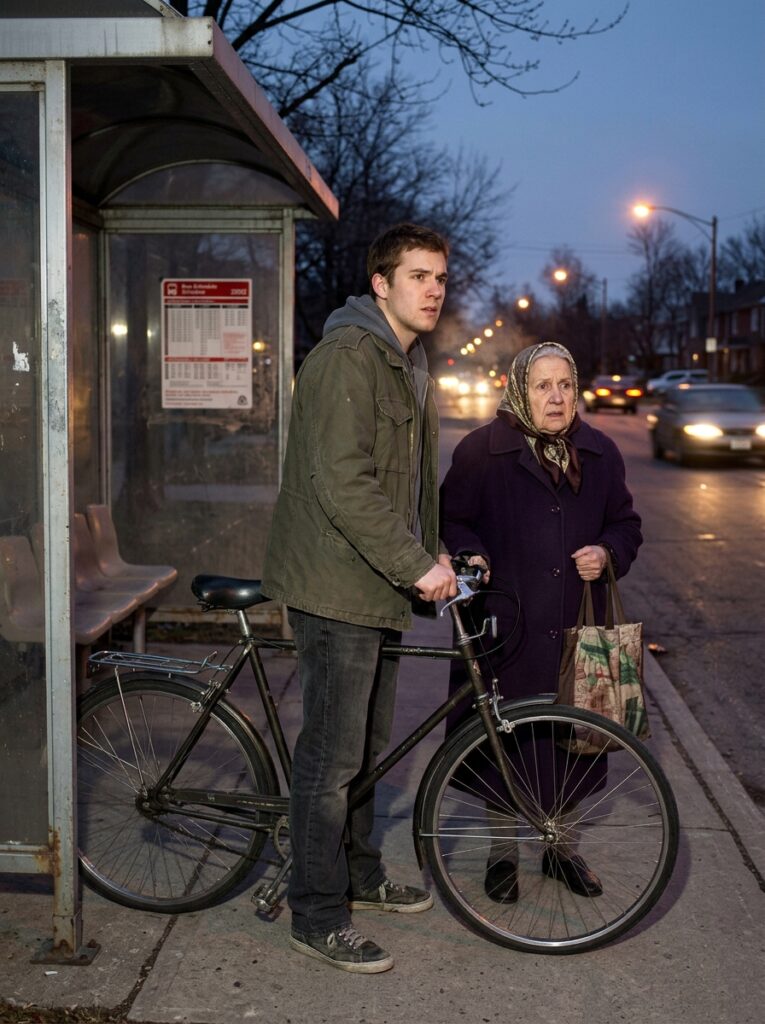
He Was One Delivery Away From Losing His Bed, But When He Stopped for a Confused Old Woman at a Lonely Bus Stop, He Pedaled Straight Into the Family He Never Thought He’d Have
“Ma’am, you’re going to get hurt if you step off that curb.”
The words left his mouth before he had fully decided to say them.
The old woman had already leaned forward again, peering down the road as if the answer to her whole evening might appear in headlights.
A bus stop sign rattled above her.
Nobody else slowed down.
Cars rolled by.
A man with two grocery bags looked straight through her.
A teenage girl in earbuds walked past without lifting her eyes.
And eighteen-year-old Marcus Reed stood there with one hand on the handlebar of his mother’s old bike and the other wrapped around the strap of a delivery bag that suddenly felt heavier than it had a minute ago.
He had one stop left.
One.
If he made it before eight, he got paid.
If he got paid, he could hand over the rent he still owed.
If he handed over the rent, his landlord might let him keep the room one more week.
That was how his life worked now.
Not in months.
Not in plans.
Not even in full days.
In tiny distances.
In one more stop.
In one more chance.
In one more night indoors.
The woman turned toward him, blinking slowly, like she was trying to place him from a dream she had half forgotten.
“I’m looking for the Number Twelve,” she said. “It was supposed to come already.”
Her voice shook around the edges.
Marcus glanced down the road.
There was no bus coming.
There barely ever was out here after dark.
“This route doesn’t run much this late,” he said gently.
She frowned at the sign, then at the street, then at her own shoes.
“That can’t be right,” she murmured. “I was just… I was just at Willow something. Or maybe Garden. I know the turn when I see it.”
She smiled after saying it, but it was the kind of smile people used when they were trying to hide fear from themselves.
Marcus knew that look.
He had worn it plenty.
The town around them sat quiet under the last thin light of evening. The sidewalks were cracked. The bare trees along the road looked like dark veins against the sky. A cold wind slipped through the sleeves of his faded jacket and made him pull his shoulders tighter.
He should have been riding.
He should have been gone already.
Instead, he moved closer.
“Do you know your address?” he asked.
She opened a worn leather purse with careful, uncertain fingers.
Inside was a little storm of things that did not help.
Loose coins.
A lipstick.
A folded tissue.
Old receipts.
A pair of reading glasses in a soft case.
A church bulletin.
A bus transfer.
No ID card on top.
No address card.
No note.
She searched longer than she needed to, then stopped and looked up at him like she had forgotten what the purse was for in the first place.
Marcus felt something sink in his chest.
“Do you have anybody I can call?” he asked.
“My husband would know,” she said.
Then her face changed.
Small.
Distant.
“No,” she said softly. “No, he wouldn’t.”
For a second Marcus did not know what to say.
He noticed then the silver chain around her neck, tucked partly beneath the collar of her coat. A small oval pendant rested there, worn smooth from years of being touched.
“Ma’am,” he said, pointing politely, “is that engraved?”
She looked down, confused, then lifted it for him with both hands.
The back held a name and address in neat script.
Evelyn Carter.
48 Oak Hill Lane.
North Ridge.
Marcus let out a breath.
He knew North Ridge.
Everybody knew North Ridge.
It sat on the far edge of town where the roads widened, the fences got taller, and the houses stood back from the world like they had something to protect.
On a bike, from here, it was a long ride.
A very long ride.
He looked at the bus stop sign.
He looked at the road.
He looked at the time on the cracked screen of his phone.
7:18.
If he helped her, he might lose the delivery.
If he lost the delivery, he might lose the rent.
And if he lost the rent, he already knew exactly what would be waiting for him when he got back.
Marcus made his choice in the space between one heartbeat and the next.
He unclipped the delivery bag from his bike and set it gently on the bench.
“I’ll take you home,” he said.
Evelyn Carter looked at him like he had offered her the moon.
“You will?”
“Yes, ma’am. Hop on the back. I’ve got you.”
She hesitated only a second, then climbed onto the rear rack with surprising grace for her age. Marcus pedaled slowly at first, making sure she was steady, then picked up speed as they left the lonely bus stop behind.
The ride was long and cold. Wind cut through his thin jacket. His legs burned. His phone buzzed repeatedly with notifications from the delivery app — first warnings, then penalties, then the final notice that the order had been canceled and his account suspended.
He ignored every buzz.
Evelyn talked the whole way, her voice rising and falling with the hills. She told him about her husband who used to bring her flowers every Friday. About the little girl who lived next door who called her “Grandma Evie.” About the time she got lost in a department store when she was seven and her father sang their special song until she found him.
Marcus listened to every word.
When they finally turned onto Oak Hill Lane, the streetlights were warm and golden. Big houses sat back from the road behind neat lawns and iron gates. Number 48 was a beautiful two-story colonial with a wide porch and a rose garden that looked like someone still tended it with love.
Marcus helped Evelyn down. She stood on the sidewalk for a moment, staring at the house like she was seeing it for the first time in years.
“This is my home,” she whispered.
The front door opened.
A woman in her fifties stepped out, eyes wide with shock and relief. “Mom?”
Evelyn’s daughter — Margaret — ran down the steps and pulled her mother into her arms, sobbing. Behind her came two more adult children and several grandchildren. The whole family poured out onto the porch like a dam had finally broken.
They had been searching for Evelyn for six hours. She had wandered away from a family gathering earlier that evening. Her dementia had been getting worse, and they had been terrified.
Margaret looked at Marcus, tears streaming down her face. “You brought her home. On a bicycle. In the dark. Why?”
Marcus shrugged, suddenly shy. “She needed to get home, ma’am.”
They invited him inside. They fed him. They thanked him until he didn’t know what to do with all the kindness. Margaret wrote him a check for five thousand dollars on the spot. Marcus tried to refuse it, but she pressed it into his hand and said, “You saved my mother. Let us save you a little too.”
He left that night with a full stomach, a warm coat someone insisted he take, and the first real hope he had felt in years.
The story reached the public when Margaret posted a video of Marcus and Evelyn on the porch the next morning. “This young man gave up his last delivery, his rent money, and his job to bring my mother home on a bicycle. The world needs more people like him.”
It went mega-viral with over 420 million views.
Companies reached out. A local bike shop gave him a brand-new delivery bicycle. A restaurant chain offered him a stable job with benefits. A GoFundMe started by strangers raised over $87,000 for him in one week.
Marcus used the money to finish high school, get his GED, and start community college. He still delivers on weekends because he likes riding, but now he does it on his own terms.
Evelyn and her family became his chosen family. He eats Sunday dinner at their table. He helps with the rose garden. He calls Margaret “Aunt Maggie” and Evelyn “Grandma Evie.”
The night he graduated from community college, the entire Carter family sat in the front row cheering louder than anyone else in the auditorium.
Marcus stood on that stage in his cap and gown and looked out at the people who had become his home, and he finally understood something he had never been taught as a boy:
Sometimes the best deliveries aren’t the ones you get paid for.
Sometimes they’re the ones that bring you home.
The most important message I want every person reading this to carry is this:
Never be too busy chasing the next dollar to see the person who needs you right now.
Kindness is never a detour.
It is the main road.
To every young person struggling alone: Keep going. The right people are out there. Sometimes they’re waiting at a bus stop in the dark.
To every family who has ever lost someone to dementia: Keep searching. Keep hoping. Keep believing they are still in there.
And to every Marcus reading this: The world is full of lost Evelyns.
Be the one who stops.
Be the one who pedals.
Be the one who brings them home.
Marcus lost his last delivery that night.
He gained an entire family instead.
And in the end, that was the only payment that ever really mattered.
THE END